Account clerk’s retirement leads to ‘organizational fix’ in Berne
Enterprise file photo — Melissa Hale-Spencer
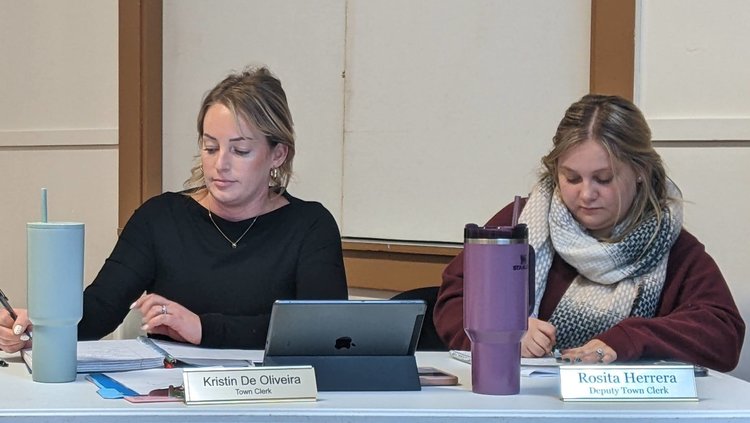
Deputy Town Clerk Rosita Herrera, at right, will now work an additional five hours per week because Town Clerk Kristin De Oliveira had been overworked, Supervisor Joseph Giebelhaus said.
BERNE — The town of Berne is restructuring how it handles money.
Soon after the new town board took office in January, tax bills came out with a 68-percent hike rather than the anticipated 38-percent increase.
Supervisor Joseph Giebelhaus, who had been instrumental in drafting the spending plan, told The Enterprise then that he was surprised by the hike and would call on the state comptroller’s office to investigate what had happened.
On Jan. 14, the town board voted unanimously to have the state comptroller’s office examine Berne’s 2026 budget and tax levy process to “provide findings and recommendations.”
“Town officials have not sent us a request for an audit,” Mark E. Johnson, press secretary for the Office of the State Comptroller, told The Enterprise in an email on March 13. “They conveyed to our office that they determined the change in the tax rate was due to a calculation error and it was corrected prior to the issuance of tax bills, and that the tax bills are based on the approved budget. At this time, we do not plan to engage [in] an audit but continue to monitor the town.”
Michael McGuire, director at Albany County Real Property Tax Service Agency, had received Berne’s 2026 budget on Nov. 13. On Nov. 17, he emailed the town asking, “Is this correct?”
McGuire said he had noted that the six-dollar tax rate would not cover the $1.38 million levy called for in the budget. “On Nov. 19, the town sent me a revised budget,” he told The Enterprise.
McGuire noted, “In both budgets — the one from the 13th and the one from the 19th — the town was still looking to collect $1.38 million. That never changed.” Rather, he said, the math that had been used to calculate the rate appeared to be inaccurate.
McGuire told The Enterprise that he had corresponded with the town clerk, Kristin De Oliveira, who sent him the revised budget on Nov. 19.
De Oliveira told The Enterprise that, after she was contacted by McGuire, she sent an email to the then-supervisor, who was out of town at the time without access to his computer, and to the account clerk.
“I was given the corrected front sheet,” De Oliveira said, which she sent along to McGuire.
On Feb. 7, Andrea Borst, Berne’s account clerk, retired after 22 years of working for the town. When The Enterprise asked Giebelhaus if Borst’s leaving had anything to do with the mixup that had caused the unexpected 68-percent tax hike, he said, “People are entitled to retire.”
On March 11, Giebelhaus proposed a number of changes to how Berne handles money and the board supported each unanimously.
“With Andrea leaving, we found out how difficult payroll is,” Giebelhaus said.
He proposed, and the board agreed, contracting with Paychex for processing the payroll and for a human-resources component, which the town “desperately needed,” said Giebelhaus.
The contract includes an electronic time-keeping system, which “allows us to track data,” Giebelhaus said. Paychex also provides counselors for employees, he said, for such matters as substance abuse.
The total cost for the year is $17,972.58. Giebelhaus said this is “considerably less” than Borst was being paid.
Berne has 47 employees, Borst said.
Paychex, based in Rochester, generated $5.2 billion in revenue and $13 billion in assets in 2024, according to Forbes.
Borst’s retirement also led to “an organizational fix,” Giebelhaus said.
To have all the town’s money handled by one person, he said, is not the best accounting practice.
So he proposed setting up a budget office, to which the board agreed, with three separate tasks.
The first is a bookkeeper to handle day-to-day transactions — “simple things,” Giebelhaus said. The second is budget management. And the third is a certified public accountant, overseeing the other two. The CPA will be responsible for the annual financial report and will interface with the state comptroller’s office, he said.
Two people were interested in filling those part-time posts on a temporary basis, Giebelhaus said. They will work from March 11 to June 11.
The board then appointed Borst as bookkeeper for $38.85 per hour not to exceed 64 hours per month and Regina Bryant as budget manager for $40 per hour not to exceed 10 hours per month.
At the same March 11 meeting, the board, on Giebelhaus’s recommendation, agreed to increase Deputy Town Clerk Rosita Herrera’s hours so that she has a full-time position and will receive health benefits.
Herrera had been working 18 hours per week as deputy clerk and 17 hours a week as clerk for the town court for a total of 35 hours.
“We are struggling in the office,” Giebelhaus said.
Herrera’s additional five hours, he told the board, will be a “resource not just for myself, but also the town board.” He said of the town clerk, De Oliveira, “Kristin’s been doing … way, way, way beyond what she’s required to do.”
Herrera is paid $21.50 per hour so will have a $4,200 increase in salary.
Asked the cost for Herrera’s health benefits, Giebelhaus told The Enterprise “roughly $6,000.”