Needham Risk outlines 15 priorities to improve safety in Berne
The Enterprise — Melissa Hale-Spencer
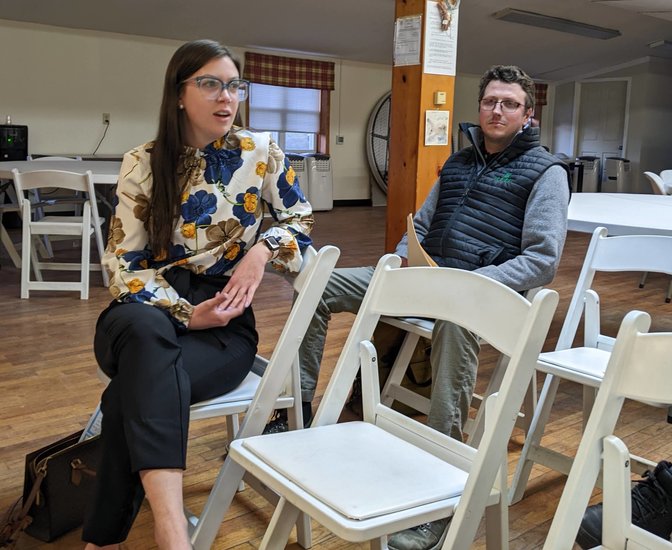
“We’re tackling everything head-on,” Laura Grippen with BST, the accounting firm Berne hired last month, told the board on April 18. Behind her is Robert Queirolo, director of project development at RIC Energy Group, who spoke to the board on behalf of a solar facility proposed for Jody Jansen’s farm that has been halted with a moratorium.
BERNE — The Berne Town Board, whose members took office at the start of the year, continues to revamp town government.
At its April 8 meeting, the board heard updates on its new payroll system and from its new accountant and also reviewed a report on how to improve the town’s safety and health programs.
The town had contracted with Paychex in March to process the payroll for its 47 employees for roughly $18,000 for the year. Paychex, based in Rochester, generated $5.2 billion in revenue and $13 billion in assets in 2024, according to Forbes.
“They’re a huge company,” Town Clerk Kristin De Oliveira told the board on April 8, noting she has had “a lot of phone calls, Zoom calls” working with Paychex.
She went on, “Our payroll is not that simple,” adding that the staff has to get on board.
The new system is slated to go live on April 26, De Oliveira said.
Laura Grippin with BST, the accounting firm Berne hired last month, told the board, “We’re looking at everything. We’re coming up with a project plan … We’re tackling everything head-on.”
Safety
In January, the board had agreed to hire Needham Risk Management Resource Group for a town-wide safety audit and to develop a required safety program.
“They would identify what training modules we need,” said Supervisor Joseph Giebelhaus at the time.
“It needs to be done,” said Councilman Brian Bunzey in voting for the resolution. “We already lost one man.”
Highway worker Peter Becker was killed on Oct. 21, 2020 after a dump truck propped up on a pneumatic jack fell on him at the town transfer station, after which the state’s Public Employee Safety and Health Bureau found the town’s highway department to be in violation of seven different regulatory items; each violation was considered “serious.”
Amy Clute of Needham Risk toured the town hall, highway garage, and transfer station in February and made 15 recommendations. These five were designated as top priorities:
— Creating a safety and health-management system, which the town does not currently have. This would include assignment of responsibilities and goals, developing a process for recognizing and controlling hazards, and providing ongoing training and education;
— Creating emergency action and response plans, which the town also lacks;
— Creating an inventory of confined spaces, like manholes and tanks, that may require permits, according to the state’s labor law;
—Creating a written program for hazardous equipment to be locked and tagged out prior to maintenance, according to regulations from the Occupational Safety and Health Administration, as well as training for employees who do this work; and
—Training employees who work on public roads on flagging safety and work zone set-up.
The report lists eight second-tier priorities: creating an inventory of hazardous chemicals, getting required personal protective equipment, writing a plan and doing training to prevent workplace violence, participating in a required clearinghouse for alcohol and drug testing, training employees in fall protection, following state requirements for offering hepatitis vaccines while writing a plan to deal with exposure to bloodborne pathogens, chainsaw training, and providing respiratory protection.
And, finally, Needham Risk lists two third-tier priorities: training staff that handle animal carcasses in rabies exposure and tickborne diseases, and training and evaluating workers who drive powered industrial trucks.
“There’s a lot of work to do yet,” said Giebelhaus of improving Berne’s safety measures. “It’s going to be a long and arduous process.”
He also said, “Do not panic. We’re going to work our way through these.”
Highway Department
“We made it through winter,” said Highway Superintendent Allen Stempel who started his job on Jan. 1.
Throughout the “terrible” winter, he said, his department was never fully staffed nor did it have a full fleet of trucks.
Neighboring towns and Albany County pitched in, for which he was grateful, Stempel said.
Upcoming projects include shoulders on Saw Mill Road and replacing two culverts on Stewart Road.
Chainsaw training has been scheduled and he took a class from the Cornell Local Roads Program, Stempel said, concluding, “Things are looking up.”
When resident Joe Burke asked from the gallery if crew members who worked under the former highway superintendent had been giving Stempel a hard time, Stempel responded, “The public has been friendly and kind … The workers have been very accommodating to me and showing me the ropes.”
Councilman Bunzey said he had stopped by the highway garage and talked to the crew when Stempel was not there. “They think the world of him,” Bunzey said. “They back him 100 percent.”
Mary-Claire Ansboro, who chairs the Parks and Recreation Committee, also praised Stempel’s work on the town park. “You’re a great joy to work with,” she said.
Later in the meeting, the board unanimously approved a series of expenditures for highway equipment and maintenance.
While the numbers may look “big and scary,” Stempel said, it will be good to be able to go into next winter confidently.
The high costs are needed, he said, “to get the fleet up to snuff.”
One of the pieces of equipment the board agreed to purchase was a plate tamper for $3,295 to be used in making culverts.
“Come to find out we’ve been borrowing an employees’ equipment,” said Stempel, stating the town should have its own.
“We own it, too, all of us, everybody,” said Stempel, waving his hand toward the 30 or so residents seated in the gallery.
Councilman Scott Duncan said, “To see somebody wanting to do road repairs the correct way is huge.”
His words were greeted with applause from the gallery.
Masonic lodge
Several residents objected to a proposal that the town buy the Masonic Lodge next to Town Hall.
At the board’s last meeting, members unanimously agreed to let Giebelhaus negotiate for the purchase.
Built in 1918, the hall was originally used by the Maccabees, a fraternal organization that provided low-cost insurance to members.
According to the town’s assessment roll, the property has a full-market value of $260,263 but Giebelhaus told The Enterprise the Masons are offering it for a “reasonable price,” although he declined to disclose the amount until negotiations are complete.
Giebelhaus told The Enterprise in March that the town would hire an architect to advise on how to best use the space. The building will definitely be used for record storage, he said then, and it will also be used either for the town court, which is currently housed in Town Hall, or for meetings.
At the April 8 meeting, Keith Audino said that, after residents were pounded with a 70-percent tax increase, such a purchase is unwise.
“I heard it was covered with mold,” Audino said and asked what the benefit was for the town. He suggested, if the town did acquire the building, it could sell the lodge to raise funds.
Resident Robert Swasey referenced an Enterprise story on the potential sale in which a Mason said, ever since the state raised the level of Route 443, the Helderberg Trail, water has flowed into the lodge’s stone foundation.
After the remnants of Hurricane Irene came through the Hilltowns in 2011, the Masons paid to have the mold remediated. “It’s very expensive and it’s come back,” he said of the mold.
“We’re all gun-shy with money with the taxes and stuff,” said Swasey, asking the board, “Would you spend the money for an architect before you bought it?”
“Will we know what the purchase price will be?” asked resident Lynn Kerr.
She also noted the historic nature of the lodge building and asked, “Are there grants available and do we have a grant writer?”
Giebelhaus responded to the residents’ questions by saying the Masons had made the offer to the town board several times before.
He suggested the town would “get an overall evaluation to see … if we have any interest in it at all.”
He also told the crowd, “You folks are 100 steps ahead of us.”
He noted there are both advantages and disadvantages to the town owning the lodge, conceding it does need some work.
“We cannot spend money behind your back …,” Giebelhaus said. “We’re just doing due diligence …. No decisions have been made at all.”
“It’s kind of at the bottom of the list,” said Councilman Bunzey.
Giebelhaus agreed, concluding, “It’s herculean.”
Solar
Robert Queirolo, director of project development at RIC Energy Group, spoke on behalf of a solar facility proposed for Jody Jansen’s farm on Jansen Lane — one of two solar projects that were underway when the board enacted a year-long moratorium in May 2025 and last month extended for another six months.
Queirolo countered an assertion made at last month’s meeting by the town’s attorney, George McHugh, who had claimed, “This energy is going south.”
Queirolo said the Jansen Lane project would bring clean energy to 1,000 residents in Berne.
He noted that a balloon test showed the facility would not be visible from surrounding homes or public vantage points.
Queirolo said further that the project would bring in $24,000 annually in tax revenue.
RIC has not been able to get responses from town officials, Queirolo said, stating, “We’ve been reaching out for quite some time.”
In response to questions from residents seated in the gallery, Queirolo said the 3.8-megawatt project had “no anticipated visual impact” and that studies showed no linkage between solar facilities and adverse values of property.
No one on the board responded to Queirolo’s comments. He went up, after the meeting, to talk to the two board members that are drafting solar legislation, Melanie laCour and Casey Miller.
Other business
In other business at its April 8 meeting, the Berne Town Board:
— Enacted a law to change the date when tax grievances will be heard. The statewide Grievance Day is the fourth Tuesday in May but Berne’s Board of Assessment Review will hear grievances instead on the first Friday in June.
This is to accommodate the schedule of the town’s sole appointed assessor, David Galarneau, who is also the assessor for Stratford in Fulton County.
On June 4, grievances will be heard from 3 to 5 p.m. and from 6 to 8 p.m.;
— Heard a request from a Dyer Road property owner that the road’s status be clearly defined, including what parts are seasonal or private.
“There are a lot of discrepancies,” she said;
— Heard from Ansboro a request to have the water at the town park tested. “We really can’t operate a park correctly unless we have drinking water,” she said.
She also invited volunteers to help with park clean-up on April 18 from noon to 2 p.m., picking up trash and winter debris and removing lights from the Christmas tree.
“Please join us,” said Ansboro. “Let’s give our park a little bit of love;
— Hear from Kathy Stempel, who directs the Berne library, that the library had 11,922 visits in 2025. The town has about 2,700 residents. Stempel modestly explained that the library uses a counter so some visitors are repeats.
The number of borrowed items last year, Stempel reported in a brochure, totaled 14,287;
— Heard from Tax Collector Stephanie Audino that she has collected 79 percent of the town taxes totalling roughly $2.9 million The uncollected balance of $773,531.55 is now up to the county to collect;
— Accepted Andrea Borst’s resignation from two paid, appointed town positions — sewer clerk and deputy tax collector — effective April 8; and
— Met in closed session to discuss a matter “regarding employment history,” said Giebelhaus.