Past issues surface again: Jansen’s solar proposal and Helderberg Lake’s request for a tax district
The Enterprise — Melissa Hale-Spencer
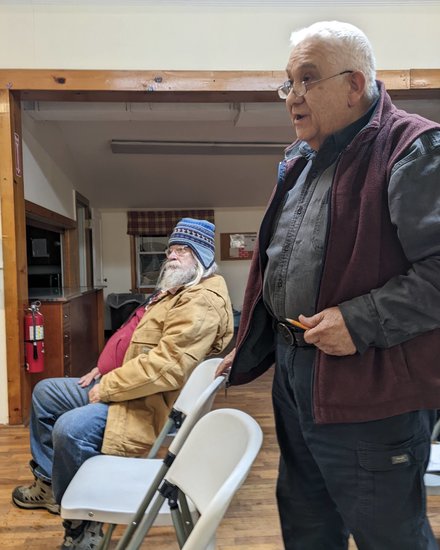
Seniors are saying that taxes are high, Michael Vincent tells the Berne Town Board on Feb. 11 as Joseph Burke listens, at left.
BERNE — The new Berne Town Board continues to hear public comments and to adopt new policies as it learns of issues left from the previous administration.
Deputy Supervisor Thomas Doolin said at the board’s Feb. 11 meeting that he had been getting phone calls from Jody Jansen and asked the board members if they were getting similar calls.
Jansen is eager to have a solar facility installed on his farm
A year ago, in January 2025, RIC Energy submitted an application for site-plan review of a 3.8-megawatt facility on his farm at 28 Jansen Lane in Berne.
Weston Hillegas, a project development manager at RIC, told The Enterprise in October that the project had been moving through the approval process with the town’s zoning board as the lead agency for the State Environmental Quality Review and had been recommended to the planning board.
“And then out of the blue, a moratorium came down from the town board,” he said. “They brought up issues of battery energy storage and we made it clear to them that this project didn’t have any of that proposed and it would never have it proposed.”
Hillegas went on, “Something to do with the batteries, I think, is what was really setting them off. Or maybe they were just using that as an excuse.”
The town currently has no commercial solar facilities but two were in the pipeline for approval when the board in April proposed a year-long moratorium. The moratorium was adopted in May 2025 and expires in May 2026.
The other proposal that was halted by the moratorium is a 4.25-megawatt facility proposed by TJA Energy in January 2024 that would be located at the intersection of Switzkill and Canaday Hill roads.
Solar moratoriums have been common in the Hilltowns, which, because of their plentiful open spaces, are attractive to solar developers. Berne, however, is unique in that it not only already had a robust solar law, but had significantly revised the law just a few years ago.
The relatively strict original law had been passed by a Democrat-majority board in 2019, and Republicans took the opportunity to make it more favorable to solar developers after gaining control of the board in 2020.
Neither version of the law, however, included regulations for battery storage, which most towns legislate separately from regulations for solar facilities.
Steve Khoury, who chairs the Berne Planning Board, said at the Feb. 11 meeting that the town needs a ban on storage batteries for solar.
Khoury referenced the June 2021 explosion at the Berne home of Victor and Lois Porlier that killed them both as it burned their house.
“Do we need battery storage in our town and have those risks?” Khoury asked the board.
In 2022, authorities concluded that the explosion was caused by propane that leaked into the Porlier home from an uncapped gas line in the home’s basement, set aflame “by an electrical arc produced during the normal operation of an appliance in that area,” a report from the New York State Division of Homeland Security and Emergency Services found.
While the Albany County Sheriff’s office told The Enterprise shortly after the explosion that a battery system in the Porlier residence connected to solar panels elsewhere on the property was being investigated, the final determination was that the batteries were not the cause of the ignition.
Khoury went on to talk at length about battery energy storage systems, known as BESS, alleging they are very dangerous — “the emissions are off the chart,” he said — and difficult for firefighters.
“Firemen are being exposed to some of these chemicals and having difficulties,” said Khoury.
The systems absorb solar energy during the day, when both demand and payments from utility providers for the commodity are lower than during peak-use evening hours, when electricity from the battery storage system is sent to the grid.
In the last decade, the number of BESS in the United States has increased exponentially — from 50 in 2015 to 820 in 2025, yet the number of failures has not increased; in fact, it decreased to just five worldwide last year.
When Doolin asked Khoury if batteries were part of RIC’s plans for the Jansen farm, Khoury said the opposite of what RIC’s Hillegas said. “They are going to do it,” Khoury said, “because you don’t want electricity to go to waste.”
RIC plans to proceed “as soon as the moratorium is lifted if the solar law hasn’t changed too much,” Hillegas told The Enterprise last fall. “We’ll have to re-evaluate that and, if they change the solar law, I think that will give us more insight into intentions.”
He concluded, “We’re willing and hoping and wanting to work with all parties involved. I even got the discussion started with the local fire department. They had a couple concerns,” he said, naming access.
“We’re willing to work with them and put in an access road in a different location if it’s beneficial to them,” said Hillegas. “So we’re by no means set in stone on what we initiated with our plan. We’re able to mold and mend and work with everybody.”
Helderberg Lake
Another holdover from the former Berne administration was a request from the Helderberg Lake Community Association to form a tax district so lake residents could pay for needed repairs on the dam that had been built to form the lake a century ago.
Supervisor Joseph Giebelhaus read a letter from the president of the Helderberg Lake Community Association who wrote that the association and its recently created sister organization, the Helderberg Lake Restoration Corporation, want to work collaboratively with the town board to secure funding.
In 2017, the state’s Department of Environmental Conservation declared that the dam was “unsound” because of cracks in the concrete and an uneven spillway crest. The Helderberg Lake dam is a high-hazard dam, meaning its failure could result in widespread damage to homes and roads or cause substantial environmental damage or loss of human life.
In 2021, the Helderberg Lake Community Association submitted a petition to the town of Berne, signed by 52 out of 73 of the proposed district property owners, to create a tax district so that residents would pay the town back for the $445,000 repair costs for over 30 years at 4-percent interest.
In April 2022, the town board unanimously rejected the association’s proposal to create a tax district to fund dam repairs. The DEC extended the dam repair permit held by the Helderberg Lake Community Association, which had an original deadline of October 2023, until March 2026.
Doolin gave a summary of the board’s thoughts on the proposal during the time he served as an elected, voting member of the board. As deputy supervisor, an appointed position, he cannot vote.
Doolin said the options were to drain the lake or to repair the dam — or the state would come in and drain it.
Doolin stressed that the lake association was a private organization and said that associations on other local lakes have higher fees and have saved money to do repairs.
“We as a board … felt it was a big burden on the town,” said Doolin.
Councilwoman Melanie laCour took issue with Doolin’s rendition, saying, “But it wouldn’t be the town taking the loan out … The taxpayers around the lake are ultimately responsible.”
LaCour said she would recuse herself when it came to voting on the issue.
“Our family owns two properties on the lake,” she told The Enterprise when asked about the conflict of interest.
“The entire town would have to back the bond ….,” said Giebelhaus. “We don’t know if it would affect our ability to borrow.”
Doolin then added that the former board thought it might set a precedent for other lake communities.
Resident Joseph Burke, seated in the gallery, questioned whether laCour should be offering her opinion since she was recusing herself from voting.
“I can still discuss it,” said laCour, continuing, “I think Tom is giving a lot of opinions and he’s not a board member.”
“This is for informational purposes,” said Giebelhaus of reading the lake association letter. He added, “I’m new in town.”
When someone in the gallery asked if Berne would be inundated if the dam gave way, Giebelhaus responded, “No … It mainly goes to New Scotland.”
Fireworks
Mary-Claire Ansboro, who chairs the Parks and Recreation Committee, told the board about the committee’s plans for a Fourth of July celebration on June 27 that will include ponies, a petting zoo, ice cream, and fireworks.
The board agreed after a heated discussion to pay $7,000 for a 12-minute fireworks show.
“I do have a concern about the cost …,” said laCour who noted she supported the celebration but paused at the cost for fireworks. “It’s a bad look considering we just rose taxes a lot.”
Town taxes went up 68 percent rather than the anticipated 38 percent. At the board’s January meeting, both Giebelhaus and laCour said they had voted for a spending plan with the 38-percent hike and were surprised to learn it was instead 68 percent.
Giebelhaus said he was seeking donations for the fireworks.
“Ask me no questions, I’ll tell you no lies,” said Ansboro.
She went on, telling laCour, “I’m 110-percent behind you.” But, she concluded, “This is part of what your taxes have paid for.”
Councilman Duncan Scott said of the town’s annual Fourth of July event, “It is usually very well attended.”
Giebelhaus said the fireworks companies — Santore’s World Famous Fireworks will be paid $4,000 and Night Sky Productions will be paid $3,000 — have already “penciled us in.”
He concluded, “I’m putting the pedal to the metal on this.”
Ultimately, the board vote was unanimous.
Other business
In other business, the Berne Town Board at its Feb. 11 meeting:
— Accepted the resignation, for retirement, of Andrea Borst, who had served as Berne’s account clerk. Borst said that her last day of work, after 22 years and 2 months, was on Feb. 7.
When Giebelhaus was asked after the meeting if Borst’s leaving had anything to do with the mixup that had caused the unexpected 68-percent tax hike, he said, “People are entitled to retire.”
Borst is listed on the town’s website as the deputy tax collector;
— Heard from Tax Collector Stephanie Audino that 71 percent of town taxes had been collected, totaling $2,624,012.13.
LaCour asked if 71 percent is in line with other years, to which Borst replied, “We have no idea.”
Borst also noted that the town is made whole by the county for the uncollected taxes;
— Adopted a town policy for drug and alcohol testing for workers “who perform safety-sensitive functions”;
— Adopted a new policy for structuring “day-to-day and human resources administration,” which distinguishes among the duties of the town board, supervisor, and department heads;
— Heard from Giebelhaus that just one company had responded to the town’s requests for information-technology work — Preville Technology Services, which has worked with the town before. He noted Preville “meets all the requirements”;
— Heard from Giebelhaus that it will cost “about $1,000” to get an easement for a road built to the town park. He had said at the board’s January meeting, “I learned this week we built a road to the town park without an easement.”
He said he found that about $20,000 had been spent on the road on private property and that he would try to negotiate an easement;
— Heard from Councilman Brian Bunzey that he had met with Duncan on cutting costs at the transfer station. “We have to get townspeople together ... to resolve issues,” said Bunzey.
Burke, speaking from the gallery, said, “We used to have a decal system.”
Later, Bunzey said, “People are cleaning out homes … Everyone’s paying for it.”
Giebelhaus said the point of the newly formed committee is to look at best-management practices;
— Heard several requests from Ansboro on behalf of the Parks and Recreation Committee. The committee wants to raise the fee for park rental from $75 to $150 for residents, and from $125 to $200 for non-residents; the $50 fee for seniors would remain the same.
The committee would also like to charge fees for the use of the senior center, the former Foxenkill Grange. “We’re asking your permission, please; let’s generate some income,” said Ansboro.
The third request was to have the water at the town park tested, to “make it drinkable.”
When The Enterprise asked Giebelhaus after the meeting what was the problem with the water at the park, he said, “It’s not potable.” Asked why it’s not potable, he said, “I’m new”;
— Hired Christopher Kuhn to drive the senior bus at $21.50 per hour;
— Heard a request from Holly Lenard that the dance troupe, the Hilltown Hags, be allowed to practice at the senior center on Mondays from 6:30 to 8:30 p.m. since it’s “a little too cold to dance outside.”
She also said, “We perform for free. We don’t make any money off of this. We’re just here to spread happiness and joy.”
Giebelhaus responded that the town is in the process of updating policies on the use of its facilities; and
— Met in executive session to discuss what Giebelhaus termed “five issues relative to personnel”: two having to do with discipline, one on hiring, one on granting a promotion, and one on an attorney-client discussion with a lawyer, he said.
The state’s Open Meetings Law lists eight reasons a board may go into executive session: matters that would imperil public safety; matters that would disclose identity of an agent or informer; investigation of a criminal offense; proposed or pending litigation; collective negotiations; matters leading to appointment, promotion, discipline, or dismissal; preparing or grading of exams; and proposal acquisition, sale, or lease of property.