Town tax hike of 69% surprises new Berne supervisor who wants comptroller to investigate
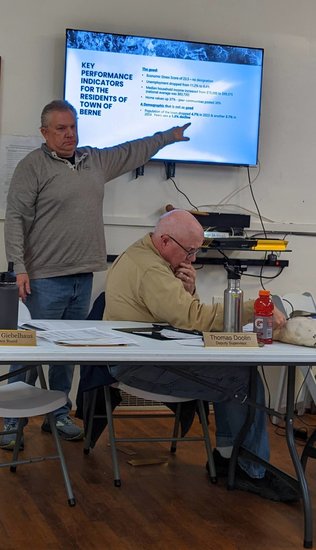
Enterprise file photo — Melissa Hale-Spencer
“I’m not saying we’re out of the woods yet,” said Joseph Giebelhaus while making a budget presentation on Oct. 22. Deputy Supervisor Thomas Doolin, in the foreground, looks at budget documents.
BERNE — Berne residents were surprised this week when they got their town tax bills: the expected 38 percent hike is closer to 69 percent.
The new supervisor, Joseph Giebelhaus, said that he was surprised as well.
When The Enterprise reached him by phone on Tuesday morning to ask why the rate was so much higher than what had been announced, he said, “I’m writing a resolution to turn the entire affair over to the state comptroller’s office to find out that very question.”
He went on, referring to the only other person besides himself who had been on the board when the $4.24 million budget was adopted in November, “I voted for a 38-percent increase. I spoke with Melanie laCour last night — she voted for a 38 percent increase and yet it is a 69 percent increase. So we want to find out as well … I don’t have a solid answer for you. I’d like to have someone else investigate it.”
Giebelhaus said he had reached all but one of the new board members and the plan is to pass a resolution at the regularly scheduled town board meeting on Wednesday, Jan. 14, to turn the matter over to the comptroller’s office.
While the tax rate per $1,000 of assessed valuation was expected to go from $4.70 to $6.48; it is actually now at $7.91.
The planned tax hike, Giebelhaus had written in an October release, was “primarily to eliminate the 30% average deficit spending from 2021–2023. Even with inflation, the new rate more accurately reflects the true cost of town operations,” he wrote.
He quoted himself in the release: “This budget confronts the hard truth: past tax policies and reliance on reserves masked chronic underfunding,” said Joe. “The 2026 plan rights the ship by aligning revenues with actual costs, investing in critical infrastructure, and protecting essential services — all while setting the stage for long-term financial health.”
It appears that the unexpected 69-percent hike may be to cover the payment to the county sheriff’s office for Advanced Life Support ambulance service, which costs $262,509.
History
Berne’s town government had been in disarray since August 2024 when three of the five members of the GOP-backed board had simultaneously resigned, claiming fiscal mismanagement by then-Supervisor Dennis Palow and a toxic work environment.
Palow did not seek re-election and could not be reached for comment this week.
After a seven-month hiatus, the town board started meeting again in March 2025 after the governor had appointed laCour, a Democrat and a lawyer new to politics, to the board. Giebelhaus, a Democrat who had retired from an Albany managerial post, was appointed to the board in April and ran for supervisor in November on three party lines: Democratic, Republican, and Conservative.
The other newly elected board members are Democrats Scott Duncan and Brian Bunzey and Republican Casey Miller.
Giebelhaus gave a lengthy budget overview on Oct. 22 and later sent out a press release about the 2026 preliminary budget. The $4.24 million spending plan, he said, “rights the ship by aligning revenues with actual costs,” increasing town taxes by 38 percent.
Typically, a supervisor, as the town’s chief financial officer, releases the budget but Palow at the Oct. 22 meeting said, “This came from Joe Giebelhaus,” as the town board considered a law that would allow Berne to go over the state-set levy limit. “He did it on his own,” said Palow.
All four board members at the time — Palow, Giebelhaus, laCour, and Thomas Doolin — voted in favor of piercing the tax cap. While Doolin did not seek re-election, on Jan. 1 he was appointed as deputy supervisor, a non-voting role.
After a contentious public hearing on Nov. 12, the four board members voted, without discussion, to adopt the preliminary budget.
Giebelhaus said on Tuesday that he was not the author of the 2026 budget. “The only thing I did with it was evaluate it and try to understand it and explain it but those were all his numbers,” Giebelhaus said of Palow.
He went on, “This is all his budget. It was all Dennis’s budget. By law, it is the supervisor’s budget … He was the CFO … It’s his budget to develop, his budget to pass. Just like the next year’s budget is mine to develop and mine to pass.”
According to New York Town Law, a supervisor is the town’s chief financial officer, but may appoint someone else to serve as budget officer.
However, a local government management guide put out by the state comptroller says this on who can prepare a town budget, “The supervisor, or eligible person appointed by the supervisor to serve at his/her pleasure; cannot be a member of the town board.” The town board’s power lies in reviewing and adopting the final budget.
Mark E. Johnson, spokesman for the Office of the State Comptroller, told The Enterprise earlier that this guidance of not allowing a town board member to draft a town budget “is consistent with Town Law § 103(2), which defines ‘budget officer’ as the supervisor, or a person appointed by the supervisor, including a town officer or employee other than a member of the town board.”
ALS
In May 2025, laCour was at odds with the other three board members when she voted against entering into a contract with Albany County for ambulance service that would cost the town roughly a quarter of a million dollars — money it did not appear to have in its 2025 budget.
That money came due in January, which The Enterprise noted in May would be after Palow left office and an all-new board took over. The town had been showing signs of severe fiscal problems, having already overdrawn its payroll account several times in 2023 and letting utility bills go un- and underpaid for years.
New York State Town Law says that a town shall not enter into a contract it has not budgeted for unless funds are transferred to the appropriate account.
“I just don’t think I can vote ‘yes’ for something that I’m not sure where we’re going to get the money to pay for it,” laCour said at the time, emphasizing that her concerns had nothing to do with the actual ambulance program from the county sheriff’s office, which the town has relied on for years.
“This is a yearly expense,” said laCour at the May meeting of ambulance service, “and you just completely left it out of the budget. All the money in the budget is accounted for. And now you’re saying we’re going to add this on top of it, and you’re not telling me where that money is coming from … I am not going to enter into a contract I know we can’t pay for. That is fraud.”
When The Enterprise asked Giebelhaus on Tuesday if the ALS cost could be what had unexpectedly hiked the tax rate, he looked up the exact figure — $262,509 — and said that could well be.
“I’ve been working on this diligently,” he said.
Referring to his metaphor in October of needing the tax hike that “rights the ship,” Giebelhaus said on Tuesday, “There’s a lot of listing going on up here, believe me.”
He went on, “To say the least, it’s very hectic up here. There’s a lot of moving parts right now. The first 13 days have been very difficult to say the least.”
While he said “some other issues” had come up in the first two weeks of his administration, Giebelhaus declined to elaborate on what they were.
“We’re going to want to touch on them tomorrow,” he said of the Jan. 14 meeting, scheduled for 7 p.m. at the Senior Center at 1360 Helderberg Trail.