Guilderland files suit against Burger King, franchisee, BK property owner
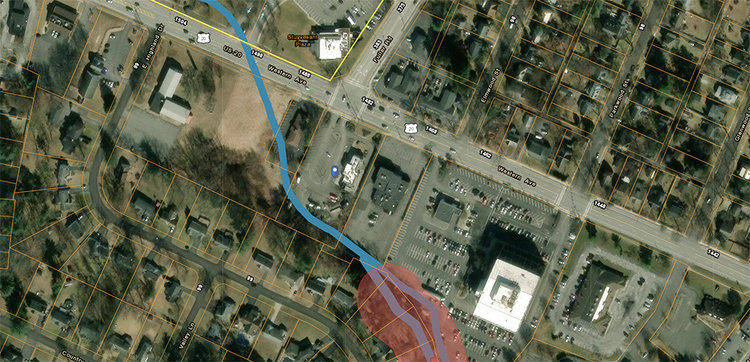
— From town of Guilderland Interactive Mapping
The Krum Kill, illustrated in blue, runs through and under the rear of the Burger King property at 1480 Western Ave.; the red area depicts a FEMA-designated flood zone.
GUILDERLAND — The town of Guilderland is turning the tables on the plaintiffs in its legal dispute with a Western Avenue Burger King.
The owner of the chain restaurant, located across the street from Stuyvesant Plaza, filed suit against the town in March of last year for construction costs and revenue lost due to flooding in the area.
The March 2025 complaint from Carrols LLC claimed Guilderland was owner of, and therefore responsible for, a 36-inch corrugated metal pipe running under its Western Avenue restaurant, and that the pipe’s failure caused significant flooding and erosion on the property.
The expanding erosion forced Carrols to close its drive-thru for six months, resulting in what the company claimed was a $400,000 revenue loss, while repair of the pipe and pumping of the stormwater cost over $1 million.
The suit languished for nearly a year until early last month when the town filed a third-party complaint against the property’s owner, seeking to shift financial responsibility in the matter.
The town has now gone on the offensive, filing a new lawsuit in late March against Carrols, the Burger King Corporation itself, and property owner VF 1480 Western LLC seeking to recoup $100,000 it says it spent to clean up the mess.
The lawsuit levels six claims against the defendants: unjust enrichment, negligence, private nuisance, breach of duty to maintain property, quantum meruit — a claim for the reasonable value of services rendered — and contribution and indemnification.
The connecting thread of the six causes of action is the same: the defendants owned the pipe, had a duty to inspect and maintain it, failed to do so, and then delayed repairs while the town bore the cost of managing the emergency.
Neither Carrols, Burger King, nor VF 1480 Western responded to Enterprise requests for comment.
The assertion
The cases revolve around the 36-inch pipe buried beneath the 1480 Western Ave. property.
According to the town’s March 26 complaint, the pipe was installed by a prior property owner to encapsulate a portion of the Krum Kill stream — historically an open-air waterway — in order to develop the site and build Burger King’s drive-thru lane.
The pipe served the sole benefit of the property, the town asserts, and was entirely under the defendants’ ownership, control, and maintenance responsibility.
The issue
The trouble began in December 2023, according to the town, when Burger King notified it of a flooded depression on the property. Town employees responded because two municipal sanitary sewer lines run directly through the area where the depression had appeared, the complaint states.
The town determined that its own infrastructure was not the source of the flooding, the complaint asserts.
By January 2024, Burger King reported the depression had grown in width, length, and depth. A second investigation — this one with the town engineer on site — identified the cause: the 36-inch pipe had failed, and the resulting collapse was producing an expanding, water-filled sinkhole, according to the March 26 filing.
Both sewer lines crossed directly over the failed section of pipe, the filing states, and continued erosion risked damaging the town’s sewer infrastructure, which could have led to service disruptions, environmental contamination, and costly repairs.
Compounding the problem was the Krum Kill’s environmental classification.
The New York State Department of Environmental Conservation, the town claims, “classifies this portion of the KrumKill as class C(T) stream, which is a waterway classified as ‘Class C’ for fisheries and non-contact recreation, that is also designated as ‘(T)’ which means it supports a trout population.”
The class C classification meant any repair work on the failed pipe would require state and federal environmental permits before a shovel could touch the ground
The fallout
Following the flooding incident, a protracted emergency response ensued, according to the complaint, in which the town claims it committed resources it says the defendants should have been deploying themselves.
Between December 2023 and January 2024, the town claims to have provided multiple truckloads of stone fill to stabilize the depression.
Over the ensuing months, it supplied a vac truck, an excavator, a backhoe, a camera van, sewer plugs, and a compressor at various points; according to the complaint, town staff were on site almost daily between December 2023 and July 2024.
The town also claims to have helped the defendants navigate the permitting process. Between January and February 2024, the town worked alongside the defendants to secure DEC permits, which were issued on an expedited basis, according to the complaint.