Phillips proposes mini-golf, pizza and ice-cream shop; Markstone scales back Pine Bush proposal
— From Phillips submittal to the town of Guilderland
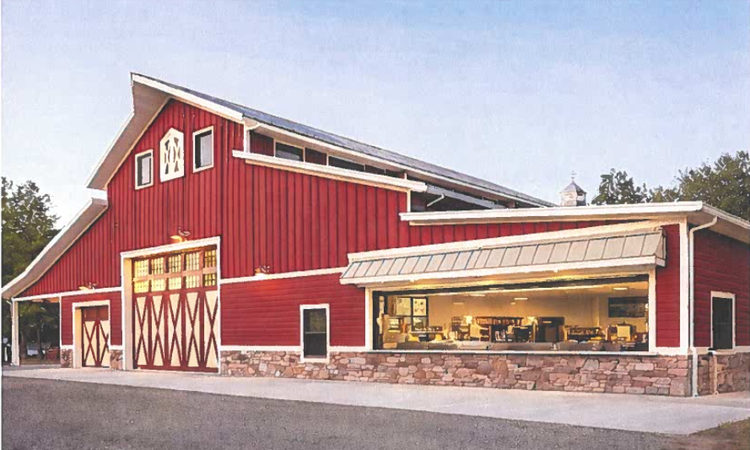
Jon Phillips is proposing an ice-cream shop and pizza pizza place as well as a mini-golf course at the corner of routes 146 and 158.
GUILDERLAND — The Guilderland Planning Board on April 22 was presented with two very different proposals asking that the town accept development on constrained land.
At the corner of routes 146 and 158, John Phillips is looking to add a mini-golf course along with an ice-cream and pizza shop on an eight-acre parcel behind his hardware store.
Phillips described the shop and mini-golf course situated on a total of over 13 acres owned by his family’s real-estate holdings company as the third phase of a build-out he has been designing since 2015. In addition to Phillips Hardware, the corner is home to a Mobil gas station, mini-mart, and Dunkin Donuts.
Phillips told board members he’d originally considered apartments but shifted to mini-golf after conversations with town planning staff about outdoor amenities consistent with Guilderland’s recently-adopted comprehensive plan.
Phillips’s proposal would place a single 8,000-square-foot building on the parcel that would contain a 3,500-square-foot ice-cream shop and a 4,500-square-foot pizza place; there’d also be two outdoor pavilions of approximately 2,060 and 2,640 square feet.
Behind the building, wrapping the parcel, would be an 18-hole miniature golf course approximately 24,000 square feet in area. Phillips told the board the course would contain water features, in-stream waterfalls, and pilings and bridges — not, in his words, “astro turf down and hoping someone comes and plays once.”
The defining design feature — and the source of the project’s largest regulatory hurdle — is accessibility. The course was engineered in accordance with the Americans with Disabilities Act, allowing a player using a wheelchair to move between holes without having to leave the course.
Phillips has paired the project with STRIDE Adaptive Sports, a Capital Region not-for-profit, whose executive director, Alex Brame, told the board his organization serves approximately 2,500 people with disabilities in the region.
The scale of the course Phillips is proposing to build, Brame said, does not exist locally. “We rely on people like Jon to put the infrastructure in,” he said.
The accessible layout of the course drives the project’s intrusion into a state-regulated buffer.
Phillips told the board that accommodating the wheelchair routing requires disturbing approximately 9,300 square feet of New York State Department of Environmental Conservation freshwater wetland, a buffer Phillips said did not exist when he began the project two to three years ago but the DEC has since expanded.
Phillips said an application is pending with the DEC, and that he’s coordinating with the United States Army Corps of Engineers on the federal wetlands portion of the site, where the proposed parking lot and building would also disturb wetlands.
Town Planner Kenneth Kovalchik’s memo flagged each impacted layer: federal wetlands disturbance requiring Army Corps coordination, the DEC adjacent-area issue, and a Black Creek 100-foot watercourse setback regulated by town code.
The town’s zoning board of appeals is the lead agency for the project; the planning board’s site-plan review role is advisory.
For the planning board, parking was an issue.
The submitted plan didn’t show how parking for a use not included in the town code would be sized. Board members estimated 30 or more groups could be on the course at peak times, with no overflow capacity available. Phillips said he expected to share his hardware store’s lot for evening parking; the board directed him to return with a defensible calculation.
With no vote required, the board’s comments will be compiled for the zoning board’s environmental review of the project.
Pine Bush
Also on April 22, the board continued to hear Markstone’s proposal for an apartment development along New Karner Road amid the Pine Bush, a globally rare pine barrens.
The project was last before the board in March.
Project engineer Scott Lansing told board members that the total unit count had been reduced from 210 to 190, that the taller of the two proposed buildings was cut from five stories to four, and that two driveways previously proposed on New Karner Road were combined into a single full-access curb cut.
The disturbed acreage was reduced from 7.23 acres to 7.05 acres, Langsing said, which was below the 9 acres authorized under a previously-approved PUD on the same site.
To make the density work, the number of workforce-housing units, set aside for tenants earning 80 percent and 120 percent of the area median income, was reduced from 32 to 19.
Public comment ran approximately two hours. None of the residents who spoke supported the project as drawn.
Residents took the proposal to task for:
— Inconsistencies in Markstone’s traffic addendum, including language describing two site driveways even though the project has been narrowed to one;
— State Environmental Quality Review forms acknowledging impacts to the Karner blue butterfly and other Pine Bush species but containing no analysis of those impacts;
— Traffic conditions that have forced current residents to make illegal left turns to reach their neighborhood;
— A workforce-housing reduction characterized as “laughable” given the supply of $4,000-a-month market-rate units already in town;
— Snow storage on a steep, eroding ravine;
— Pesticide use;
— Stormwater runoff; and
— The cumulative load on schools, water, sewer, and emergency services from recent multifamily approvals.
The planning board, choosing to list comments made rather than block the project, voted unanimously to forward a sketch-plan report to the town board, the lead agency for planned unit developments.
The planning board:
— Requested that the traffic engineer evaluate whether a center turn lane would address problems at the Pine Knob Drive and Gladwish Avenue intersections;
— Recommended that accident data from the intersections be pulled; and
— Asked that a question about quantifying cut-through traffic in surrounding neighborhoods be resolved.