GCSD grapples with declining enrollment
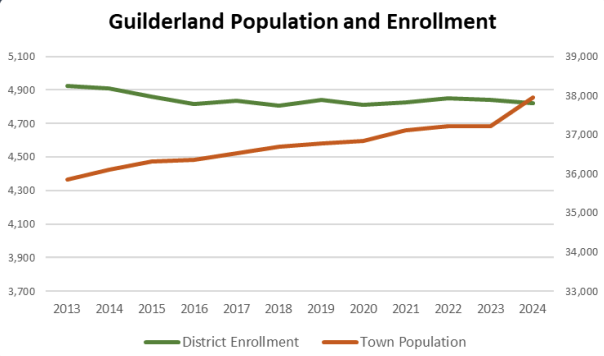
— Graph from Robert Scardamalia
Enrollment in Guilderland schools (the green line) is declining even as the town’s population (the red line) is increasing.
GUILDERLAND — Although Guilderland’s population is growing, school enrollment is falling, the Guilderland School Board heard on April 13 from the demographer the district hired.
Robert Scardamalia, who formed RLS Demographics Inc. in 2010 after serving as the chief demographer for the state of New York for nearly 20 years, went over projected changes for the school district, setting the enrollment decline in a statewide and national context.
Birth rates are declining nationwide and immigration is slowing. More than half of New York’s counties, Scardamalia said, are in a state of natural decline with more deaths than births.
The Guilderland school district has wrestled with declining enrollment in the past.
Decades ago, after the baby boomers passed through the schools that had been built to accommodate them, the district closed Guilderland Elementary, leasing it to a Hebrew school, and sold Fort Hunter Elementary.
When the echo boom — the millennials — arrived, the district re-opened Guilderland Elementary and built Pine Push Elementary to serve the Fort Hunter catchment area.
In this century, the first mention of the need for a formal study was in March 2011. In 2014, the district under then-Superintendent Marie Wiles hired consultant Paul Seversky to conduct a capacity study.
Wiles delineated three challenges she said Guilderland faced: declining enrollment, excess capacity, and diminishing resources. At that point, enrollment had decreased by 13 percent from 5,645 in 2004-05 to 4,908 in 2014-15.
Seversky’s recommendation to close an elementary school to save about $2 million annually at a time the budget was about $90 million was wildly unpopular.
Ultimately, the school board, in a split vote, set aside Seversky’s recommendations and formed citizens’ task forces to look into various uses for excess classroom space while keeping all five elementary schools open.
The task force committees considered preschool, adult day care, incubator start-ups, and commercial rental to fill the empty classrooms at Altamont Elementary, Pine Bush Elementary, and Farnsworth Middle School. The board ultimately decided on an outside pre-kindergarten business to rent the extra classrooms.
On April 13, Scardamalia displayed graphs showing that, while population was still growing in the town of Guilderland — 36,000 in 2024, up from 16,000 in 1960 — “it’s a slowing rate of growth,” he said.
The median household income is around $129,000, he said.
“The Capital Region is a relatively healthy region in New York state as compared to the Southern Tier and other areas,” said Scardamalia.
The only way that population changes, he stressed, is through births, deaths, and migration. He looked at data for births and deaths, which is reliable, Scardamalia said, and also for migration, which is trickier.
The key to projecting births is projecting the number of women of childbearing age, he said. Birth rates in the United States “are at historic lows,” he said, “and the number of births has been declining.”
Teenage births have plummeted and there are reductions “even in the 20-to-24 age category, which in my generation was when we were all having kids,” said Scardamalia. With delayed marriage and childbearing, most births are now occurring in the 30-to-34 or 35-to-39 age brackets.
As baby boomers die, “cohorts coming in are relatively small,” said Scardamalia, stressing, “This is not unique to Guilderland.”
Guilderland still has “a natural increase” with more births than deaths, he said, while some 35 of New York’s 62 counties “are already at a state of natural decline with more deaths than births.”
Scardamalia displayed graphs showing Guilderland in comparison with neighboring school districts.
“Each of the districts is pretty flat,” he said, adding, when it comes to growth, “New York just isn’t doing a whole lot.”
Comparing it to a high-growth state, Scardamalia said of New York, “We are not an Arizona and we haven’t been an Arizona for probably 50, 70 years. The growth rates in New York state are very low.”
While most of the growth is downstate, he said the Capital Region is “a relatively healthy region.”
“New York’s population growth is heavily dependent upon foreign immigration,” he explained.
Historically, New York has been the recipient of about 100,000 foreign immigrants yearly, Scardamalia said, mostly focused in the downstate metropolitan area but it affects the entire state.
“There’s filtering off, and we see that in our communities all over,” said Scardamalia. So national population growth is being slowed not just by declining birth rates but by decreased immigration, he said.
“And what that picture is going to be like in the next five years, I wouldn’t pretend to know because we’re going through a pretty turbulent time right now and how that’s all going to shake out, I don’t know.”
Currently, 12.5 percent of Guilderland’s population is foreign born.
School board member Meredith Brière asked, “As the aging population continues to pass on and their homes become available, do you think that that will have any effect on this data set?”
“Absolutely yes, with a whole lot of qualifiers,” Scardamalia responded.
With more than half of New York’s counties in a state of natural decline, he said, “We have beautiful quality-of-life communities, many of them are dying.”
He suggested a model to attract new families might be found in Arlington, Massachusetts — where the median housing value is $500,000 or $600,000 — which is redeveloping, “carving them up into, in some cases, lower income housing, lower market-rate housing” to attract younger family populations.
“So it sounds to me,” said board member Rebecca Butterfield, “like it’s incumbent upon districts to make the district as appealing as possible for young families, right? Or young people who are apt to reproduce, right?”
Scardamalia responded, “Very few of these trends in New York are unique to the current time period … We bring in a ton of students to the educational system, universities. And what happens? They leave after their education … What do you need to do to keep them here, to attract them?
He went on to name jobs and housing — and Butterfield added child care.
“So, if we can advocate for that, that would really be helpful, right?” asked Butterfield
“I would like to think so,” Scardamalia responded.