Developer wants 210 apartments at the edge of the Pine Bush, Guilderland Planning Board says the math doesn’t work
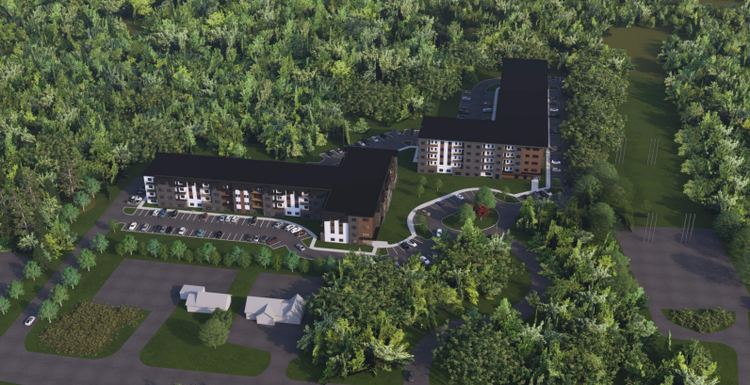
— From Markstone submittal to the town of Guilderland
The Markstone Group is proposing a 210-unit apartment development on New Karner Road adjacent to the Albany Pine Bush.
GUILDERLAND — A developer’s plan to build 210 apartments along New Karner Road amid the fragile ecosystem of the Pine Bush stalled recently due to a disagreement over what constitutes buildable land.
Developer Markstone Group made the claim to members of the Guilderland Planning Board late last month that 30 of its proposed project site’s 51 acres constitute buildable land, entitling the developer to place 210 apartment units on 11 acres of the site.
The planning board disagreed, arguing only 10 acres were viable for construction, drastically cutting the potential number of units Markstone could construct from 210 to 120.
In 2017, the town board had approved a Planned Unit Development on the same site that was to include 96 units for independent senior living, 56 units for assisted living, and 40 units in a memory-care facility.
Four years later, the proposal, still a PUD, was amended, removing the senior-living units and making them affordable senior-living units while keeping the memory-care and assisted-living units.
But the applicant failed twice to secure New York State Homes and Community Renewal low-income housing tax credit funding, and the PUD expired.
In March, the town board, save for Deputy Supervisor Amanda Beedle, voted to approve Markstone’s proposal for another PUD on the site.
In his memo to the board, Town Planner Kenneth Kovalchik recommended the board accept the application because of the town’s need for affordable housing — 15 percent of units, or 32 apartments, are to be set aside for residents whose annual income is between $68,250 and $102,400; rent would be about $1,700 per month.
The remaining 178 apartments — largely one- and two-bedrooms units with a few three-bedroom units sprinkled in — would have monthly lease payments between $1,800 and $2,800.
Markstone, much like it did with its Hamilton Parc luxury senior-living facility on State Farm Road, would subdivide the 11-acre PUD area to make financing easier.
During the board’s earlier March meeting, project engineer Mike Lansing’s housing estimate relied more on clever wording than arithmetic, as he used gross density — taking into account the entire parcel area, including land that can’t be built on — rather than net acreage. Net acreage makes subtractions for constraints like wetlands, steep slopes — which is any land area where the ground rises or falls sharply enough to affect stability, drainage, or buildability — and required setback to calculate unit density.
Kovalchik noted at the March 11 meeting that town code states unit density is calculated per buildable acre, and that the maximum number of units that can be placed on a single acre is 12, and with Markstone proposing to hand over 39 of its acres to the Pine Bush preserve, math shows that the remaining 11 acres would have 19 units per buildable acre, or 58 percent more housing per acre than allowed.
On March 25, Lansing was back before the board with an optimistic estimate.
Lansing once again began with 51 acres, but this time partially took into account some of the site’s topography, arriving at a net density of 7.43 dwelling units per acre; his previous density figure was 4.1 units per acre.
His latest estimate relied on what he said was “unconstrained” buildable land located on the eastern and western sides of an 80-foot ravine that bisects the property.
“Is that something that it would be a great idea to cross that ravine and access that land and develop that?” Lansing said during the meeting. “No, we do agree that that’s not a good environmentally responsible thing to do.”
But, he argued, the land still qualified as “unconstrained” under the town code and should therefore generate a density “credit” — allowing Markstone to cluster all 210 units on the eastern side of the property while dedicating the western 39 acres to the Pine Bush Preserve.
“From a planning board’s perspective, you can’t really take land you can’t really get to and call it buildable,” Planning Board Chairman Stephen Feeney said. The board would not forward a density recommendation to the town board, Feeney said, “without seeing a map.”
Feeney said standard planning practice requires buildable land to be functionally accessible and contiguous — not divided by ravines, wetlands, and streams. The board estimated the accessible, contiguous land on the eastern side of the ravine at under 10 acres.
“If it’s 10 acres of buildable and you’re looking at how many, 210, is it 210 units?” Feeney said. “That’s like 20 units an acre.”
The dispute over acreage spawned a second question: Does the project qualify as a Planned Unit Development in the first place? Guilderland’s town code requires a PUD to include preservation of trees, natural topography and geologic features, promote smart growth principles, and incorporate a mix of residential and non-residential uses.
It was noted by board members that the New Karner Road proposal is entirely residential, and that the proposal of fitting four- and five-story buildings near the edge of a steep, actively eroding ravine could potentially require 20-foot retaining walls stretching hundreds of feet, in direct contradiction with the PUD mandate to preserve natural topography.
Lansing defended the PUD classification by pointing to the 39-acre dedication. “We feel we more than meet that with retention of trees and natural features with the 39 acres,” he said.
Feeney was unconvinced, and said the project more closely resembled a standard Multi-Residence rezoning, which caps buildings at three stories and limits density to 12 units per buildable acre. The board then declined to make any recommendation to the Town Board, concluding that debating site plan details is premature until the density question is resolved.
For his part, Lansing said he would return in April with a detailed map of unconstrained buildable lands; a formal density determination and justification; specific workforce housing rent figures; a written justification for why the project meets the legal definition of a PUD; and additional traffic analysis regarding a proposed two-way left-turn lane extension on New Karner Road.