Archive » December 2025 » Columns

— Photo from Mike Nardacci

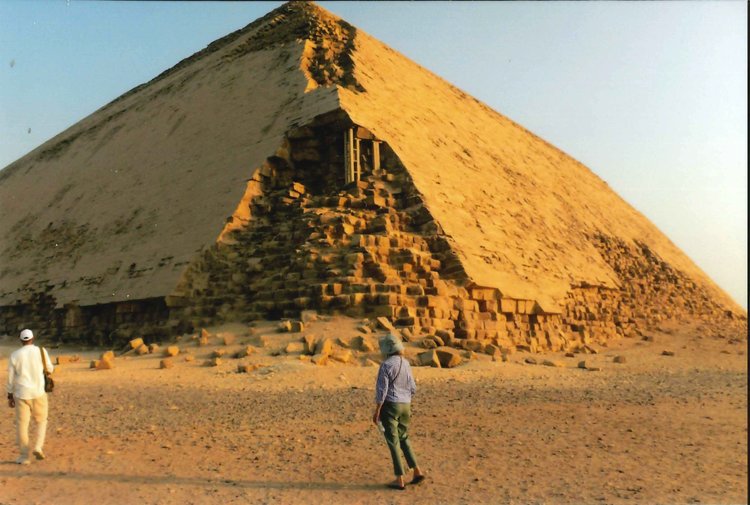
“The Bent Pyramid” is 600 feet on a side and towers 330 feet above the Sahara.

The pyramids on the Giza plateau west of Cairo are almost certainly the prime attraction for visitors to Egypt and they may draw thousands a day during the height of tourist season.

Relics of Egypt’s Old Kingdom rising starkly out of the desert, they overwhelm the visitor with their gigantic profiles. Though the 4,600-year-old Great Pyramid of Pharaoh Khufu is the most famous and towers nearly 450 feet, its neighbors belonging respectively to Pharaohs Khafre and Menkaure are stunning in their own ways. That of Khufu’s son Khafre is only a few feet lower than the Great Pyramid and, while Menkaure’s pyramid is only half the size of the other two, it projects its own grandeur.

These structures are massive, built of millions of limestone blocks weighing many tons and inspiring numerous theories — some remarkably daft — as to how they were constructed.

Perhaps the most outlandish is that they were built under the direction of alien beings who, having solved the challenge of faster-than-light travel, crossed many vast stretches of space for the purpose of showing less technically accomplished people how to pile up rocks. Might they not more profitably have taught them about electricity, computers, and advanced medicine?

Then there are those who insist that the three Giza pyramids are for some esoteric purpose lined up in a row like the stars in the belt of the constellation Orion — blithely ignoring the fact that any three objects in a row are arranged like the stars in the belt of Orion.

Nonetheless, there remain many questions as to how the ancient Egyptians raised the blocks in the pyramids to such great heights; how they managed to organize, feed, and house the required workforce; and what the impulse was to raise such monuments so that their kings might enjoy eternal life with their gods.

The fact remains, however, that there are many, many more pyramids on the west bank of the Nile River — they may number as many as 100 — some older than the Giza pyramids, some nearly as large, some eroded to heaps of rubble resembling natural rocky outcrops in the desert. They vividly show the evolution, the flourishing, and the final dissolution of the technology that raised them.

And contrary to popular depictions — Cecil B. DeMille notwithstanding — these structures were not built by slave labor. The graves of the men who raised them have been found and their remains are those of workers who not only enjoyed healthy diets but were given the best medical treatment available for injuries.

They frequently left behind graffiti on the blocks with which they were building indicating that they worked in teams that were in competition with one another, perhaps vying for extra portions of beer or time off.

But for all of their grandeur, it must be admitted that seeing the Giza pyramids at the height of tourist season as I did recently when they are surrounded by enormous noisy crowds posing for photos, bargaining with souvenir sellers or camel drivers for rides, or lining up in chattering groups for the chance to enter the pyramids’ eerie interiors can induce a negative reaction. Tourist brochures that show the pyramids seeming to be in isolation in the desert with nary a soul in sight are wildly misleading.

Pharaoh Sneferu’s pyramids

But a couple of dozen miles south of Giza on a lonely stretch of the great limestone plateau called Dashur rise the pyramids of Pharaoh Sneferu — well, two of them anyway — and they illustrate a remarkable chapter in the history of pyramid construction.

Sneferu was the father of Khufu and his building activities not only seem to have inspired his son to outdo him, they created a construction force that accomplished astonishing —sometimes bewildering — things and made possible the wonders of the gigantic pyramids of Giza.

But the story of Sneferu’s pyramids begins about 20 miles from Dashur on a site with a spectacular view of the Nile River where Sneferu ordered the construction of what is now known as the Pyramid of Meydum (or Meidum). Googling the name and clicking “images” reveals a structure that looks like a tower rising above the desert — all that remains of Pharaoh Sneferu’s initial bid for immortality.

And that was precisely the function of pyramids — they are what archaeologists term “resurrection machines”: Pyramids were intended to carry the deceased pharaoh to the realm of the Sun-god Ra. For generations before Sneferu, pharaohs built what are called today “step pyramids,” looking like huge staircases reaching toward the sky.

But perhaps inspired by shafts of sunlight breaking through clouds and forming wedge shapes on the horizon, Sneferu commanded his architects and engineers to try something new.

After what must have involved years of planning and construction, something went wildly wrong.  Whether the ground beneath the pyramid was too soft to bear its weight or there was some major engineering error as the structure grew in mass, a catastrophic collapse occurred and much of the pyramid was reduced to a pile of rubble on which its interior structure sits today.

Interestingly, the intended burial chamber and the passages leading to it survived the collapse.  But Pharaoh Sneferu was not about to start his journey to the afterlife in this monumental failure so he ordered his engineers and work teams to start a new pyramid, this one in the site called Dashur.

No one knows how much time and treasure was lost in the building of the Meidum pyramid — the ancient Egyptians did not keep records of such endeavors — but Sneferu’s subjects dutifully regrouped and went to work. One does not question the will of a god-king.

The result of their efforts stands today above the bleak sands of Dashur — the strange construction known as “the Bent Pyramid”-- (Figure 1) 600 feet on a side and towering 330 feet above the Sahara, the enormous structure is visible from many miles away.

But its odd shape demonstrates that Sneferu’s engineers had not yet fully learned from their failure at Meidum. As the pyramid grew in elevation, cracks began to appear in its base threatening collapse.

The slope of the pyramid was evidently too steep and had exceeded the angle of repose, meaning that the whole thing could collapse as had the pyramid of Meidum. To solve the problem, they changed the angle of the sides, thereby reducing its final weight and resulting in the “bent” profile the pyramid exhibits today, though the separation of some of the lower sections of the structure show the effects of the steep angle.

The interior of the pyramid was also completed — a complex series of tunnels and rooms leading to an impressive burial chamber with a corbelled ceiling. The fact that these are intact after over 4,600 years shows that Sneferu could indeed have agreed to be interred there.

But incredibly the pharaoh appears to have said something like, “Very nice but not what I ordered up.  Let’s try again.”

It is at this point that two relevant facts should be mentioned. The first is that there is a small step pyramid on a site called Seila near Egypt’s fertile Fayum area, which also apparently was built at Sneferu’s command though its interior was evidently never intended for a burial. 

The other fact is that, for generations after his reign, the pharaoh was referred to as “Good King Sneferu” and had the reputation of kindness and generosity toward his subjects. What these folks thought about all that labor and national treasure going into the building of Pyramid Number Four is unrecorded.

Known today as “the Red Pyramid,” the giant structure rises about a mile to the north of the Bent Pyramid and it is a masterpiece. Third in size to the Giza pyramids of Khufu and Khafre, it gets its name from the presence of oxidized iron in the limestone blocks from which it was constructed, a coloring that time has intensified.

Its somewhat flattened appearance demonstrates that Sneferu’s engineers had learned from their past errors and gave the pyramid a more stable profile, enduring through the millennia without obvious signs of erosion. Neither Sneferu’s son Khufu nor any subsequent pharaohs in Egypt’s Old Kingdom attempted a pyramid with sides as steep as those of the Bent Pyramid.

Today these monuments induce wonder as they stand in splendid isolation above the desert sands. They are seldom visited. The day my companions and I went to Dashur, there were just three other people at the Bent Pyramid. At the Red Pyramid, there were none.

Yet here rise two of the master works from Egypt’s past proclaiming the ingenuity of their builders and perhaps the ego of their pharaoh. Lacking the sometimes carnival atmosphere that accompanies the Giza pyramids, they silently evoke the mystery and stimulate the contemplation for which they surely were intended.

— Photo from Mike Seinberg

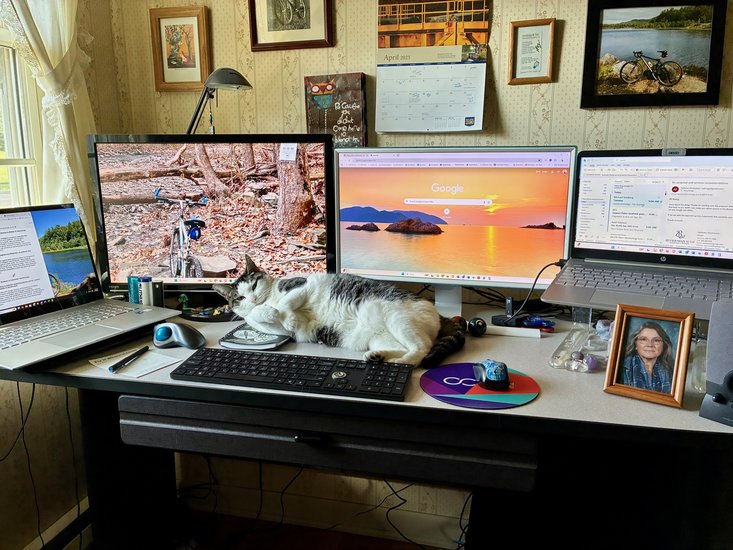
After a long nap, Sylvie has returned to the keyboard.

Good day to you humans, I am Sylvanus Windrunner Seinberg-Hughes, or Sylvie the cat, and I’ve taken over Mike’s computer today. I have decided to speak to humans as I see some serious issues bubbling that must be addressed by you opposable thumb types. Mainly, I hear a great deal of you out there arguing about silly things.

Here it is, the season where you bring out the tall green, lit-up, decorated scratching posts with all the shiny cat toys hung on them. You create lots of interesting smelling food, put lights around the litter box and generally run around like hummingbirds on a sugar high for about a month to make yourselves feel jolly. Funny thing is that, by the time the season ends, you all just appear wasted, broken, depressed, and hung over. You people seriously need more naps.

But besides the usual yearly madness, there seems to be an extra layer of tension and grumpiness overlaid on your rather fragile society. I keep hearing about some group of evil humans you refer to as billionaires as the main reason, you’re all so angry and unhappy. My human staff has indicated that this very tiny group has stolen most of the resources you folks place value on and that has left most humans in need.

In the cat world, if a particular cat eats more food or overuses the litter box (kind of tied in there) we tend to address the issue in a direct manner. Usually, some loud yelling suffices but occasionally claws, teeth, and expulsion are known to come into play. In our well-ordered society, we cats all share in things so nobody goes wanting; it’s simply common sense for a civilized species. What’s the excuse for your silly resource management?

It seems to me that, if you all simply agreed the billionaire creatures need to share, you could then force them to do so. You far outnumber them, your needs are legitimate, and no one individual needs so much that others suffer, that’s just common sense. Or is common sense now considered an oxymoron among humans? 

In the world of cats where we run from the svelte to the chonks, we still make sure everyone’s needs are met to the very best of our abilities. There’s a cat in my neighborhood that stops by every so often to say hi and, if I have some extra mouse, or cat food, I always share. It’s just polite. Why is that such a tough concept for people who invented the easy-open can to grasp?

My staff is very invested in donating to something they call a food bank on a regular basis, but if you have grocery stores everywhere, why would you need a food bank? Perhaps it’s because my cat food cans have gone from about 50 cents to over a dollar in the last couple years, and I’m not quite sure why that is. Have chicken innards, or those wonderful dead-fish smelling shreds suddenly become rare, or hard to find? Or are those billionaire types messing about again? You folks really need to rein that bunch in. 

It’s very simple. You need to be paid decently to keep us and yourselves fed and housed properly. I’ve heard you people contribute to the greater good collectively by paying something called taxes that get collected by something called government, which then spends that money, theoretically, to help your society.

But again, you vastly outnumber these government types and supposedly you choose them every couple of years so, if they’re doing a bad job, you should choose some better ones.

I suppose, when you get right down to it, if you humans are allowing small groups of you to make life worse for most of you, then you should simply agree on that, and fix it. Choose better pack leaders, tax people who have too much, and use that wonderful human nature that allows you to take such good care of us, to do the same for each other. It’s how civilized beings act. Get with the program, folks!

Editor’s note: Mike Seinberg says that Sylvie has been running her home for more than 10 years now, and with her feral sister, Nibbler, keeps the humans in line.


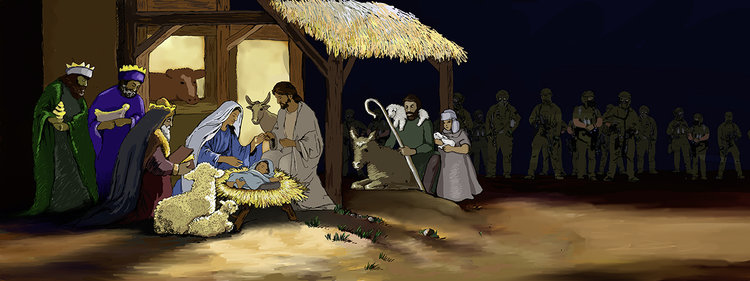
Art by Elisabeth Vines

For Jim and Wanda Gardner

When you strip away the tinsel from the Christmas message, you see right away that, when you buy into the child in the manger — the Nativity Scene — you also buy into the whole 33 years of the child’s life.

Thus, on Christmas morning you not only sing, “The blessed angels sing” from “It Came Upon the Midnight Clear” but also chant the beloved Negro Spiritual, “Never Said a Mumbalin’ Word” which goes:

“He bowed his head and died …
and he never said a mumbalin’ word;
Not a word, not a word, not a word.”

And if its refrains are unknown to you, there is tenor Anthony León’s performance of Moses Hogan’s arrangement, Elvin Rodríguez on piano.

I’ve not seen anything on Fyodor Dostoevsky’s take on the birth of the child Jesus but you can see from “The Brothers Karamazov” that he’s quite familiar with the whole 33 years of his life 

In the story, a woman with money asks an elderly monk, Staretz Zosima, if it’s possible to prove the existence of God. 

The priest says no intellectual argument or explanation seems to exist, but proof can be found in the practice of the “active love” Jesus announced on Christmas Day.

She said she thought of becoming a nun living out the “dream of forsaking all … full of strength to overcome all obstacles. No wounds, no festering sores could … frighten me. I would bind them up and wash them with my own hands. I would nurse the afflicted. I would be ready to kiss such wounds.”

Which is how Pope Francis treated the poor in his neighborhood inviting them to his apartment for meals — the apartment the digs of a simple man. He could never imagine throwing a grand ball for the rich and greedy in “Great Gadsby” style at a Mar-a-Lago estate while scads of poor — not far from where the champagne was being poured — were clawing away to put a decent meal on the table. 

And the Washington billionaire who sponsored the gig is the guy who took away coupons from those souls that we, as an assembled Congress, had allocated for them through the Supplemental Nutrition Assistance Program (SNAP).

Dostoevsky’s rich lady was also a retributionist in that she wanted to be paid like “a hired servant, I expect my payment at once — that is, praise, and the repayment of love with love. Otherwise I am incapable of loving any one.”

It’s the quid pro quo ethic of an unconscious waif reflecting the economically-debilitating ethic of do ut des: I give so you can give something in return: feelings of reciprocity we all grapple with.

Zosima tells the woman to stay in her dream world because “love in action is a harsh and dreadful thing compared with love in dreams. Love in dreams is greedy for immediate action, rapidly performed and in the sight of all.”

Dorothy Day, the founder (with Peter Maurin), of the Catholic Worker Movement spent 50 years of her adult life offering food, shelter, and clothing to those in need, in person and face to face: A mumbalin’ word never left her lips.

In “The Long Loneliness: The Autobiography of Dorothy Day,” she tells how she came to embrace the child of Bethlehem, and was able to remain un-distraught by the loneliness that comes from embracing a love that seeks nothing in return.

Charles Dickens in “A Christmas Carol” shows he knows well the meaning of harsh and dreadful love. Indeed, he’s the fifth gospel of the New Testament: Matthew, Mark, Luke, John, and Charles. 

And “A Christmas Carol” offers far greater insight on economics than Adam Smith’s “Wealth of Nations.” Scrooge’s transformation is the Sermon on the Mount grounded in the day-to-day language and thought of the poorest of the poor.

One Christmas Eve two men come to Scrooge and ask for a donation to help the “Many thousands [who] are in want of common necessaries; hundreds of thousands are in want of common comforts.” 

Scrooge snaps, “I can’t afford to make idle people merry … they had better [die], and decrease the surplus population.”

The story came out in 1843 but Scrooge is among us still in Elon Musk and his genre who, following orders from the President of the United States, shuttered the United States Agency for International Development (USAID) that was offering life support to those in dire need — which has resulted in what Microsoft co-founder Bill Gates called “killing millions.” 

A flabbergasted Gates told “The Financial Times” he still could not absorb, “The picture of the world’s richest man killing the world’s poorest children.” 

“I’d love for him to go in,” Mr. Gates said, “and meet the children that have now been infected with HIV because he cut that money,” funds to allow every Tiny Tim in the world to have a life.

Being a billionaire is not the disease that causes savagery; Mr. Gates — himself once the richest man in the world — just pledged to give away his final $200 billion through a foundation he and wife, Melinda, started for “the cause of saving and improving lives around the world.” They’d already donated billions. 

“People will say a lot of things about me when I die,” Mr. Gates said, “but I am determined that ‘he died rich’ will not be one of them. There are too many urgent problems to solve for me to hold onto resources that could be used to help people.”

How radically opposite is the billionaire in the White House calling Somalian immigrants “garbage;” a woman newspaper reporter a pig; another “ugly,” another “stupid” and endless other slurs reflecting mental savagery.

It’s the same guy heard on tape in October 2016 saying, “When you’re a star they let you [do this] … do anything … Grab them by the pussy. You can do anything.”

In his classic “Jesus: A Revolutionary Biography,” the revered Jesus scholar John Dominic Crossan says he understands how people treated as pigs and ugly bags of garbage can feel like they got “a boot on their neck … [and] envision two different dreams. One is quick revenge — a world in which they might get in turn to put their boots on those other necks.” 

But, Crossan says, there’s another “world in which there would never again be any boots on any necks.”

In all his years of work on Jesus, Crossan kept coming back to the child of Bethlehem embracing a message so radical that Roman and Jewish authorities silenced him for it by execution.

The Christ child in the manger, anthropologist James Scott says, was calling for “a society of brotherhood in which there will be no rich and poor, in which no distinctions of rank and status … will exist … the abolition of rank and status … the elimination of religious hierarchy in favor of communities of equal believers. Property … held in common and shared. All unjust claims to taxes, rents, and tribute …  nullified … a self-yielding and abundant nature as well as a radically transformed human nature in which greed, envy, and hatred will disappear.”

And yet Good Friday disbelievers continue to jeer: “Save yourself, if you’re God’s son! Come down from the cross!” 

Jill Jackson and Sy Miller wrote a hymn that countermands the savagery of the current President of the United States whose mantra persists: “If they screw you, screw them back 10 times as hard.” 

Jackson and Miller sing:

Let there be peace on earth
And let it begin with me;
Let there be peace on earth,
The peace that was meant to be.

They are the angel of Christmas today: “Do not be afraid. I bring you good news that will cause great joy for all the people.”

All people. ¿Entiende?

Thus, Happy Hanukkah; Happy Kwanzaa; Merry Christmas; Happy Midnight Winter Sun — and whatever words anyone else has to celebrate the love Jesus brought on Christmas day.

The other day, I was almost killed while, of all things, trying to upgrade my cell phone. Think I’m kidding? Read on.

There are plenty of folks who are known as “early adopters.” These kinds of people have to have the latest phone, computer, or other tech gadget as soon as it’s available.

Sometimes the manufacturers will have a special midnight event. Then folks will camp out all day to be at the front of the line for the dubious honor of spending hundreds of bucks or much more to get the latest and greatest device that will still be obsolete in a few years anyway. Such a deal. Not.

In case you haven’t guessed, I’m the opposite of an early adopter. I tend to hold onto things so long they slow down, stop working, or fail such that I’m finally forced to buy new. My thinking is: If something works, why replace it?

Here are a few examples of how bad I am when it comes to catching up with new things:

— I remember when denim jeans came out. We called them “dungarees” back then. One day everything was normal; the next everybody was in blue pants. I never got on board when they first came out because I never want to be like everyone else. Who wants to be a lemming? But I finally caved and, clearly, denim jeans have become iconic and ubiquitous because they just work;

— I wore my favorite concert T-shirt — ZZ Top at Madison Square Garden — until it looked like I was wearing rags. No other concert tee has ever been as good; and

— My trusted mechanic insisted I not put a new engine in my worn out but much loved minivan. He was right of course but I really liked that vehicle. Too bad it couldn’t last forever.

Now let’s talk about my cell phone. It was at least seven years old but it still did everything I needed. Make calls. Take pictures. Give me GPS directions when needed. Face-time with the grandkids. That’s it.

You see, though I carry a phone all the time, I’m not a phone guy. When I know I’m going to be waiting somewhere I take a book, always. So when the screen on the phone started getting a strange green tint at random times I knew it had seen its better days. Rebooting it helped, but it’s no fun rebooting 10 or more times a day.

So my wife and I went to a big phone store on Central Avenue in Albany. This place is huge and there’s always a crowd in there. You have to give them your phone number, and then they will call you when it’s your turn.

Then you have to figure out what phone you want, what options, what accessories, and what plan you need. You would think it would be simple — just give me a new phone, thank you very much — but it’s quite the opposite. In fact, upgrading to a new phone makes negotiating a new car purchase seem like a walk in the park. I mean it.

So the deal is they basically give you the phone for free if you agree to get locked into a three-year plan. My new phone has extra storage, so I had to pay a little more, but that’s the deal. Where they get you is in the activation fees, taxes, and the markup on the accessories you need. Mine didn’t even include a charger, just a cable. Unbelievable.

Mind you, it took us three hours to agree on all this. At that point, they still had to transfer all the data from the old phones to the new phones, which was going to be another hour at least.

Now here’s the kicker: This huge store, always crowded and with at least 50 parking spots, has no public bathrooms. In fact, I said to the lady helping us that I was going to go across the street to use the bathroom, hoping she’d let me in the back of the store where you know they have bathrooms, but no such luck.

This meant, on a dark winter night during what passes for rush hour in the Capital District, I had to cross one of the busiest east-west roads on foot if I wanted to get the relief I desperately needed. Some deal, huh? They really care about their customers!

If the roads had been clear, I would have simply waited at the corner in the crosswalk for a green light, but there was packed snow there. So I waited until the coast was clear and ran across four lanes of traffic. Then I had to cross a side street to get into Stewart’s, which is its own challenge as they do so much business there are vehicles pulling in and pulling out constantly. Finally I got to use the bathroom, thankfully.

Let’s take a moment out of this sorry saga to give big props to good old Stewart’s. They have great coffee, great ice cream, gas, free air for your tires, a reasonable selection of lunch and even dinner items, a milk club, and friendly staff who always go out of their way to be helpful.

I love Stewarts and I’m glad they are a part of our community. Now if they would only bring back my beloved Stargazer Light ice cream. Come on guys, it’s been gone way too long.

So now it was time to return to the phone store. I made it across the side street from Stewart’s OK. But now I had to cross Central Avenue. Mind you, it was dark out, and I was wearing my black winter coat.

I had no idea when I put that on that I’d be trying to cross one of the busiest roads in the Capital District in the dark. Had I known that, I would have worn something like my motorcycle jacket, which has reflective striping.

I started to cross as the left-turning cars were finishing up. I waited for the last one then proceeded. Just then — out of nowhere — a small, white, two-door car started accelerating to beat the red light in the left-turn lane.

Clearly, he never saw me, as he was just flying right at me. I had no time to react. Somehow, I leapt forward just in the nick of time and barely, by the skin of my teeth, got out of his way.

I mean, in my mind’s eye I was rolling over his hood, over the windshield and roof, and flying onto the street. Holy moly. I honestly don’t know how I didn’t get smushed.

At that point, I was so keyed up I didn’t stop running until I had run all the way back into the store. I was a nervous wreck.

When I got back to where my wife was, there were now two employees working with us, as we had been there well over three hours.

My wife then announced that she had to use the bathroom, whereby I said loudly, “You better take the car, because I almost got killed crossing the street coming back from Stewart’s.”

Wouldn’t you think, after hearing that, one of the employees would have offered to let my wife use the bathroom in the back? But all we got was crickets. How sad.

You know, I don’t blame the phone store for this fiasco. They are a for-profit enterprise. If they can get away without a public bathroom, they will do so to save money if nothing else.

I blame the town and/or the zoning board for this. If you allow a very large-square-foot building to open that is always busy and has at least 50 parking spots, you damn well better make sure they have public bathrooms.

I’m not litigious by nature but, had I gotten hurt, crippled, or killed from that white car, I’m sure my wife or I would call an attorney. It’s just not right. I should never have been running for my life across four lanes of busy traffic on a dark winter night just to use the bathroom.

So now I have a new cell phone. It’s much faster than the old phone and the battery charge lasts a lot longer. Are those features worth almost getting killed for? All I know is, if I were a cat, I’d be down one of my nine lives for sure.
MIDDLEBURGH — Wow! Just 30 more days till Christmas. Twenty years ago, that would have been plenty of time, but today they start touting Christmas while the leaves on the trees are still green. This OF thinks it is to remind people of the color of money and the stores want it.

On Nov. 25, Mrs. K’s Kitchen wafted the morning breakfast aroma out through the valley and into the hills, and like a well-trained coon hound the OMOTM picked up on this and sniffed their way to the source.

Once there, the OFs began to cover the events to them that mattered over the last week. Strange how not much of it was current events, but what the OFs had or did in the smoky memory of the past.

This covered everything from food, to, of course, cars. There was considerable time jumping on what Mom used to cook, and what is considered food today. One or the other, the pallet has changed or the memory.

Memory of black-strap molasses with a little sugar on bread as a snack or dessert, or homemade butter on toast with a little sugar for the same thing. The OFs thought that, if we offered that to a kid today, the kid would choke on it.

Hesitant on hybrids

A current event was a couple of OFs discussing, what else, vehicles older versus new. Apparently this was not necessarily all about the new engine-powered covered wagons, but the rushing of technology before it had been well tested and ready for production to the masses.

Strange, this scribe has heard from a couple others involving the hybrids. After a little while of running them, they begin to have problems. The scribe thought that it was just one or two vehicles, but then the OMOTM started complaining about the same type of problem.

Maybe this type of vehicle should go back to the drawing board before the whole concept is soured and nobody wants them. Lecture for the day.

Luck changes

As has become a tradition, an OF (Frank Dees) supplies a turkey to be raffled off the gathering before Thanksgiving. The breakfast of Nov 25 was no different. The raffle was held and an erstwhile OF won. 

The names were drawn from a shopping bag by a waitress, and included in the raffle were a few of the regular patrons of the restaurant. As an aside here, all the patrons, and of course the OMOTM were guys, old guys, the only ladies this scribe could see were Angela, Carol, out front, and Patty in the kitchen.

Three ladies taking care of 42 basically OFs. The scribe thinks: Ask three guys to do the same thing and they would b---- the whole time.

The erstwhile OF who won the turkey mentioned that he never wins anything; well, today his luck was changed by the OFs. And he is now taking charge of a frozen, dead bird.

Rising prices

A couple of OFs who are true farmers, and still active in the profession, were in a discussion at the end of the long table and one could tell it was not retro but current, very current, and it appeared to be on prices and how fast they are increasing.

If this scribe was able to discern any of the conversation, it would be that one of the products they have to purchase to remain in business rose 30 percent between deliveries. Does not seem right.

The smell of bacon frying in a pan with eggs, and pancakes, home fries, sausage, or hash on the side, maybe even the whole kit and caboodle, would lure anybody, not only the OMOTM, to Mrs. K’s Kitchen in Middleburgh but the OMOTM who did follow their noses were: Harold Guest, Wally Guest, Ed Goff, Frank Fuss, Joe Rack, Mark Traver, Glenn Patterson, Roger Shafer, Rich Albertin, Randy Barber, Robert Schanz, Pastor Jay Francis, Jamey Darrah, Al Schager, Russ Pokorny, Chuck Batcher, Warren Willsey, Frank Dees, John Jazz, Gerry Cross, Jack Norray, Dick Dexter, David L. Wood, Henry Whipple, Dave Hodgetts, Elwood Vanderbilt, Bob Donnelly, Allan DeFazio, John Dap, Paul Guiton, and me.