Anderson unearths Revolutionary War history
— Photo from New York State Museum
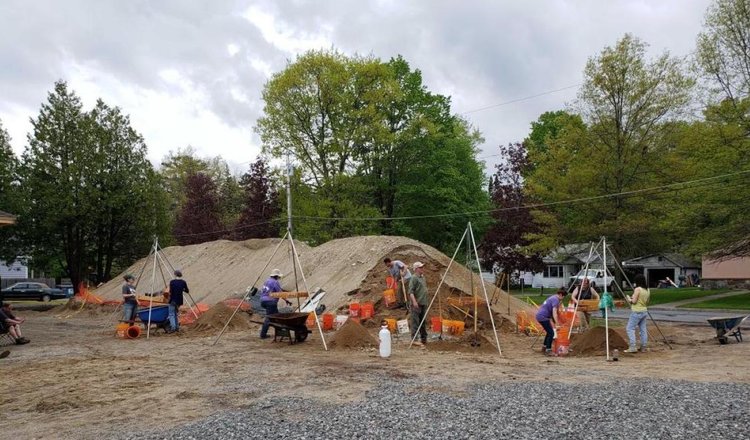
Volunteers excavate a house-sized spoil pile left by the construction crew in Lake George village. A regimental button from the First Pennsylvania Battalion placed this cemetery at the time of the American Revolution. Lisa Anderson, the curator of bioarchaeology at the New York State Museum, will talk about the project on April 12 at a free New Scotland Historical Society program.
To the Editor:
On Feb. 7, 2019, while excavating for a housing development to be built on Courtland Street in Lake George village, numerous unmarked military graves were unearthed and destroyed. The exposed human remains were reported.
This was the beginning of a multi-year effort by Lisa Anderson, curator of Bioarchaeology at the New York State Museum, and archaeologist Charles Vandrei of the Department of Environmental Conservation to recover and analyze these Revolutionary War remains in advance of their planned reinterment at Lake George Battlefield Park.
Going back 250 years, America’s first major offensive operation of the war, the invasion of Canada, was underway. It was a disaster.
Our troops were not only fighting the barrage of enemy soldiers, they were also being ravaged by infectious diseases. In June of 1776, Major General Horatio Gates established a hospital at Fort George to remove soldiers with smallpox and other contagious diseases from the rest of the troops.
Conditions at the hospital were ghastly. By mid-August it was said there were 2,000 sick with 20 to 30 soldiers dying daily. On Aug. 28, a Dr. Beebe viewed the burying place and counted as many as 300 graves. Today, few facts are known of the size and other details of the hospital.
The above information is taken from an article written in 2012 by Russell P. Bellico, professor emeritus at Westfield State University in Massachusetts. Mr. Bellico ends his article by writing, “Further archaeological study at Fort George may yet reveal new details about the hospital during the American Revolution.”
And now this is happening.
At the end of a ceremony held on June 14, 2024 to consecrate the ground at the Lake George Battlefield Park where the remains found in 2019 will be buried, Lisa Anderson remarked, “As our work continues, piece by piece, we hope to be able to tell more of their story — who they were, how they lived, and maybe how they died.”
Lisa Anderson is the curator of bioarchaeology at the New York State Museum. She is involved in repatriation and works with Indigenous Nations, law enforcement, and landowners when human remains are found under the New York State Unmarked Burial Site Protection Act.
As a bioarchaeologist, she is interested in the ethical treatment of human skeletal remains and what can be learned about the lives and experiences of people in the past.
Come and join the New Scotland Historical Association to learn more about this fascinating topic and how it is unfolding. For our April program, Lisa Anderson will speak on “Hallowing This Ground: The Courtland Street Burials and Lake George Battlefield Park.”
This program will be presented at 2 p.m. on Sunday, April 12, at the Wyman Osterhout Community Center in New Salem on 7 The Old New Salem Road. Admission is always free.
The New Scotland Historical Association Museum, with its new exhibit featuring items from the Timothy and Susan Albright Archive, will be open for a half hour before the program.
Judy Kimes
Publicist
New Scotland Historical Association