If we allow our history to be whitewashed, the richness and strength of our nation will disappear
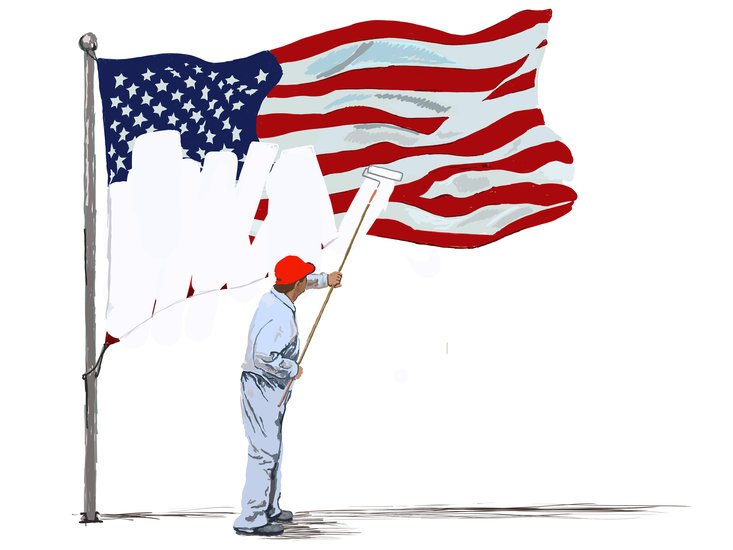
Art by Elisabeth Vines
We first met Mary Liz Stewart in the 1990s when she was teaching in rural Berne-Knox-Westerlo. Her fifth-graders were engaged in original research on slavery in the Hilltowns. Her students also learned about the Underground Railroad in which a network of Americans helped enslaved people to freedom.
She was a teacher who did not view her students as passive listeners; she turned them into active learners.
Mary Liz and her husband, Paul Stewart, founded the Underground Railroad History Project, which purchased and saved from ruin the brick rowhouse on Livingston Avenue in Albany’s Arbor Hill where Black abolitionists Harriet and Stephen Myers had once lived.
Stephen Myers was the editor of The Northern Star and Freeman’s Advocate. “We devote all our time to the care of the oppressed who come among us,” he wrote in 1860.
Over time, the Stewarts’ vision grew, largely supported by volunteers and grants. We wrote about the archeological treasures unearthed in the neighborhood and displayed in the Myers House. We wrote about the programs for youth, the Young Abolitions, and about the many conferences the Stewarts hosted.
The Stewarts planned for a $12 million center to be built next to the Meyers House to serve as an educational and interpretive center.
They arranged to use the salvaged timbers of a 1700s barn — from a farm where slaves had worked — to build an entry to the modern center.
Now, the Underground Railroad History Project has garnered national attention after Lawyers for Good Government on March 20 filed a federal suit on the project’s behalf.
The Washington Post covered the story the day after the suit was filed and other media followed, including national networks.
As we read through the 40-page suit filed by Nina Loewenstein, we remembered a conversation we had with Paul Stewart eight years ago as we sat in the parlor of the Myers House.
He said the Myers residence has a double-barrelled meaning.
“On the one hand,” he said, “it was a refuge for people and also a home for Stephen and Harriet and their children. Their interest was standing foursquare against the federal laws that sanctioned slavery and providing an uplift to the Black people who suffered under slavery.
“Today, it’s about understanding their struggle and it’s a beacon for showing us how we should react to similar kinds of oppression in our world and surrounding us.”
That is precisely what the Stewarts are doing in their lawsuit. They are standing foursquare against our current federal administration while serving as a beacon to stop oppression.
The suit describes the Myers House as “a community anchor in a majority Black, economically disinvested neighborhood” and says the Stewarts’ project “interprets the Underground Railroad movement as a civil rights movement propelled toward social and racial justice … and the people at its center are a source of pride and lessons for contemporary struggles for equality and opportunity.”
The trigger for the suit was the abrupt and unexplained withdrawal of a $250,000 Challenge Grant from the National Endowment for the Humanities, which was to help support the building of the interpretive center.
The suit, filed against the NEH, the Department of Government Efficiency, and the Office of Management and Budget along with two officials, seeks an order declaring the withdrawal of the Stewarts’ grant as unconstitutional, and setting aside the Trump directive that caused the withdrawal.
The suit makes a convincing case that the grant withdrawal violates both the First and Fifth Amendments of our Constitution.
The suit goes over the founding of the NEH, which was established by Congress in 1965 with the statutory mission of reaching underserved populations and supporting diverse viewpoints.
The suit correctly notes that the Stewarts’ plans are closely aligned with NEH’s initiative, “American Tapestry: Weaving Together Past, Present, and Future.”
Shelly C. Lowe, a Navajo woman who chaired the NEH under the Biden administration, said the purpose of “American Tapestry” was to help Americans study, evaluate, and respond to some of the nation’s greatest challenges, among them “sustaining our democratic institutions, building a more just and equitable society, and preparing for and protecting our cultural inheritance from the effects of climate change.”
Lowe stated in her announcement of the new initiative, “As Americans we are the inheritors of a uniquely rich and vibrant history, a magnificent tapestry of diverse cultures, beliefs, experiences, and intellectual movements, bound together by the warp and weft of American ideals of progress and opportunity.”
Lowe resigned in March 2025 at the direction of President Donald Trump.
The suit argues that the Congressional intent in founding NEH “was to ensure that what is now sometimes short-handed as ‘DEI’ and branded by Defendants as illegal and undesirable, would be central to NEH’s mission … This mandate was carried out for 60 years, under Democratic and Republican administrators until upended this past Inauguration Day.”
The suit goes over the rigorous review process that each NEH grant applicant, including the Stewarts, underwent to be selected, concluding that only 16 percent receive funding, representing “the best of the best.”
The Underground Railroad History Project accepted its NEH award in February 2024 and, as required, submitted full environmental assessment and financial review documents by May of that year. Ahead of schedule, in July, the Stewarts certified matching gifts for the first year.
That December, NEH confirmed that “NEH absolutely sees the value of this project and the benefit that it will bring the community.”
NEH communicated nothing further until, on May 14, 2025, it sent an email saying that the offer was being withdrawn and that the decision could not be appealed.
“NEH is repurposing its funding allocations in furtherance of the President’s priorities,” the withdrawal notice said.
The Stewarts’ grant was among 1,477 identified for termination, including dozens related to United States Black history and communities.
“These terminations essentially wiped out all NEH support for Black cultural institutions, and research, education, and programing concerning Black history, terminating 174 grants altogether,” the suit says, naming the two Black history grants that survived.
“None of the forty other remaining grants supported projects relating to indigenous, Hispanic, or other people of color or Native communities,” the suit goes on. “The grants all supported projects relating to largely white male presidents, politicians, writers, scientists, and philosophers, as well as support for historical and educational projects relating to the American Revolution and other aspects of American history, with no references whatsoever to non-white or minority cultures.”
In April 2025, the NEH put out a release saying it had taken steps to “ensure that all future awards will, among other things, be merit-based, awarded top projects that do not promote extreme ideologies based upon race or gender, and that help to instill an understanding of the founding principles and ideals that make America an exceptional country.”
Among the founding principles of our nation is the Bill of Rights.
In addition to the suit’s assertion that, by withdrawing the Stewarts’ grant, NEH improperly ignored the statutory priorities Congress set out for grant-funding, it claims relief because of First Amendment and Fifth Amendment violations.
“The Due Process Clause of the Fifth Amendment prohibits the federal government from denying equal protection of the laws,” the suit notes. “The federal government is prohibited from discriminating on the basis of race …. Defendants terminated hundreds of NEH grants based on their racial content, and the Withdrawal of funding for the Interpretive Center supporting Black Underground Railroad History was yet another expressly discriminatory action.”
The suit goes on to assert, in identifying grants to terminate, NEH and DOGE “systematically targeted grantees and programs that sought to increase the public’s understanding of Black history and cultures” and that the treatment of the Stewarts’ grant “was motivated by discriminatory animus.”
The suit goes on to quote Judge William Young, of the U.S. District Court of Massachusetts, who found pervasive racial discrimination is selecting NEH grants for termination. “I’ve never seen a record where racial discrimination is so palpable,” Young wrote.
The Underground Railroad suit makes a second claim for relief based on violation of the First Amendment, noting that the amendment states the federal government “shall make no law … abridging the freedom of speech.”
The suit quotes a decision from a 1995 case, “discrimination against speech because of its message is presumed to be unconstitutional …. At the heart of the First Amendment’s Free Speech clause is the recognition that viewpoint discrimination is uniquely harmful to a free and democratic society.”
Loewenstein writes, “Defendants have expressly stated that their goal in terminating and withdrawing NEH funding for certain organizations and projects is to eliminate projects that promote their unknown definition of diversity, equity and inclusion — that is, exactly the mission that Plaintiff pursues in being ‘agents of change toward and equitable and just society.’”
The suit goes on, “In an effort to drive views they disfavored out of the marketplace of ideas, Defendants withdrew its offer of funding pasted on URHP’s viewpoint.”
The suit says the Underground Railroad project has “suffered concrete economic and non-economic harm, including loss of funding, loss of funding opportunities, loss of access to federally faded programs and resources, loss of investments, costs of mitigation, diversion of resources, reputational harm, and chilled association.”
Since the executive branch of our government has taken over many functions reserved for the legislative branch — like setting tariffs and declaring war — we rely on the judicial branch to preserve some of the foundational tenets of our democracy.
We hope the United States District Court for the Northern District of New York sees this prejudicial removal of a grant for what it is, a violation of our Constitution in two important ways.
We have watched, over the decades, as the Stewarts have slowly built upon their important work, drawing support from diverse quarters.
Last September, when the Underground Railroad project accepted a state grant, Mary Liz Stewart said, “It’s not just about yesterday. It’s about human rights work that informed the lived work of those who we call abolitionists today but it carries on through history as the first civil-rights movement informing … other works for justice.”
She correctly noted that the same issues abolitionists like the Myerses struggled with — housing, health care, jobs, and education — are still issues today. We need that history to guide and inspire us.
When the center was informed last year that a federal grant has been terminated without cause by the Institute of Museum and Library Services, Mary Liz Stewart told us, “Some days, I turn to Paul and say, ‘It feels like the Federal Fugitive Slave Law and bounty hunters again.’”
But, Stewart went on, she is encouraged by the expanding number of people coming out to protest.
“I tell myself the Phoenix will rise,” she said.
Let us rise up in support of a nation that values the richness of its diversity and history.