Composting: A call to action
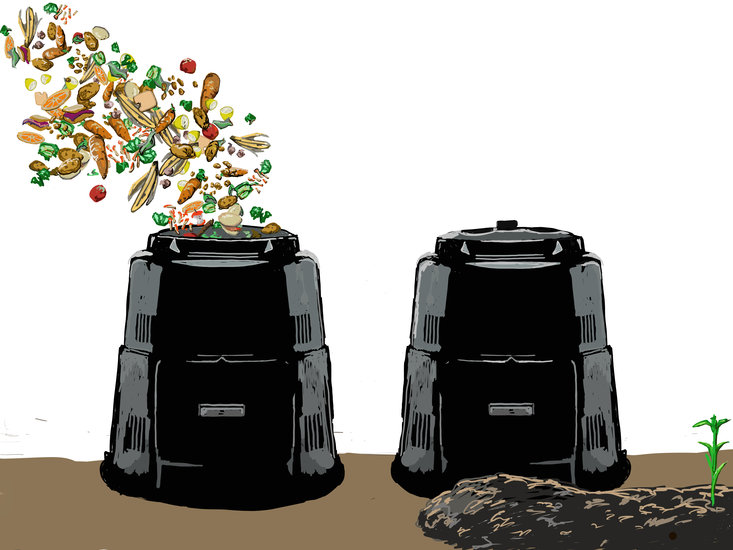
Art by Elisabeth Vines
“The State of the Global Climate is in a state of emergency. Planet Earth is being pushed beyond its limits. Every key climate indicator is flashing red,” said United Nations Secretary-General António Guterres last month as the World Meteorological Organization released its report.
The report found that the Earth’s climate is more out of balance than at any time in observed history, as greenhouse gas concentrations drive continued warming of the atmosphere and ocean, and melting of ice.
When our climate was stable, about the same amount of energy came in from the sun as was reflected back.
That is no longer true.
Greenhouse gases have reached their highest level in over 800,000 years, upsetting the natural equilibrium, the scientists found.
That imbalance is heating up not just the atmosphere but the oceans and the once-frozen areas on earth.
We’ve just lived through the hottest 11 years on record, the report says, as the resulting extreme weather affects millions of people and costs millions of dollars.
And yet we Americans live in a nation being led by a climate-change denier. The overwhelming worldwide consensus of scientists doesn’t matter to Donald Trump who has called climate change a “hoax” and whose administration has dismantled the core tenet of the Environmental Protection Agency — its very name now a mockery.
Although our nation is a major cause of climate change, we have left the Paris Accord and abandoned worldwide efforts to right or at least curb the imbalance we have caused.
We can feel the effects locally. Our reporter Sean Mulkerrin in a front-page story last week detailed the effects of Trump’s memorandum withdrawing off-shore wind leasing areas, directing the Department of the Interior to suspend all permitting.
Albany County’s plans for manufacturing wind towers on Beacon Island — with thousands of permanent jobs projected and thousands more in construction to boot — were cast to the wind.
Meanwhile Trump is opening more federal lands for coal mining and forcing coal plants to stay open — part of his initiative to “revitalize the coal mining industry.”
It is easy to feel helpless, watching from afar as a war is being fought in our name funded with our money that has the transport of oil as a central focus.
A change in our federal government is needed to return to a rational course of action to prevent the further imbalance caused by climate change.
Until then, we call on local governments and individuals to make a difference where we can.
We’re pleased that the town of Guilderland is taking a first step towards a Bronze designation as a Climate Smart Community. Guilderland made the pledge to become a Climate Smart Community in August 2019 but had taken little action in the seven years since.
The pledge adopted by Guilderland in 2019 stated, “The effects of climate change will endanger our infrastructure, economy and livelihoods; harm our farms, orchards, ecological communities, and wildlife populations; spread invasive species and exotic diseases; reduce drinking water supplies; and pose health threats to our citizens.”
This is even more true today than it was seven years ago since the United Nations report has shown for the first time that our Earth is out of balance.
Members of the town’s Conservation Advisory Council have agreed to serve as Guilderland’s Climate Smart Communities Task Force. And Mansi Parmar, the town’s senior planner and GIS analyst, has been appointed as Guilderland’s Climate Smart Community Coordinator.
Parmar wrote to the board, “As expressed in public input during the Comprehensive Plan Update process, the Guilderland community has a desire to mitigate the hazards of a changing climate through resiliency measures coupled with proactive steps to reduce the Town’s collective contribution to climate-warming pollution.”
We’ll be eager to see what those steps are.
Neighboring Bethlehem was named a Gold Town of Excellence this year by the New York State Association of Towns.
“Bethlehem stood out for its environmental leadership, through earning the Climate Smart Communities Silver Certification in 2025, protecting 700 acres of open space over the past eight years (including a 307-acre historic farm and a new 160-acre nature park), and operating a model compost facility that produced 20 million pounds of compost/mulch in 2025 while diverting 850,000 pounds of food scraps from the waste stream,” an organizer of the competition told us.
Bethlehem’s composting program should serve as a model for the other towns we cover. Bethlehem was ahead of most municipalities in developing its food scraps and composting operation a decade ago.
The state’s Department of Environmental Conservation estimates that 40 percent of food in the United States goes uneaten — that’s more than 20 pounds of food per person each month.
In addition to the water and nutrients that are used to produce food that is simply thrown away, wasted wholesome food represents a lost opportunity to feed the estimated 14 percent of New Yorkers who are food insecure, and wasting food waste eliminates the potential to convert this material into energy or useful soil products through composting and anaerobic digestion.
Even if your municipality doesn’t have a program like Bethlehem, there is a simple way that individuals can make a difference — we can compost.
Rather than filling landfills, polluting the Earth and adding to global warming, we can return our organic waste to the earth to replenish it naturally.
The numbers are sobering:
— Every year, Americans throw away 24 million tons of leaves and grass; leaves alone can account for 75 percent of the solid waste in the fall;
— The average American family produces more than 1,200 pounds of organic garbage every year; about 70 percent of the garbage Americans create is compostable;
— Organic waste buried in a landfill releases explosive methane gas, a powerful greenhouse gas that contributes to air pollution and global warming.
Forest Abbott-Lum, the Composter in Residence at the Yale Sustainable Food Program, describes composting — “the managed process of decomposition” — simply, by focusing on a banana peel.
Here she describes the typical way an American would dispose of a banana peel: “You would take organic waste — let’s say it is a banana peel — put it into a garbage bag, seal it off, and then most likely, it would be taken to a landfill or an incinerator.
“If it was taken into a landfill, the banana peel will be buried under hundreds of thousands of tons of other garbage. Trapped under here, the banana peel begins to decompose anaerobically, or without the presence of oxygen. When organic waste decomposes anaerobically, the process releases methane, which is a greenhouse gas that is 28 to 34 times more potent than carbon dioxide.”
She goes on, explaining the alternative, “When you compost that food waste, microorganisms are responsible for breaking it down. As they work, these microorganisms exhale carbon dioxide just like you and I, which is a much less potent greenhouse gas.”
And not only does composting reduce harmful gases, it also enriches soil. And then, once plants grow in that soil, they pull carbon-dioxide out of the atmosphere.
This week, Bethlehem posted a notice that it will be selling compost bins at a reduced price, urging, “Backyard Composting is an excellent way to reduce trash going to landfills, helps significantly address climate change, and allows you to make your own compost!” Orders have to be placed by April 24.
Dan Lilkas Rain, Bethlehem’s recycling coordinator succinctly described the many benefits of composting: “Composting significantly reduces landfill waste and addresses climate change, enriches the soil, holds soil moisture and saves water. It also helps prevent erosion, suppresses weed growth, reduces the need for chemical fertilizers, and offers other benefits. Healthy soils grow healthy food and plants!”
If you’ve read the United Nations report and are feeling frustrated and helpless over our nation’s current role in adding to the imbalance, why not try composting?
Over a century ago, Minnie Aumonier wrote, “When the world wearies and society ceases to satisfy, there is always the garden.”
So there’s that; you may find solace and some peace of mind in working the earth.
But now, we are facing more than a weary world; we are confronted with the world’s ruination.
We shall end where we began and perhaps know the place for the first time.
“Humanity has just endured the eleven hottest years on record,” said United Nations Secretary-General António Guterres. “When history repeats itself eleven times, it is no longer a coincidence. It is a call to act.”