DEC looks to regulate PFAS in sewer sludge while bill proposes statewide moratorium
The Enterprise — Michael Koff
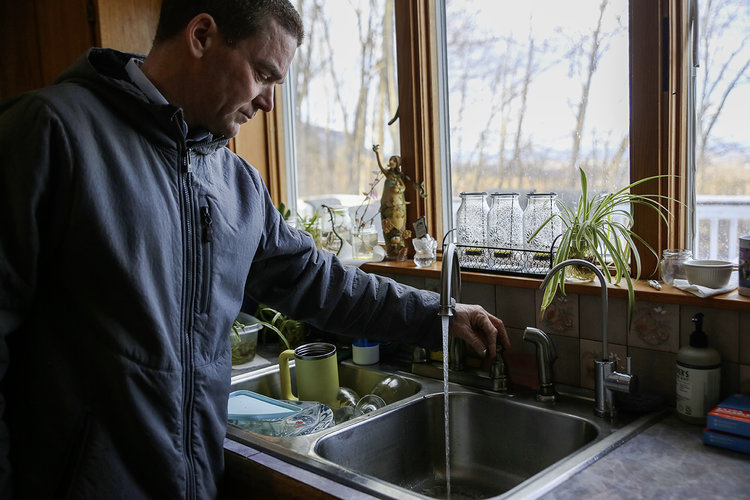
New Scotland resident Ryan Dunham is once again able to drink the water from his well after it was contaminated by sewer sludge.
ALBANY — In the face of federal inaction, the New York State Department of Environmental Conservation is looking to impose limits on the amount of cancer-causing compounds in biosolids.
Biosolids are a byproduct of the wastewater treatment process. Residential, commercial, and some industrial operations send wastewater to water resource recovery facilities — New York has just over 600 such facilities, ranging from small rural plants to large urban operations — where the sewer sludge undergoes processing to reduce harmful bacteria, viruses, and other contaminants with the goal of making it safe to use as an agricultural fertilizer, soil conditioner, or compost.
Close to 70 percent of the state’s biosolids end up in a landfill, according to the DEC; just 16 percent is considered “beneficial use,” meaning recycled, while the remainder is set aflame.
The DEC does not dictate how a municipality manages its biosolids — those decisions are made locally based on cost, sustainability practices, hauling logistics, plant size, and other factors.
Researchers have found that these municipal-filtered wastes contain heavy metals like lead and mercury, numerous pathogens, and perfluoroalkyl and polyfluoroalkyl substances (PFAS), so-called forever chemicals.
The DEC, shifting from interim program policies, recently initiated the formal rulemaking to incorporate PFAS management into existing solid waste regulations.
“As we know, there hasn’t been enough federal action to control PFAS contamination, but that’s not stopping New York from taking the necessary steps to protect public health and the environment,” Molly Trembley, an environmental engineer with the DEC’s Division of Materials Management, said during a recent stakeholder meeting about how the department intends to regulate PFAS in biosolids.
“DEC is moving forward regardless, trying to tackle PFAS across all environmental media,” Trembley said.
The state’s earlier promotion of biosolids led a number of municipalities to adopt bans or moratoria.
Albany County is currently under a moratorium on biosolids, first established over a year ago, after the application of biosolids on a cattle farm in New Scotland raised questions about water quality in Bethlehem, because of the farm’s proximity to the Vly Creek Reservoir. The reservoir is in New Scotland but supplies Bethlehem’s drinking water, and roughly 760 New Scotland residents get water from the reservoir as well.
Last December, the Guilderland Town Board adopted a six-month moratorium “on the sale or use of biosolids.” Chief among the board’s concerns was protecting the Watervliet Reservoir, located in a rural part of town, which serves as Guilderland’s major source of drinking water.
The local push around biosolids began with New Scotland resident Ryan Dunham, who lives across the street from a farm that had been fertilized with manure, causing no issues. Last year, biosolids were applied,which polluted his well water and that of his neighbors; the county health department found both coliform and E. coli in the wells.
“Once you walk into the bathroom and see your daughter taking a shower in raw sewage essentially, it changes you,” he told The Enterprise this week.
Dunham has remained active in advocacy, responding, “I don’t want that ever to happen to anyone else,” when asked why he’s continued to champion the cause.
Dunham said once spraying of the PFAS-infused biosolids stopped, his water returned to normal within weeks and the bacteria cleared, but added that he did install a reverse osmosis system as a precaution.
“You live 21 years across the street from a farm field, they spray manure, you have no problems, and then all of a sudden, they spray this other stuff and you immediately have a problem,” he said. “Once they stop, everything goes back to normal. You can draw some pretty adequate conclusions about what caused it and how to remediate it.”
Pollutant and soil concentration limits
The proposed regulations introduce thresholds for both biosolids material and soil at the application site.
Under state regulations, there are two defined categories of biosolids:
— Class A biosolids are treated to a level where pathogens are virtually undetectable, resulting in products that have a wider range of permissible end uses like compost or heat-dried pelletized products; and
— Class B biosolids have significantly reduced but still potentially detectable pathogens and are subject to stricter “site management strategies” like buffer zone requirements and limitations on public contact, both of which are meant to minimize environmental and public health risk.
Under the DEC’s proposed new rules, all biosolids — meaning both Class A and B — must meet a concentration limit of 20 parts per billion (ppb) for perfluorooctanoic acid (PFOA) and perfluorooctane sulfonate (PFOS).
When it comes to maximum soil-concentration limits at land-application sites, the DEC says 1.5 ppb for PFOA and 3 ppb for PFOS would be acceptable.
The figures, it was noted during the stakeholder meeting, are an established baseline PFAS level derived from a Division of Environmental Remediation study that sampled hundreds of uncontaminated sites in rural areas across the state, and showed no associated groundwater contamination at the 1.5 ppb and 3 ppb levels.
Agricultural prohibitions
The DEC is proposing rules related to which activities can occur on fields receiving biosolids:
— No food crops intended for human consumption may be grown on agricultural fields where biosolids are applied;
— Livestock grazing will be entirely prohibited on Class B land application sites; but
— Growing livestock feed crops such as corn and hay would be permitted.
Site life and municipal solid waste
One part of the framework the DEC is looking to implement is a concept the agency calls “site life,” a calculation that effectively treats farmland the way regulators treat contaminated remediation sites, tracking how much PFAS a field can absorb before it becomes dangerous.
To calculate, operators take the PFAS concentration in their biosolids, multiply it against the application rate — typically five to ten dry tons per acre — and factor in whatever contamination already exists in the soil. The result tells operators how many years a given field can keep receiving biosolids before it breaches the 1.5 or 3.0 parts-per-billion soil thresholds.
Getting to that threshold requires two tests: Every field would undergo annual soil sampling, while on the production side, treatment facilities would have to test their biosolids for 40 PFAS compounds.
But even before the product hits the field or leaves the manufacturing facility, the DEC, rather than simply regulating what leaves the wastewater treatment plant, is proposing facilities with biosolids exceeding 20 parts per billion launch a “track down” program that would involve quarterly sampling of influent and effluent over a full year to identify contamination sources.
Shortcomings
Dunham called the DEC’s proposed rulemaking “a step in the right direction,” but said it falls short.
Under the proposed rules, Dunham said, the farm field across the street from his home would still be eligible to receive biosolids because the crops being grown on site are feed crops for livestock, which would be allowed under the proposed rulemaking.
Dunham added later, “If you are spreading biosolids and your cattle are eating it and then you sell the cattle for meat … — which is exactly the situation across the street from me — then people are still ingesting these forever chemicals. So in that way, their policy really does not make a lot of sense to me.”
He also said the proposed regulations fail to account for large waste haulers that purchase land solely to dump biosolids, and do not address the impact on people who rely on private wells near application sites.
“Or what about public water sources?” he asked. “What about quality-of-life issues for those people that live near those fields?”
Proposed legislation
Dunham said he’d like to see a five-year moratorium on the use of biosolids, “because I think the state needs to figure out how many farmers were told that they could spray this stuff and there were no adverse effects,” but it ended up ruining “their land and their livelihood. How many people have their wells contaminated but don’t know it?”
Dunham supports a proposed biosolids bill from Assemblywoman Anna Kelles, and was recently among a group of speakers who appeared at the state Capitol at the invitation of Kelles, when she gave a presentation to fellow legislators on the issue.
The legislation would impose a five-year moratorium on the land application and commercial sale of biosolids across the state. The prohibition would extend beyond cropland to parks, golf courses, and other non-crop applications.
The bill states that, once a quarter for one year, soil at every current and recent biosolid application site, drinking water wells within a half-mile of those sites, and surface water within one mile would be tested. Wastewater treatment facilities would test their biosolids quarterly for the full five years.
The legislation also proposes that, within 18 months of enactment, the DEC must build and maintain a public database of all PFAS testing data collected under the bill.
The legislation’s second major component would create a program to provide grants to farmers and landowners whose land exceeds PFAS thresholds. The money could be used for alternative cropping systems, remediation strategies, technological adaptations, transitions to alternative revenue streams including alternative land use, and costs associated with locating viable replacement farmland.