Guilderland adopts moratorium on sale or use of sewage sludge
Enterprise file photo — Sean Mulkerrin
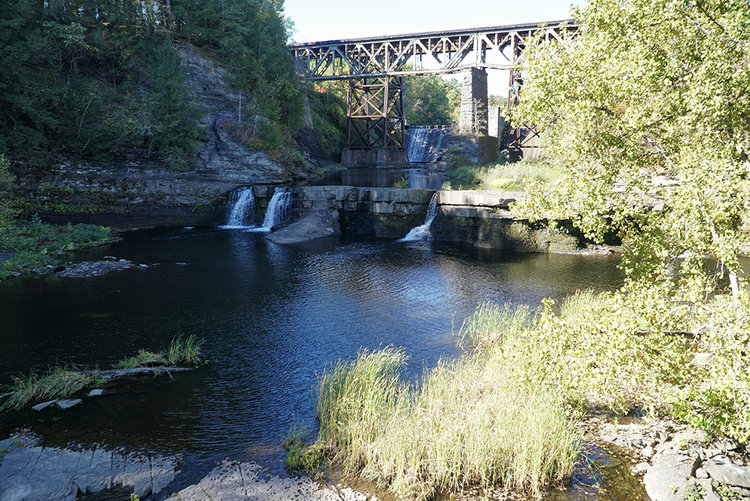
The Watervliet Reservoir, Guilderland’s major source of drinking water, will be somewhat protected by a new moratorium on biosolids but Supervisor Peter Barber said he is particularly concerned about the effect the sludge could have on the reservoir if it were used within the watershed, such as in Duanesburg or even more distant Schoharie.
GUILDERLAND — By unanimous vote, the Guilderland Town Board on Dec. 2 adopted a six-month moratorium “on the sale or use of biosolids.”
The moratorium, which goes into effect once it is filed with New York’s secretary of state, can be extended for up to another six months.
Caitlin Ferrante, who chairs the town’s Conservation Advisory Council and who works as the Conservation and Development Program Manager for the Sierra Club’s Atlantic Chapter, inspired the legislation and spoke at length in support of it at Tuesday’s public hearing.
The only other speakers were Ryan and Laura Dunham whose New Scotland property was polluted by biosolids applied by a farmer with a field across the street from their home.
On Jan. 27, Albany County Executive Daniel McCoy issued an executive order halting for 90 days the agricultural use of biosolids within county limits, extended that order for 180 days until Oct. 24, and then extended it for another 180 days from Oct. 24.
While biosolids have been used to fertilize farms for years, recent research has raised concerns about health and environmental issues.
For decades, America’s farmers were encouraged by the federal government to spread on their land inexpensive fertilizer from sewage-treatment facilities. But now, a growing body of evidence claims to show that yearslong use of dried-up human waste can be toxic.
While New York state continues to promote recycling, some municipalities have enacted bans on the use of processed sewage to fertilize farmland.
This municipal-filtered waste, known as biosolids, researchers claim, contains heavy metals, like lead and mercury, numerous diseases, as well as perfluoroalkyl and polyfluoroalkyl substances, PFAS, the so-called forever chemicals.
Supervisor Peter Barber said that, as more communities impose moratoriums, “The word gets spread.”
Acknowledging that, while Guilderland was included in the county’s moratorium, Barber said “A lot of times, people don’t follow what the county does.”
Barber said that he isn’t aware of anyone “improperly disposing of biosolids, but it only takes one, and you can have a devastating impact upon water quality and upon, you know, basically our environment.”
Barber said he was particularly concerned about the effect the sludge would have on the Watervliet Reservoir, Guilderland’s major source of drinking water, if it were used within the watershed, such as in Duanesburg or even more distant Schoharie.
A number of municipalities have taken on the state, imposing their own bans on biosolids, even as Governor Kathy Hochul has proposed an ambitious plan to recycle 85 percent of all waste in the state — which has a current rate of about 20 percent — by 2050.
Neither the county nor the town has imposed a ban; rather, both have moratoriums, causing a pause in the use of biosolids.
While the wording for the town and county moratoriums are similar, discussion on the county moratorium has focused on the application of sewage sludge to farmland while the Guilderland board also discussed sales at stores and use by home gardeners.
Albany County’s moratorium stipulates that a verified complaint will trigger an inspection from the county’s health department; Guilderland’s moratorium does not have this stipulation.
“No person or entity shall sell, offer for sale, apply, offer to use biosolids or compost derived from wastewater treatment for residential, agricultural, or commercial purposes and land in the Town,” Guilderland’s law says.
For a violation, Guilderland’s law implements a fine of not more than $2,000 per day, which is double the county’s fine.
Environmentalist’s view
Ferrante told the board that biosolids “have been marketed as an affordable fertilizer alternative to farmers and sold as compost in big-box stores to home gardeners. But evidence shows sludge-spreading puts rural communities, surface and groundwater, and food systems at serious risk.
“The sludge often contains a wide range of harmful contaminants including PFAS, forever chemicals, microplastics, industrial solvents, pathogens, and pharmaceuticals, none of which are fully removed through current treatment processes,” she said.
Ferrante noted there are currently no enforceable levels for PFAS in sewage sludge spread on farmland. “Despite the New York DEC [Department of Environmental Conservation] identifying biosolids as a source of emerging contaminants, the state continues to promote land application of these materials in its solid-waste management plan,” Ferrante said.
She noted that Maine was the first state to ban the use of sewage sludge as fertilizer after high PFAS levels were found in farmers’ blood.
Ferrante also spoke of the federal Environmental Protection Agency releasing in January a draft risk assessment for two forms of PFAS in sewage sludge, “determining that spreading it on lands may create human health risks for those near impacted sites or who rely primarily on their products, including food crops, animal products, and drinking water.”
“Is that recent EPA or old EPA?” asked Barber, alluding to the EPA gutting its core principles under the Trump administration.
“It’s old EPA,” responded Ferrante, adding, “They haven’t retracted that report …. They just haven’t finalized the report under the current administration.”
She said that some red states — naming Texas and Oklahoma — “are looking to address biosolids.”
Ferrante also noted that a bill that would place a five-year moratorium on spreading sludge on land in New York had passed in the State Senate but not in the Assembly.
“While we wait for the state to take action,” Ferrante said, “Guilderland can ensure we are working to protect our open space, farmland, and watersheds within our town boundaries.”
She went on, “We have seen in our own neighboring communities of New Scotland and Bethlehem what can happen when sludge is spread, including contaminated wells, impacts to larger drinking water supplies, etc.”
She said she hoped, with Guilderland passing a moratorium, “it’ll put pressure on some other more local communities to do something similar,” Ferrante said, naming New Scotland and Bethlehem.
“Why wouldn’t they just do it?” asked Barber.
“It could be essentially just an education issue … Once people learn about it, they want to take action,” said Ferrante.
She added later that municipalities are concerned with the cost of hauling the waste to landfills if it can’t be spread.
“We argue that there are potentials for cost to municipalities if you have to treat the water supply or if you do contaminate land …,” she said. “We also don’t want to create superfund sites around the state, dirty water that no one wants to drink, and farmland that you can’t farm.”
Ferrante concluded, “We haven’t been seeing much traction in terms of a nationwide push so that’s why we’ve been trying to focus state by state.”
Board views
Councilwoman Amanda Beedle asked if there is a list of entities in town that sell biosolids. Ferrante responded she could provide a list of what ingredients a consumer should look for when buying a bag of compost to avoid buying compost that includes sewage sludge.
Beedle added, “We’re on a moratorium but I’d like to see a ban because this is not just impacting us here now; it’s the future generations of the town.”
Beedle also asked if there was any recourse for a neighboring town not complying and affecting Guilderland’s water supply.
“I think it would put a lot of pressure on our representatives to pass something statewide,” said Ferrante. “To say, ‘Hey, if this local community isn’t going to protect what’s happening in our watershed, the state needs to take action.’”
Barber said he had spoken to a manager of a farm-supply store in Guilderland and reported, “They basically know that, if they were to sell something that was contaminated, they would be responsible so … they’re trying to keep that stuff out of their stores; they’re trying to buy from clean sources whatever clean sources might be.”
Later, after the Dunhams spoke, Beedle asked if the town should implement some kind of application process, as is used for pesticides, so that neighbors of a farmer using biosolids would know it was being spread on the land.
“I’m not sure how we would even know if they’re going to violate the moratorium,” Beedle said. She surmised, “If they don’t even know that we’re having this conversation tonight about a moratorium, and they’re like, ‘Oh, were going to go business as usual’ and go spread it.”
“I think this is a good first step ….,” said Deputy Supervisor Christine Napierski. “We do have a fine in place for enforcement.”
“But how do you know who to fine if you don’t know who’s spreading?” asked Beedle.
“The stuff that was spread across the street from us came from Massachusetts,” said Mr. Dunham. “And it was purposely trucked in and unmarked. And then, when we inquired about it, we were told it’s very difficult to trace permits from out of state. That’s what EPA told us and basically put up a brick wall.”
The DEC in response to questions posed by The Enterprise in March said in a statement, “Currently, there are no DEC permits issued to facilities to perform land application of Class B biosolids in Albany County and DEC has no records of issuing permits to facilities to perform such applications. Some out-of-state biosolids products with an approval to distribute in New York State were distributed in the county in the past.
“If a finished Class A biosolids product (compost, heat dried/pelletized material, etc.) comes in from out of state, DEC requires distributors to meet New York’s stringent requirements.”
Mr. Dunham went on, telling the town board on Dec. 2, “Once they spread this stuff, all of a sudden there’s these weird algae blooms in the Bethlehem reservoir. And then they discover there’s PFAS in the reservoir.
“Well, we live 380 feet above the reservoir … The United States Geological Survey concluded that, when you spread biosolids, if you live in a porous region or a karst region … think about Thacher Park … the water just goes straight down with the contaminants and travels much further than we previously thought.”
“Everything changed”
Laura and Ryan Dunham, whose well was contaminated by biosolids, which The Enterprise earlier documented at length, closed out the public hearing.
The Dunhams with their two children live at 2920 New Scotland Rd. near Thacher Park across from a farmer’s field.
“The farmer would spread manure a few times a year. It would smell bad for a few days. Life would go on,” said Mr. Dunham. “He needs to make a living. Last year, everything changed.”
Ms. Dunham described a smell so awful she had no words to describe it, nothing to compare it to. “It was so foul and sour …,” she said, “like there’s something in the air; it’s not right.”
The smell was coming from the field, she said, where the Dunhams observed “a pile of something dark; it kind of looked like wood chips, but not really,” she said.
They couldn’t open their doors or windows; the smell clung to their children even at school. “It just permeated our home and our family,” said Ms. Dunham.
Their daughter saw brown water as she showered and called her parents upstairs. “I said, ‘Ryan, this smells like outside,’” Ms. Dunham recalled.
The Dunhams called Cornell Cooperative Extension, which confirmed it was sewage sludge, she said. The health department then tested their well and found both E. coli and coliform levels at 200 times what is safe from the EPA, she said.
The Dunhams shocked their well five or six times with chlorine, replaced all the filters “all at our own expense,” Mr. Dunham said, and the levels, since no more biosolids have been spread, have “gone back to normal.”
Six out of 10 wells in the neighborhood also tested positive, Ms. Dunham said. “This number has now risen to 10 wells and it just was really scary because, when we researched biosolids and everything that goes along with it, it’s you know cancer, infertility —
Her husband picked up, mid-sentence, where she left off: “Liver issues, inability to heal from surgery.”
He went on, “It’s a horrible feeling — my daughter being in the shower is singing Taylor Swift and I’m thinking about what is she ingesting? What heavy metals are in her body? What’s going to happen later down the road in terms of kidney failure or cancer?”
Mr. Dunham worries that the state won’t pass the moratorium or the county may lose its political will.
“It’s up to the towns of New York to take action,” he said. “It’s up to the people to show from the bottom up that at a grassroots level the state needs to take care of this issue.”
Mr. Dunham said he planned to take a copy of Guilderland’s new law to New Scotland’s supervisor and say, “What gives?” He envisioned telling him, “They have the foresight a town over and it actually happened here and we haven’t done a thing.”