DEC hosts virtual meetings on PFAS, seeks public comment
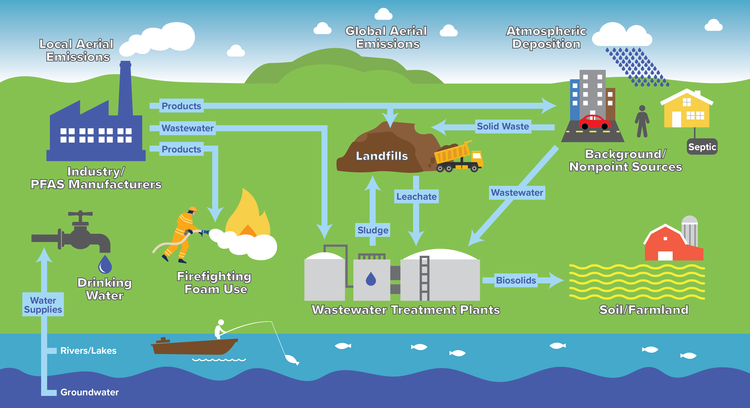
— Graphic from NYSDEC
Sources of PFAS, which can contaminate soil, groundwater, surface water, wildlife, and people, are illustrated by the state’s Department of Environmental Conservation.
The state’s Department of Environmental Conservation is hosting a series of virtual meetings about its efforts “to protect, educate, and assist New York communities in addressing the ubiquitous threat of per- and polyfluoroalkyl substances known as PFAS.”
PFAS are a class of human-made chemicals that were widely used in various consumer, commercial, and industrial products since the 1940s. These chemicals are resistant to heat, oil, stains, grease, and water.
PFAS were also historically widely used in large commercial and military applications, including firefighting foam, and continue to play a role in some industrial processes. PFAS do not readily break down naturally in the environment, remain in the human body for a long time, and have been linked to a range of health effects.
The webinars will focus on the PFAS Rural Background Study, treatment of landfill leachate, wastewater treatment guidance, sampling of PFAS in biosolids, and drinking-water policy.
The Rural Soil Background Study found results in New York similar to other Northeast states, with PFOS (Perfluorooctane Sulfonic Acid) detected in more than 97 percent of surface soil samples and PFOA (Perfluorooctanic Acid) detected in 76.5 percent.
The DEC has drafted an updated policy to require sampling and analysis of soil products produced from biosolids — recycled sewage sludge — such as compost and heat-dried products.
The state’s promotion of biosolids led a number of municipalities to adopt bans or moratoria.
Albany County is currently under a moratorium on biosolids, first established a year ago, after the application of biosolids on a cattle farm in New Scotland raised questions about water quality in Bethlehem, because of the farm’s proximity to the Vly Creek Reservoir. The reservoir is in New Scotland but supplies Bethlehem’s drinking water, and roughly 760 New Scotland residents get water from the reservoir as well.
As the name suggests, biosolids are the solid leftovers of the wastewater treatment process that can be “recycled” through their use as fertilizer. However, they are also known to contain many substances harmful to human health, like lead, mercury, pathogens, and PFAS.
Last December, the Guilderland Town Board adopted a six-month moratorium “on the sale or use of biosolids.” Chief among the board’s concerns was protecting the Watervliet Reservoir, located in a rural part of town, which serves as Guilderland’s major source of drinking water.
For decades, America’s farmers were encouraged by the federal government to spread on their land inexpensive fertilizer from sewage-treatment facilities.
The federal Environmental Protection Agency proposed new drinking water standards for six PFAS chemicals in 2023, marking the first new federal drinking water standards since 1996. The EPA under President Joseph Biden finalized the rule in April 2024.
Since then, the finalized rule has been challenged in court, and the Trump administration has communicated that it intends to delay enforcement and rescind parts of the rule, according to a report released this month by the Rockefeller Institute of Government.
In the required cost-benefit analysis for the new rule, the EPA estimated the cost of implementing the rule at $1.548 billion to $1.631 billion annually.
The EPA modeled the health benefits of the rule as resulting in an estimated 1,302 fewer infant deaths, 9,645 fewer total deaths, and 29,872 fewer nonfatal cases of disease (including heart attack, stroke, cardiovascular disease, and cancer) over 80 years.
Based on those projections, the EPA estimated the total quantifiable savings from the health benefits would be $1.549 billion annually.
The Trump administration announced in May 2025 that it would delay enforcement of some of the restrictions until 2031 and rescind regulations on the other PFAS chemicals in the rule, the institute report notes. Consistent with this intent, the EPA filed a motion in September 2025 to vacate parts of the PFAS drinking water rule and no longer defend them.
“As the legal and political future of federal PFAS drinking water regulation remains in flux,” the Rockefeller Institute report says, “states may step in to further protect their residents and provide greater certainty.”
“Governor Kathy Hochul’s State of the State outlined a number of key priorities for protecting New York’s environment, including the development of new regulations to address PFAS contamination and protect New York communities,” DEC Commissioner Amanda Lefton said in a release from the department, promoting the public meetings.
“Public input is critical to the success of the state’s ongoing progress,” Lefton said, “and we encourage New Yorkers to participate in upcoming opportunities to help guide these important efforts forward.”
Hochul’s 2026 State of the State address directed the DEC to develop draft regulations to instruct landfills to treat leachate for harmful contaminants at the source before discharge and to provide funding for local governments to comply.
Development of regulations to treat landfill leachate at the source will better protect the environment, drinking water sources, and save taxpayers millions in future cleanup costs, the DEC says.
The DEC is drafting regulations that will instruct landfills to treat leachate for harmful contaminants at the source before discharge to wastewater treatment plants and will provide funding for local governments to comply.
Information sessions specifically about the leachate initiative are scheduled for Jan. 27 and Feb. 11.
In December, the DEC issued a suite of new actions and resources to assist New York communities in addressing the threat of PFAS contamination.
This includes a progress report detailing the state’s leadership in addressing PFAS; a study detailing the widespread presence of PFAS on the landscape; wastewater-treatment-plant guidance that protects drinking water and other surface waters; proposed policies directing the DEC’s actions in PFAS investigations and sampling of biosolids products; and a webpage – dec.ny.gov/pfas – about these and other initiatives.
These topics and the leachate initiative will be addressed at the Jan. 29 information session being held in cooperation with the state’s Department of Health.
The DEC is also hosting a virtual webinar on Feb. 4 outlining the rulemaking process to draft a proposal regulating PFAS in recycled biosolids to determine the long-term management processes and standards related to biosolids-derived soil amendments.
Details and registration for each meeting are listed here: bit.ly/3LOnOYx