DEC says: Stay alert for bird flu
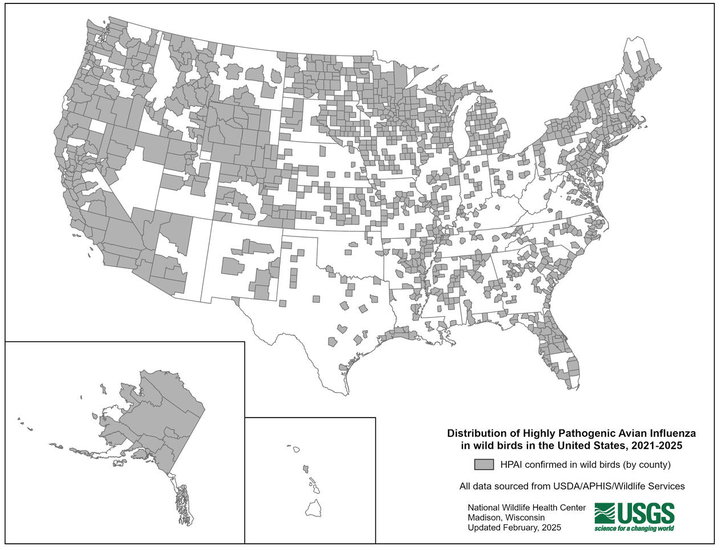
— Map from usgs.gov
The National Wildlife Health Center has mapped the counties, including Albany County, across the United States where confirmed cases of Highly Pathogenic Avian Influenza, known as HPAI, have occurred from 2021 to 2025.
While the risk to humans remains low, the state is urging New Yorkers to be vigilant about cases of bird flu, which typically increase during winter months.
Albany County is mapped by the National Wildlife Health Center as one of the many counties — including all but a small swath in central New York — as having confirmed cases of Highly Pathogenic Avian Influenza, known as HPAI, from 2021 to 2025.
Kevin Hynes, a research scientist who heads the DEC’s wildlife health section, said in a recorded interview that “cold winter temperatures preserve the virus and keep it viable.”
The current strain, H5N1, is “very virulent” and is spread in the saliva and feces of water fowl, Hynes said; H5N1 came “down from Canada” into the United States in 2022.
The virus is carried by free-flying waterfowl and other waterbirds, such as ducks, geese, and shorebirds, but can also infect domestic poultry, raptors, and corvids as well as mammals.
Birds that scavenge, like eagles, hawks, and vultures, pick up the disease from dead water fowl and spread it, Hynes said. With climate change, birds that typically migrated south for the winter are often now staying in New York state, he said.
“You can’t tell by looking at the birds,” said Hynes, to see if they are infected. Birds and animals carrying the disease may show no symptoms at all, he said, or may show signs of respiratory distress like sneezing or nasal discharge; lethargy; neurologic malfunction like ataxia, stargazing, or seizures; diarrhea; weakness; or sudden death.
“Unfortunately, it seems to be going into mammals, which is pretty concerning,” Hynes said, but the current strain “does not seem to go into humans from causal contact,” he said.
So far, only about 70 cases of humans contracting H5N1 have been documented, he said; two of those cases were fatal, according to a release from the state’s Department of Environmental Conservation.
The people infected with H5N1 were either cleaning out infected poultry farms, Hynes said, or were farm workers milking infected cows.The symptoms for both sets of workers, he said, were "fairly minor”: the poultry-farm workers suffered flu-like upper-respiratory symptoms while the dairy workers suffered from conjunctivitis.
There is no evidence yet, Hynes said, that the virus has gained the ability to spread from person to person.
The DEC is advising the public to avoid any contact with sick or dead birds and mammals that may be infected with virus and says there is no way to contain infection in wild birds.
However, the DEC’s Wildlife Health Program is monitoring the spread and impact of the virus throughout the state and has an online reporting tool New Yorkers can use to report suspected HPAI mortalities: NYSDEC Avian Influenza Reporting Form.
Updates on HPAI may be found on the Cornell Wildlife Health Lab website.
In November and December 2025, the DEC received 69 reports of suspect mortalities through its online reporting platform, and presumptive positive cases were detected in wild birds in 10 counties. With migration beginning, HPAI incidence may remain high through spring, the DEC says.
At this point, the DEC reports, the virus is widespread in wild birds and even suspected to be present in counties where it has not yet been detected. Species of wild birds confirmed as infected in New York state commonly include the snow goose, Canada goose, swans, other waterfowl, bald eagle, red-tailed hawk, other raptors, crows, and shorebirds. Songbirds and other passerine birds do not appear to be highly susceptible to infection.
In addition to wild birds, HPAI has also been confirmed in red fox, striped skunk, Virginia opossum, raccoon, fisher, gray squirrel, muskrat, and bobcat in New York state, the DEC says, and in a wide range of mammals, particularly carnivores, in other parts of the U.S. In addition to domestic poultry, dairy cattle in other states have also been infected.
The state’s departments of Agriculture and Markets, Health, and Environmental Conservation “are working together to ensure an aggressive, coordinated, and proactive approach in response to outbreaks of HPAI across the nation,” said State Agriculture Commissioner Richard A. Ball in the release.
“Our department’s proactive efforts to prevent the spread of HPAI,” Ball said, “including implementing testing and import requirements for dairy cattle, remain in place. In addition, as we are in the midst of the migratory season, we encourage vigilance and remind our farmers to take precautionary measures with strong biosecurity practices on the farm.”
While New Yorkers are encouraged to report dead birds and animals they suspect may have succumbed to the virus on the online registry, whether or not DEC staff will respond depends on the severity of an outbreak, Hynes said.
The reporting is nevertheless useful, he said, even if the carcasses aren’t removed for testing.
If a person finds a dead bird or animal and suspects the cause is bird flu, Hynes advised wearing gloves and eye protection while triple-bagging the carcass and then putting it in with household trash for delivery to a landfill.
Since there is no treatment for HPAI, the DEC advises against transporting suspected HPAI-infected birds to wildlife rehabilitation facilities to prevent the spread of the disease to other animals in care.
The state’s health commissioner, James McDonald advises New Yorkers to “stay safe by avoiding contact with sick or dead birds and animals and reporting anything unusual.”