Why does the amphibian cross the road? To mate on the other side
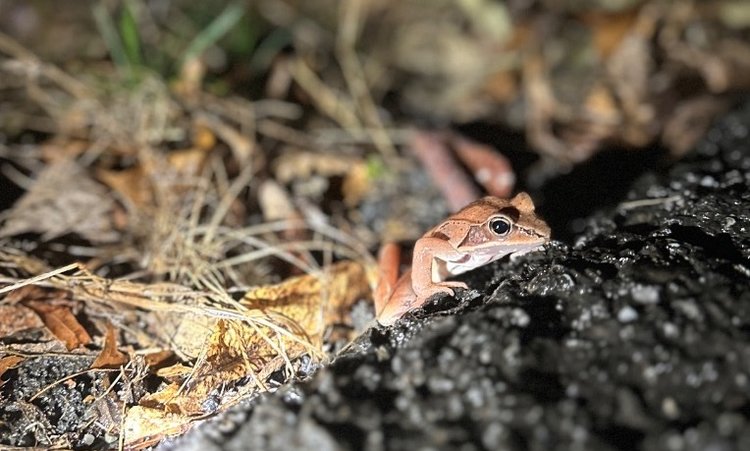
— Photo from NYSDEC
A wood frog climbs onto pavement.
Warmer temperatures and rain have spurred the start of annual migrations of amphibians that breed in vernal pools.
Throughout the Hudson Valley, Amphibian Migrations and Road Crossings Project volunteers are surveying roads to safeguard frogs and salamanders who cross roads to mate.
As the climate changes, amphibians are changing their migration patterns.
Just as maple sap used to run in early to mid-spring, so too did amphibians migrate from the forest to vernal pools to mate.
Now the sap runs at the end of winter just as the amphibians migrate then.
Not only that but, as Laura Heady explains in a video put out by the state’s Department of Environmental Conservation, there used to be what was called a Big Night each year, when amphibians would migrate in explosive numbers.
Now, Heady says, with erratic weather patterns, the migrations, too, are sporadic and spread out over several nights. Heady is a biologist with the DEC’s Hudson River Estuary Program, which runs the Amphibian Migrations and Road Crossings Project in collaboration with Cornell University.
More than 1,000 volunteers have participated in the effort since 2009, helping to move an estimated 51,000 salamanders, frogs, and toads safely across roads, according to the DEC.
Al Breish who lives in New Scotland, and has retired from his job as New York State’s amphibian and reptile specialist, spoke to The Enterprise about the value of salamanders soon after his book, “The Snake and the Salamander,” was published in 2017.
Although each salamander is no more than four inches long and many people have never seen one or heard of one, Breisch said, “They are a driving force for the entire food chain. It eats many small invertebrates and is eaten by snakes and robins and turkeys.”
Breisch’s book cites studies showing that, without the red-backed salamander to eat decomposers like earthworms, much of the leaf litter on the forest floor would be gone, causing drying and erosion and potentially changing the character of the forest.
In late winter and early spring, amphibian species like wood frog (Lithobates sylvatica), spotted salamander (Ambystoma maculatum), and Jefferson-blue spotted salamander complex (Ambystoma jeffersonianum x laterale) emerge from underground shelters in the forest and head to vernal pools for breeding.
Vernal pools are small, temporary wetlands that serve as critical breeding habitat for these amphibians. The pools hold water until summer, so the adult amphibians must gather, breed, and deposit eggs early enough to ensure their aquatic young can hatch, grow, and leave the pools before they dry up.
Due to their importance, vernal pools were added to DEC’s recently expanded freshwater wetlands protections.
The timing of migration is weather-dependent, with concentrated activity on the first rainy nights of the season when the ground is thawed and night air temperatures remain above 40 degrees Fahrenheit.
This year, migration started slowly in the first week of March, with a bigger night of migration documented by volunteers on March 11, when scattered rain fell in the Hudson Valley and evening temperatures were above 60 degrees Fahrenheit.
On March 11, the DEC reports, at least 125 volunteers surveyed roads from the Lower Hudson Valley to the Capital District, contributing more than 50 hours of survey time and assisting more than 1,650 amphibians across roads. On the next warm, rainy nights, the DEC expects more salamander and frog species will be migrating.
Volunteers’ role
Volunteers document road locations where they observe migrations in the Hudson Valley, record weather and traffic conditions, and identify and count amphibians on the move.
Volunteers also carefully help the amphibians safely across roads. Between 2009 and 2025, volunteers have documented 20 species and counted nearly 58,000 live amphibians and more than 25,000 migrating amphibians killed by passing vehicles.
Species reported most frequently during migration nights include spotted salamander, wood frog, and spring peeper (Pseudacris crucifer). To a lesser degree, volunteers also observe Jefferson-blue spotted salamander complex and four-toed salamander (Hemidactylium scutatum), two species of conservation concern in New York.
Safety is paramount, the DEC says, and project volunteers are advised to take all necessary precautions. Volunteers are strongly encouraged to wear reflective safety vests and headlamps to increase visibility on dark roads and not interfere with passing vehicles.
Amphibian safety is also important, and frogs and salamanders should be handled carefully with clean, wet hands, free of hand sanitizer, lotion, and other substances that can be toxic to amphibians’ porous skin.
With such a large geographic area to cover, the project benefits greatly from the support of local partners who assist, the DEC says, with coordinating volunteers in their communities. This year, local partners include the Albany Pine Bush Preserve Commission and John Boyd Thacher State Park.
For more information, including a short video about amphibian migrations, visit DEC's website. The DEC held in-person and virtual training for volunteers in February with 131 participants.
New Yorkers interested in volunteering to participate in this Hudson Valley project are encouraged to watch a recording of the training on YouTube and read the Volunteer Handbook.