Archive » October 2025 » Columns

One of the most interesting changes I experienced when I moved to Altamont more than 30 years ago was getting the mail. Up until that point, I had always had a mailbox on the house so the only time I ever went into a post office was to buy stamps or mail a package. Suddenly, I had to visit the post office every day to get mail, and it turned out to be a really great change.

In a place like Altamont, the post office is more than just a government office; it becomes a social hub, meeting place, and unofficial clubhouse. It also gives you a very different view of dealing with government employees.

Most of us go to the DMV, Social Security office, IRS, and can’t wait to get away. The people you run into are strictly doing a job and, while they may be professional (or not), the whole interaction is fast, not always fun, and makes little long-term impression on you.

But at the Altamont P.O., you get to know the people on the other side of the counter, and that’s a good thing. Over the years, I have seen a steady stream of really nice folks working in our post office.

They greet you with a smile, handle your transaction with professionalism and ask how the kids/spouse/cat/dog/parents are doing. They may commiserate about the weather, your favorite sports team, or a shared movie or TV show. And the folks behind you in line may get in on the conversation too. Overall, it’s a nice place to spend a few minutes of your day.

As time has marched on, things have changed in some ways. The overall volume of mail we get has gone down due to things like electronic bills and banking, the cost of mailing going up, fewer companies sending out catalogs, and of course, email in all its nefarious forms.

And yet, our courteous P.O. folks continue to deliver the best service they can despite all the changes. But that may not last. There are more than a few clouds on the horizon of the USPS. It seems late-stage capitalism and greed are gunning for the USPS.

According to the American Postal Worker Magazine:

Project 2025 seeks to undermine this expectation of efficiency and expertise in public services by dismantling the Federal Government and reinstating Trump’s 2020 “Schedule F” Executive Order. This would allow the ruling administration to reclassify many civil servants as policymaking or policy-evaluating workers, thereby removing their civil service protections and making them at-will employees. President Trump could then install whomever he pleases based on favoritism and loyalty to his administration.

Furthermore, in the long run, this practice could effectively dismantle public trust and efficiency in government services, letting billionaires like Donald Trump and Elon Musk make the case for a privatized, capitalistic government that profits off its citizens, instead of a government that exists to uplift workers and our communities.

I’ve never understood the philosophy of “running government like a business.” The basic truth is that government is not a business and is here to protect, aid, and assist the people who elect our government representatives.

The postal service does, in fact, support itself, for the most part, and certainly does not cost us anything near what the military, corporate welfare, or tax breaks for billionaires are soaking us for. But with oligarchs looking for more ways to bankrupt our country to steal even more than they’ve already stolen, the idea of starving functional government agencies and then “rescuing” them through privatization has become quite popular.

The current regime has been actively destroying things like the Department of Education, Health and Human Services, NOAA (the weather folks), the Food and Drug Administration, the CDC and FEMA.

In each and every case, they install incompetent department heads (RFK Jr. is a prime, worm-ridden example), decry the vast destruction of a once functional department, and then miraculously come up with a solution that involves hiring some billionaire’s company to take over the function of the former government agency and run it like a business.

However, let’s remember that in 2025 the current head of the regime is a 34-time convicted felon who has been barred from even running a charity in New York state, bankrupted casinos, was sued and lost over his fake university and has pretty much failed at every business he has ever run. In other words, not someone you want to run a business, or choose others to do so.

But, beyond that obvious issue, is the ongoing campaign by billionaires to take over and run things for profit that were never meant to be for profit. Take education as a prime example.

In Albany County we once had around a dozen charter schools whose prime job was to suck off as much money from the public-school budget and transfer it to corporate coffers. At least five have closed because they utterly failed their unfortunate students who were so badly “educated” they couldn’t pass a standardized test.

The truth is, school vouchers, charter schools, and brick-and-mortar “home schools” are all just dodges to steal money from public education and, at the same time, weaken the schools, which results in ignorant, uneducated people who are easier to control and lie to. Just look at places like Alabama, Arkansas, Louisiana, and Florida where test scores rank near the bottom of the barrel.

Another area the billionaires are going crazy for is private prisons. Just take a guess at where the hundreds of millions of dollars spent on Alligator Alcatraz (Auschwitz) ended up. Yup, in the pockets of billionaires who donated to the regime. It was their payoff.

And even though that concentration camp was closed by a judicial order, many of the kidnap victims remain unaccounted for and the companies behind the crime are now off to other red states to build new concentration camps without even a whisper from the mainstream media.

If you remember, former president Biden made it a point to take private prison companies out of the federal prison system due to widespread abuses and many complaints of horrible conditions and needless deaths. The private-prison industry is basically a horror show with little to no oversight because most people feel that anyone in prison deserves to be there, even though The Innocence Project and similar programs continually free wrongly convicted prisoners across our vast, racist nation.

If you doubt any of this, please note the results of a recent Internet search:

CoreCivic and GEO Group are the largest private-prison companies that have been building and expanding U.S. Immigration and Customs Enforcement (ICE) facilities, with other companies like LaSalle Corrections and Management and Training Corporation also operating ICE-contracted facilities. These companies are reopening old prisons and adding new beds in various locations, including Delaney Hall in New Jersey, and have been awarded new or expanded contracts with ICE.

The bottom line is that this is what the regime and its oligarch backers have in store for the USPS. The current postmaster general is David C. Steiner, who was appointed in July of 2025. Previously he was chief executive officer of Waste Management and a member of the FedEx board of directors. Not exactly a guy with years of granular experience in the USPS, but certainly a rich guy with ideas about privatizing the organization.

He replaced a guy named Louis DeJoy who was put in place during the previous version of the regime and who had a billionaire background in the shipping industry and was accused of trying to destroy the USPS, though his tenure was mixed overall.

I hope our P.O. survives and the fine civil servants who staff it keep their jobs, but I’m worried and you should be too. The regime is hellbent on destroying our government to profit from it, not serve the public.

Under a private P.O., you can expect fewer hours, incompetent staff, higher prices, and erratic service, at best. That’s not about through rain and sleet; it’s about getting a billionaire another yacht on our dime. 

Editor’s note: Michael Seinberg says he has always enjoyed getting the mail and chatting with the people at the Altamont PO. The only thing he likes better is petting strange dogs.

Editor’s note: The scribe is under the weather this week so we’re running a never-before-printed column on the Sept. 30 breakfast and hope he is shining like the sun again soon.

SLINGERLANDS — Thirty-seven degrees this morning. That just about tells you all you need to know about the weather.

 We did manage to arrive at the Windowbox Café on time and were greeted by Bob, the owner, outside looking at the classic, very early 1950s, Hudson automobile. So we stayed outside with him. Bob is also the chief cook and bottle washer; as long as he was outside, he wasn’t inside cooking anything for anybody!

But it sure was nice to take a moment to appreciate this fine old classic car. The OF who owns it had it so clean and shined up it would glow in the dark!

We did go inside; we made Bob get back to work against his wishes. We said hello to the other OFs who were already there and our waitress brought the ever-present coffee, and the conversations about old cars and engines versus new cars and engines started right away. As usual.

Another OF arrived on his motorcycle so naturally a new conversation promptly started about motorcycles. Of course the first conversation didn't stop or even slow down; the noise level just went up some more.

About that time someone commented about the brand new Corvette sitting out in the parking lot. Yup, another conversation started going about even bigger, faster sports cars (and the price tags that go with them) which of course got the OFs with their classic sports cars in which you must wear the classic English  “Flat Cap,” or, if you are in Ireland, you would call it a “Paddy Cap.”

By the way, the Flat Cap originated in northern England. The things you learn while at breakfast with the OMOTM is amazing.

Boat-ramp

challenges

To change the subject entirely, even abruptly, without warning or even with an appropriate segue to ease this column’s transition from cars and motors old and new, all the way to observations witnessed at a local boat launch this weekend. I happened to be at the boat launch to help a fellow OF take his pontoon boat out of the lake.

There are some jobs that simply require more than one person to accomplish. This was one of those times.

If there is only one of you, how can you get both your truck and boat trailer to the boat launch and your boat there at the same time? If you drive your truck and trailer first, then you are faced with the prospect of getting back to your boat, which is across the lake and at the other end.

Or, if you bring the boat to the launch first, you must find a way to go get the trailer, which, of course, is across the lake at the other end. You must have a second person to either drive the boat to the launch, or drive the truck and boat trailer over to the launch. Or, if you are going to do all the driving of both boat and truck, you need someone to at least provide your transportation from place to place.

OK, now that we have all the players at the boat launch, it is time to actually put the boat on the trailer and go home. This is where the fun and games start to happen. Or rather, this is when we start to separate the men from the boys, or the rookies from the pros.

Exactly, how good are you at backing that boat trailer straight down that boat ramp? At some point at this particular boat ramp, you lose sight of your trailer because it is going down the ramp and you are still up high on level ground. All you can see in your mirror, or out the back window, is air and the water in the distance. No trailer. 

If you are a rookie, about now is when someone is yelling at you to stop backing up because your boat trailer is now in sight at a right angle to your car or truck. They are telling you to go forward and start over again.

If you are lucky, after you have tried a couple of times, a nice person will ask if they could help you. Now is the time that you swallow your rookie pride and quickly say, “Yes! Thank you!” and get out of the way. 

The next question you have is, “How far does the trailer go into the water?”

Never mind, the guy backing the trailer down the ramp knows.

Then comes, “How do I line this boat up with the trailer and then get the boat all the way on?” Winch? What’s that? How does that work? You mean I have to get wet?

Don’t worry if there is a line starting to form, waiting for you to get your boat out, and not all of them are smiling. A couple of them will step forward and offer to help, and your response is the same as before, “Yes! Thank you!” and get out of the way.

In short order, your boat is securely on the trailer and up on dry level land and those nice people are telling you not to worry.

They are saying, “Don’t worry, we have all been there, every last one of us. We are not rookies now, but each and every one of us was a rookie at one time or another and we are laughing at our own memories, not of what just happened to you.”

You can laugh at yourself next year, or maybe when you get home today. 

By the way, the OF and I got his boat out in a matter of minutes. After all, we are not rookies, we are the OMOTM, and pros at the boat ramp!

More boat ramp stories in the future, but it is time for the attendance list: Harold Guest, Wally Guest, Ed Goff, Roland Tozer, Wm Lichliter, Jim Austin, Pete Whitbeck, Frank Dees, Russ Pokorny, Chuck Batcher, Gerry Chartier, Lou Schenck, Jake Herzog, Pastor Jay Francis, Elwood Vanderbilt, Bob Donnelly, Dave Hodgetts, Alan DeFazzio, Henry Whipple, Gerry Cross, Jack Norray, John Jaz, Dick Dexter, and me.

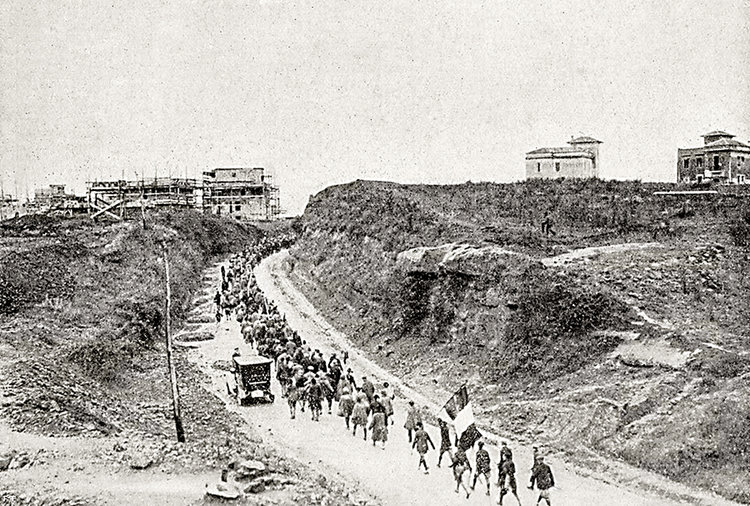
The Fascist March on Rome, Oct. 28, 1922, led by Benito Mussolini.

For Jimmy Kimmel

On Oct. 28, 1922, more than 30,000 black-shirted paramilitary fascists — the Italian word is squadristi — under the leadership of Benito Mussolini marched into Rome to take control of the capital of the Italian nation.

Historians refer to the insurrection as “The March on Rome,” which seems to have been a harbinger of the mob attacking the Capitol of the United States on Jan. 6, 2021.  

Two days after the take-over, the Italian King Victor Emmanuel III — with the support of the social elites of the nation, the corporate world, and the military — ceded power to Mussolini. On Halloween, the dictator formed a government that soon became the one-man-rule of il duce.

In her profile of Signore Dux, in “Fascist Spectacle: The Aesthetics of Power in Mussolini’s Italy,” cultural sociologist Simonetta Falasca-Zamponi says the dictator saw himself as “God’s elect;” a “savior;” a homo unus — the one and only who could help Rome be great again.

Was that not a harbinger as well of what was broadcast across the United States in 2016 when the country’s current president said he was going to save America because “I alone can fix it;” and in November of the following year, when the cult personality of homo unus was solidified, added: “I’m the only one that matters.”

After taking control of the capital — Italy’s legislators having folded like a house of cards — Mussolini turned to his propaganda tsar, the “philosopher of fascism,” Giovanni Gentile — officially the Minister of Public Education — and ordered him to soak every Italian kid in every school in the nation with the hose of fascist doctrine.

He wanted under his control every Italian kid when he turned 6 until he reached 16, because he knew, by then their veins were plump with totalitarian Newspeak.

Gentile’s treatise “Manifesto degli Intellettuali del Fascismo” “The Manifesto of Fascist Intellectuals,” served as a blueprint for the political and ideological underpinnings of Italian fascism. The idea was to get control of the big minds, the smart guys, and have them work on the hoi polloi below.

The work is a justificatory rationalization for the black-shirted guards of the National Fascist Party (PNF) using violence against those who refuse to submit to psychological debasement.

In a section called “Fascism and the State,” Gentile reminds the reader that a “victorious Nation was now on the path to recovering its financial and moral integrity” and by “recovering” he meant MRGA “Make Rome Great Again.”

In no time, the curricula in schools were ablaze with fascist lingo. British writer Anthony Rhodes, in “Propaganda: the art of persuasion, World War II” (Wellfleet Press, 1987) says, “very soon, at least 20 percent of the curriculum in the elementary schools had been revised in this sense, teaching the adolescent from very early days his duties as a Fascist citizen.” 

When the school-day started, the kids joined in on the “Giovinezza,” the national anthem of the Italian National Fascist Party, the PNF, Partito Nazionale Fascista.

Its refrain is:

Youth, youth,

Spring of beauty,

In Fascism is the salvation

Of our freedom.

At the university level, students were “urged” to join Gruppi Universitari Fascista, if they hoped to get somewhere in life. ¿Entiende?

As the totalitarian disease spread across the nation, the citizenry were forced to retreat to their minds for emotional support—as Orwell says people did in “Nineteen Eighty-Four”—and as many Americans in the United States are doing today for psychological relief.  

If a picture is worth a thousand words, a movie is worth a million and no director has put more millions on the big screen addressing the insanity of fascism than Federico Fellini.

He hits its coercive socialization in the face in “Amarcord,” his big-screen portrayal of him growing up in Rimini, a small town on the Adriatic coast.

Amarcord is dialect from the Romagna region where Rimini is located and means “I Remember.” 

Thus, every frame of the memoir-driven jewel has the maestro shooting off Roman-candle images of every kind of person you can imagine living in a small town in 1930s Italy.

Fellini told potential viewers to keep their eyes peeled for the part when a fascist government official, a federale, comes to town and rouses the locals to march like soldiers in double-time-step and sing songs honoring the very power enslaving them; he said the scene is “the central, irreplaceable, indispensable episode” of the movie.

The artistic genius of “Amarcord” was duly acknowledged by the film world by being awarded the 1973 Academy Award for Best Foreign Language Film. It’s on the top-10 list of untold thousands — cineastes and otherwise — and close to the top of mine. 

Though the film is filled with humor and an irony that reaches the heart, there’s sadness in seeing Rimini’s pedagogues, the Latin, Theology, and Science teacher at the local school — practitioners of the old-time rote method of learning, unaware of the lives of the young men before them — donning black shirts and pants and goose-stepping boots to show the federale how much they loved kissing the emperor’s ass.

For more than a decade I’ve told members of my memoir-writing group at the Voorheesville Public Library to view “Amarcord” and use it as a rod to measure how well they extricate truth from the past and put it down on paper with clarity. So far, all I’ve heard is crickets.

Mussolini encouraged acts of intimidation, ordered beatings and the breaking of bones, even murders. Anyone who blinked the wrong way, they said, was subject to the manganello (the billy club) and castor oil.

Castor oil? As “Amarcord” progresses, the black shirts drag a local into headquarters for questioning — an older family-man, a brick-layer-cum-foreman — and accuse him of having thoughts contrary to the regime.

To force the sorry soul to come clean — no pun intended in any way — they force castor oil down his throat, a personally-denigrating torture Mussolini’s black-shirted employees used to embarrass infidels by causing them to lose control of bodily functions.

Remember: Castor oil is a powerful laxative.

Thus our oil-soaked brick-layer-cum-foreman didn’t get past the front door before messing his pants and suffering the humiliation the fascists sought to achieve.

It was the [crazy] Italian poet Gabriele D'Annunzio who introduced the regime to castor oil, as well as to the fascist salute, and black shirts, and balcony speeches, and other forms of drama made to force the ethically insecure to cave. Some say D'Annunzio was Mussolini’s John the Baptist.

Fellini said understanding fascism was no big thing: it derives from “a provincial spirit, a lack of knowledge of real problems and the rejection of people, whether out of laziness, prejudice, greed or ignorance, to give their lives a deeper meaning.”

He said “Fascism and adolescence …  [were] permanent historical phases of our lives. Adolescence is of our individual lives; Fascism is of the national life: [the desire] to remain, in short, eternal children.”  Pueri aeterni.

No matter what level one has reached in knowing the basics of history, no one has not heard of the saying: When we fail to pay attention to the evil our forebears did, we pay double because we repeat the same evil by becoming it incarnate.

The Oregon-based American novelist Chuck Palahniuk has rued, “If you watch close, history does nothing but repeat itself. What we call chaos is just patterns we haven't recognized. What we call random is just patterns we can’t decipher. What we can’t understand we call nonsense. What we can’t read we call gibberish. There is no free will.”  

To translate such dystopian talk, I turn to our beloved national treasure, Mr. Pete Seeger — blacklisted for espousing beliefs under another regime — in his 1955 American classic “Where Have All the Flowers Gone?”

In the somber tone of a Greek chorus he inquires:

When will you ever learn?

When will you ever learn?
MIDDLEBURGH — I have no idea if the OMOTM’s ride to the Middleburgh Diner witnessed another beautiful sunrise or not on Oct. 7. I was asleep — finally. Sometimes even the wise ol’ Men of the Mountains do some stupid things. Like wearing out. We forget who we are. We are the OMOTM, emphasis today on the word “old.”

Yes, old, not young. Old folks just physically cannot do what young folks can do. We kid ourselves sometimes by saying things like, “I can still do that, maybe for not as long as I used to, but I can still do it for a while.”

Part of that faulty thought process is the total lack of consideration given to those three little words, “for a while.” Define that.

It makes no difference what we used to do in comparison to what we did 50 years ago. If we worked in an office and never broke a sweat (unless we were nervous) or if we labored outdoors doing heavy lifting hour after hour, we just cannot do at 80 years old what we used to when we were 30 years old.

Sure, the guy doing the heavy, strenuous, sweaty work was always stronger than the pencil pusher, but can he do it now? Not a chance. Can the pencil pusher put in three or four consecutive 20-hour days meeting a deadline? Nope, not anymore.

But we forget those facts, and when we do, there is a price to pay. Always a price to pay.

My daughter and son-in-law bought me an electric lawn mower a couple of years ago. It is really nice and light (and quiet) and does a fine job mowing the lawn.

Except I have to push it! It is not self-propelled like the mower I was using.

Now, in fairness to everyone, what’s the terminology that is always used today? “With full disclosure” or something like that, the old mower was a really heavy, noisy, gasoline-powered, self-propelled piece of equipment that should have found its way to the junkyard long ago.

Not only with all those negatives going for it, the self-propelled part of that mower did, in fact, leave for the junkyard for defunct self-propelled lawn mower transmissions a long time ago. The only time I did not have to help (read push) this old heavy mower was when it was going downhill on the driveway!

The new electric mower is so light, I can hang it up on the wall. Much, much better. Still, pushing it around mowing the lawn for the best part of an hour, takes its toll on my own self-propelled transmission, my legs.

Then off I go to an OMOTM breakfast, followed the next evening by a Kiwanis meeting, followed by a hearing-aid appointment. (I don't think they were all that interested in tweaking my existing hearing aids as they were in selling me new very expensive ones — not going to happen.)

Then I found out that an old friend from high school and an Albany area businessman had passed away. That kind of makes us OFs take pause and do some reflecting. Takes a little something out of us that is not coming back. We truly are diminished each time it happens.

A little humorous side to that is that, for a couple of years now, I have been successful in my efforts at losing some weight, the results of which is now manifesting itself with my sport coats looking like tents on me! So off I went to Albany to have some major alterations done! It will be ready in time.

Then I went to see the optometrist because my eyes are killing me. They hurt. They are itchy, scratchy, blurry and I have trouble seeing the words I type clearly on the monitor or when I’m reading a book. After a while it wears on you. 

The optometrist gave me a script and said my eyes would feel much better in two days. He was right, I am two-and-a-half days into a five-day program and my eyes are, in fact, much better.

Did I mention that I got a flu shot and my COVID shot at the same time as all this was going on? I did. I have never had any kind of a negative reaction from these shots and I have had them together before. I don’t even get a sore arm.

So I really don’t know where I got the tired-out, sleepy, weak-as-a-kitten legs that didn’t want to work, eyes that couldn’t see, ears that couldn’t hear, being sad about friends no longer here, clothes that don't fit, but I do have my OMOTM friends!

After a totally terrible night’s sleep on Monday night, the last thing I remember was looking at the clock at 6 a.m. and thinking how happy I was that the OF I car pool with was not in town because he is on a family vacation and therefore I didn’t have to pick him up. So I smiled and said to myself, “Not day OMOTM, not today. Mother Nature has shut me down.”

The next thing I knew, it was two or three hours later and the phone was ringing. One of the OFs I work closely with each week was calling to check up on me and to tell me he had the attendance list and would email it to me.

He told me I was the topic of conversation. I can imagine what was being said; “Where is he? Is he sick? He is not where he usually sits. Is he OK? What do we do with the attendance list? Who’s gonna write the OMOTM column? (That one is easy to answer, get John Williams!)”

Those OFs who mixed concerns about me and concerns about breakfast at the Middleburgh Diner were Harold Guest, Wally Guest, Ed Goff, Miner Stevens, Roland Tozer, Wm Lichliter, Pete Whibeck, Jim Austin, George Washburn, Duncan Bellinger, Jamey Darrah, Gerry Cross, Jack Norry, Lou Schenck, John Jaz, Herb Bahrmann, Pastor Jay Francis, Al Schager, Frank Dees, Russ Pokorny, Warren Wilsey, Gerry Chartier, and not me.

Not too long ago, my wife and I were out for a walk and, as we went down Schoharie Plank Road, I turned and saw a deer staring at us. He or she (too early in the season to tell) was standing in a shredded, destroyed section of land that will eventually become another road to a housing development nobody wants or needs.

The trees were ripped from the ground; the earth was torn up and even the weeds were dead. The deer stood in the middle of the devastation and stared at me with a look that said, “Hey man, what the hell?!” And I didn’t have an answer for him really.

We’re living through what has been termed late-stage capitalism and it’s pretty much like a form of Stage 4 cancer that’s ripping through our country and our planet. I read an observation recently from an American ex-pat (a smart person who left the country to live in a saner place) who returned and observed that virtually every aspect of American life is now for sale.

Words and phrases such as side hustle, monetize, grind culture, and ROI (return on investment) now routinely enter conversations that take place everywhere from school playgrounds to street corners.

Every inmate, er — citizen, is now desperate for ways to maximize output, capitalize on time investment and basically squeeze every possible cent out of every action and waking moment. Why?

Two reasons, I think. One, the cost of everything has been rising faster than my blood pressure every time I turn on the news. And at the same time, billionaires have made it a point to keep wages as flat as possible. Ironic in that CEO salaries are now 280 times the average worker whereas they were more like 20 times in the 1970s. So, they keep stealing from us and raising prices and we must keep trying to find ways to make more money to simply survive.

The second reason is because many people have bought into the big lie that the true ambition for all Americans is to be rich. And that is truly an insidious lie constantly pushed by the mass media, social media, movies, TV shows, and popular culture that glorifies wealth and materialism as the ultimate form of human achievement. I call bull excrement on that one.

Look at life in Altamont. Folks who have chosen to live here generally appreciate the lack of traffic, general level of quiet, and focus on community. It’s a pretty, little village set in a lovely space surrounded by green and the Helderbergs in the distance. 

But in the 30 years I’ve lived here I’ve seen several greed-driven trends change things rather for the worse. Much of the green space that forms a buffer between us and the vast, endless hellscape of suburban Builderland is being eaten away as rapacious developers tear up the land to build ever more ugly McMansions on once virgin land (hence the angry wildlife).

That has led to our water/sewer bills going higher even as our water quality drops due to high demand from all the new homes. If the plan to bring us water from Builderland’s water system succeeds, I suspect we’ll be lost forever.

Perhaps the only possible benefit to us getting water from the town might be a lowering of our bills and less manganese in our water. But I’m not holding my breath. A lack of water is all that’s keeping the monsters at bay.

The other problem besides needless land rape is the increase in rents by greedy landlords who like to blame rising taxes but are really driven by the “passive income” trend that drives rent up. In the old days, landlords usually based rents on the cost of owning the home, taxes, upkeep, and so on and thus rarely exceeded the 30 percent of gross income that has always been accepted as reasonable.

Now, it’s all about maxing out the rent to max out the passive income. Add to that billionaires buying up rental properties and residential homes to rent them out at over-market rates and you have a recipe for disaster.

I spoke to a young woman who works as a public-school teacher in New York City and got her apartment in a lottery. Her current rent is upwards of $3,000 per month. It’s not that crazy in Altamont yet but rent on a simple one-bedroom apartment can easily exceed $1,200 per month.

All this greed isn’t good for anyone. We’ve created a society that isn’t livable, sane, healthy, or sustainable. But for the psychopaths at the top, none of that matters because they own everything. And they’re so mentally ill and insulated from reality that, unless we radically revamp our tax system and identify them as what they are, mentally ill wealth hoarders and thieves, we’re doomed.

We live on a small planet with finite resources that we all must share and if a tiny group of financial predators controls most of those resources, we’re screwed. The system they have created is based on limitless growth on a planet that can’t sustain that. If things in Altamont and things on the planet keep on careening forward at this rate, our children and grandchildren won’t have a livable planet, and rent will be $12,000 for an outhouse.

The lie that development and progress are good for everyone is wearing thin. I think a permanent moratorium on new nonaffordable housing is in order. Also, no one person should be able to buy up large chunks of contiguous real estate like what has happened in the center of the village.

We all share the planet; we all need to really share it equally. Allowing wealthy people to control our lives and our village life simply because they have enough money to buy real estate makes no sense in the long term. 

I don’t want to have to explain to random deer why their habitat has been destroyed so one old white guy can buy another sports car. That’s not why we’re here folks. We’re here to live decent, sustainable lives in a way that leaves the village and the planet better than we found it.

I don’t want to have to explain to my granddaughter why she can’t live her life in Altamont if she chooses because the whole village was sold off to condo developers.

Life isn’t about he/she who dies with the most toys wins. Real life is about living a life that enriches you and those around you spiritually, psychically, physically, and emotionally. Keep your yachts, Porsches, McMansions, and portfolios folks; I’m going for a bike ride in the woods while there are still trails left.

Editor’s note: Michael Seinberg says he was born genetically opposed to greed as religion.

Unlike a lot of folks, I can remember way, way back. I can even remember my very first birthday party. We lived in a tiny apartment in Williamsburg, Brooklyn. The birthday cake is what I remember so vividly.

It was round, with white frosting and blue and yellow icing. It had a little round train track on top, with a little train on it. What little boy wouldn’t remember that? Best birthday ever.

There’s another early memory I have that is not so good. I was around 4 at the time. I made the mistake of telling my parents that I hadn’t pooped in a week. I had no idea this simple admission would become such a big deal.

My parents were very laissez-faire in their parenting style. As long as my brothers and I weren’t playing with fire or knives or killing each other, we could basically do what we wanted. That’s why I was so blown away by what happened next.

My father comes home from work, and next thing I know we’re all in the tiny bathroom. He has a bag with him. In it is a pink rubber bladder of some sort. After filling the thing with water, he hangs it from the shower rod. There is a long plastic tube hanging from the pink thing.

The next thing I know the tube is inserted into my rectum and I start screaming, screaming, screaming at the top of my lungs. I had no idea at the time that anything this bizarre and evil even existed in the world.

So much for my first and only enema. I don’t know what happened later, but they never did it again so it must have worked.

Despite the fact that humans can achieve all sorts of fantastic feats in the worlds of science, sports, the arts, and so much more, we are still all just animals, albeit ones with high intelligence (although if you read the news you may not believe that most of the time).

We have to find suitable food stuff to ingest on a regular basis, extract all the nutrients, and then excrete the waste products. We have to do this so often it’s kind of hard to believe we have time to get anything else done.

All of history is the story of figuring out how to get enough food and how to handle the waste. Read about New York City in the early 1800s before the city got sanitary infrastructure in place, when horses were the main method of transportation. It wasn’t pretty and it must have smelled just terrible.

I’m bringing all this up now because recently I found out I needed to have not one but two enemas. Talk about a pain in the rear! What happened was my doctor noticed that my PSA (prostate specific antigen) level was slowly getting higher. This happens to all men as we age.

So it was determined I should have a prostate biopsy just to be safe. That meant first having an MRI ( magnetic resonance imaging) scan – my old friend, not. Before the scan and the biopsy, I would need to have an enema. Hooray!

My first step was to the pharmacy to buy the enema. Have you ever noticed how people get all quiet and sad and look down in deep concentration when they shop in the pharmacy? I mean, who wants their neighbors to see them pricing out enemas or adult diapers or hemorrhoid cream, ouch.

Soon I was able to find a two-pack of Fleet enemas. Honestly, I had no idea what this product would cost. I mean they could have said it cost $100 and I would have believed it; what do I know about enemas?

I must have gotten “lucky,” as the two-pack was only $2.89. At this point, I should buy a case and resell them on eBay for $10. I could call myself The Enema Man. My theme song could be “Lookin’ Out My Back Door.”

Wouldn’t you think all the “action,” as it were, involving an enema would take place on the toilet? That’s what I thought, but I was wrong, as usual. According to the instructions, you are supposed to lie on the floor on your left side and slowly — yes, slowly — insert the enema while “pointing it at the naval.” I mean, you can’t make this stuff up.

As I got ready to do this horrible thing to myself, I decided to try adding a little music to the otherwise very depressing milieu. But what kind of music do you play during an enema? Never thought about that before.

It couldn’t be pop, because what if “How Deep is Your Love” came on? Ouch! It couldn’t be opera or classical. Those are too dignified for such a disgusting act. Then I thought it would have to be the blues. I mean, if sticking something so invasive up your butt isn’t the blues, then what the heck is?

But in the end — no pun intended — I went with the Sirius/XM “Outlaw Country” channel, “coming to you live from Mudlick, Kentucky,” as they loudly proclaim all the time. I figure between Outlaw Country regulars Willie Nelson, Kris Kristofferson, Waylon Jennings, and Johnny Cash there must have been a few enemas. Good company to be in.

When the appointed time came, I laid down on my left side and, ahem, inserted the appliance into my rectum. Then I squeezed the bottle. The instructions said, at this point, to wait until you feel a bowel movement coming on before moving.

At this most intimate and delicate time, these are the thoughts that came to me:

— If there is a benevolent creator who loves us, why didn’t He make it so there wouldn’t even be a need for enemas in the first place? Come on, man;

— If I’m supposed to lie on the floor filled with poop solution until I feel the urge to go, what’s the chance I won’t have an accident before even making it to the toilet?;

— Why, for crying out loud after all these years, doesn’t the Capitol District have a zoo, an IKEA, a Wegmans, a Stew Leonards, and a White Castle, to say nothing of a decent pastrami sandwich?

When I finally made it to the toilet, I found that the product did indeed work, but not all at once, if you know what I mean. You need to sit there and bide your time until the tsunami subsides. In any case, I’m glad I was able to get it over with, and do it all by myself.

My wife offered to help, but she’s put in her time over the years, so I gave her a pass. In fact, she reiterated to me to just man up and take it because many people deal with a lot worse on a regular basis, and to be glad that at least I never had to go through childbirth. Point taken.

There’s a reason men aren’t made to have children, obviously. For me to go throw something like that I’d need a fifth of Jack Daniels and some Cuban cigars, just to start. And that’s before conception; can you imagine after?

On “Seinfeld,” nutty neighbor Kramer had to have an enema. When he was asked how it went, he said it was “wet and wild.” He nailed it for certain.

Having to self-administer an enema is, literally, a pain in the you-know-where. On the other hand, I’m glad my doctor is looking out for me. And now you’ll have to excuse me. I need to go find a soft spot to sit down on.

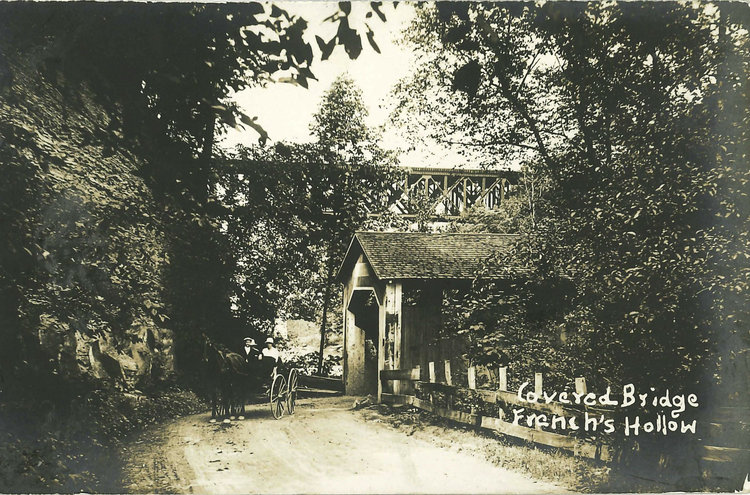
Having just exited the French’s Hollow covered bridge, this horse and buggy are about to climb French’s Hollow Road on the way to Guilderland Center. Behind the bridge is the West Shore Railroad trestle.

When last did you write or receive a picture postcard?

Modern technology’s new communication methods have made them a thing of the past. However picture postcards of the past have proven to be a valuable resource, adding to our knowledge of long-ago scenes.

Recently, the children of the late William P. Chamberlin donated his postcard collection of local views to the Guilderland Historical Society. Included in his carefully organized and notated collection were some views never previously included in the society’s archive of photographs and postcards.

In 1873, the United States Post Office introduced postal cards printed with an image representing the one-cent postage and space to write the address on front and a blank back for the message.

Picture postcards were introduced at Chicago’s 1893 Columbian Exposition, catching on with fairgoers immediately. At first, United States postal regulations slowed their use, but by 1901 private printers were permitted to call them postcards.

However, messages were not permitted on the same side of the card as the address, resulting in only a tiny blank spot for a greeting or brief message on the picture side. Finally, in 1907, the Post Office began to permit the back to be divided for both message and address. At first, the postage was the same as a first-class letter, but later reduced to one cent.

Several factors led to the production of millions of postcards up until World War I. Kodak had developed a folding, portable camera, allowing men to visit a community or scenic spot to quickly snap prominent buildings and scenes or to travel to parklike settings, and in this area the Helderberg escarpment that became Thacher Park was the big attraction.

Two photographers who captured many views of Guilderland locations were Parker Goodfellow of Schenectady, who was supposed to have taken a total of 32,000 views as he traveled far and wide and Binghamton photographer John Dearstyne who shot some as well. Others are unidentified.

In addition to views, holiday postcards produced for Christmas, Easter, Halloween, and Valentine’s Day were popular. Other types of postcards were comic cards and cards featuring important people such as a patriotic George Washington card.

With the frequent rail service hauling attached mail cars, which delivered mail as often as twice daily, in many areas along rail lines mailing a postcard became a rapid means of communication with short messages of the “come quickly, mother is ill” or ”I will be arriving on the 4:22 train on Friday” variety.

The public not only mailed millions of postcards, they collected and mounted them in albums designed to display them. This is the reason why so many antique postcards are blank, intended only for an album.

Because postcards were inexpensive, most people could afford them. In 1911, L.S. St. John , an Altamont news dealer, advertised six new Altamont views at two for 5 cents or five for 10 cents.

Postcard “showers” for special occasions or illness were regularly mentioned in Enterprise columns. One man, having just celebrated his 80th birthday, put a card of thanks in the Enterprise to thank everyone who has sent him a total of 90 cards.

In 1913, the U.S. Post Office claimed a total of 900 million postcards had been mailed in this country.

Since huge numbers of the higher quality cards were printed in Germany, once World War I began, the supply of cards diminished, and gradually the telephone began to take the place of brief communications.

With that, the postcard lost popularity. Although postcards continued to be printed during the 20th Century, the local photo cards, especially of smaller communities, were no longer produced.

Fortunately, because so many of the old postcards were saved and have survived into the 21st Century, we are able to look at our communities as they once were.

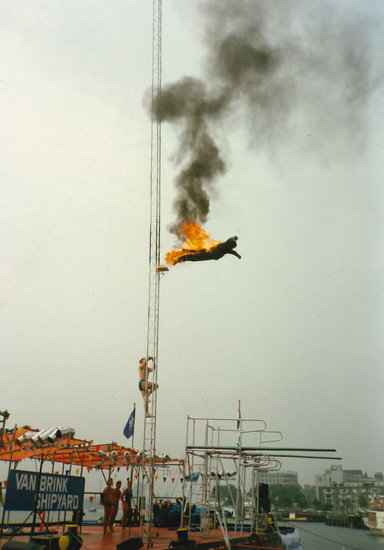
In his youth, one of the Old Men of the Mountain had a summer job, jumping from a platform 80 feet high, wearing a cape that was set ablaze, and landing in the water below.

DUANESBURG — And a grand birthday party it was, held at the Chuck Wagon Diner on Sept. 23 for Elwood Vanderbilt on his 98th birthday. The singing was awful as usual, but what was lacking in quality was more than made up for with enthusiasm and volume from the exceptionally large crowd of OFs.

Tuesday’s attendance caused at least two of the tables to have completely different sets of OFs sitting at them. Never saw that before. One table held six OFs and the other table held four. As soon as each table got up to leave, it was immediately filled back up with some latecomers to the party.

At another table, an OF got to thinking what with Elwood being 98 years old, and the rest of us not far behind him, that the cumulative age of those present would easily surpass 3,000 years! Not surprising; after all, we are the Old Men of the Mountain!

It is that time of the year again, or maybe it is just because we are up and about at the crack of dawn, but there seems to be plenty of deer to be seen, and some to be avoided, on the way to breakfast these days.

We were treated to a spectacular red sunrise Tuesday morning, which of course made some of us mentally recite the old saying, “Red sunset at night, sailor’s delight. Red sunrise in the morning, sailors take warning.”  Sure enough, the rains came later in the day.

Life journeys

As the regular readers of this column are aware, the life experiences of our members make for very interesting conversations and maybe just a few tall tales around the breakfast table on any random Tuesday morning.

We know of a few of these life journeys taken by our OFs.  They include the hard work of being the fourth-, fifth-, even sixth-generation family farmer here in the Hilltowns.

One fifth-generation family farmer told a humorous story about the time when he was pulling into his driveway at the farm after running a few errands and a car pulled right in behind him. The other driver, a much younger man than our OF, got out and came up to him and commented how very beautiful the farm looked with the farmhouse and barns and fields.

Our OF proudly said thank-you and told the stranger that he was the fifth generation in his family to operate this farm. At this point, the young stranger informed him rather authoritatively that that was not true, that he knew the previous owner personally.

Our OF wished him well and they parted company and each went on their way. It should be noted that pastors, who are also fifth-generation farmers, seldom get into arguments regarding their own family history with young strangers who have no idea what in the world they are talking about.

The proof is in the pictures

While we are on the subject of the past journeys that we have all taken to finally arrive at this point, an OF last week was telling the story of one of his summertime jobs. Now, we all enjoy a good tall tale, but this particular tall tale was taking the tall-tale telling to truly Olympian heights.

It seems that last week he told the OFs at his table that his job was to jump into the water. That’s it, just jump into the water, and he got paid for it!

He didn't jump from the side of the pool, he didn’t jump from the diving board. No, not even from the 10-meter (33 feet) platform used in competitive diving meets.

Noooo, he jumped from over 80 feet up while standing on a 12-inch square platform! The only difference in the story from last week to this week was — he brought pictures this time!

There was even one picture, taken mid-flight, where he was wearing a cape that had been doused with a flammable substance and set ablaze just before he jumped.

One OF, in typical OF fashion, commented that our OF jumper used to be slender and six feet, six inches tall but every time he jumped and landed in the water, he sort of squished down and out a couple of inches, resulting in his current height of five feet, nothing by a width today of three feet, four.

Canadian travel

Not really enough time to get into the Reversing Falls tourist attraction that one of our OFs found in Canada while on a family vacation recently.

He also commented on the price disparity for gas between the two countries for the same brand-name gas just across the border from each other. One wonders if the price difference was a result of the price per liter versus the price per gallon.

Our vacationing OF also commented on the total lack of traffic going north or south on the four-lane road in each direction at the border crossing in northern Maine at this time of the year, resulting in bored customs officials with too much time on their hands, who, in good humor, decided to do a really thorough job of inspecting their camper while commenting how nice it was.

Those OMOTM who enjoyed the birthday party at the Chuck Wagon were Harold Guest, Wally Guest, Frank A. Fuss, Jacob Lederman, Ted Feurer, Wayne Gaul, Jim Austin, Chuck Batcher, Russ Pokorny, Warren Willsey, Frank Dees, Marty Herzog, Roland Tozer, Miner Stevens, James Darrah, Wm Lichliter, George Washburn, Pete Whitbeck, Jake Herzog, Pastor Jay Francis, Randy Barber, John Williams, Lou Schenck, Joe Rack, Al Schager, Robert Schanz, Mark Traver, Gerry and Winne Chartier, Duncan Bellinger, Herb Bahrmann, Paul Guiton, Gerry Cross, John Jaz, Dick Dexter, Jack Norray, Elwood Vanderbilt, Bob Donnelly, Dave Hodgetts, Alan DeFazio, John Dab, and me.

To the Editor:

During a very delayed reading of the Aug. 28 edition of The Enterprise, as I digested the news regarding Knox’s winter-salt dilemma and Frank Palmieri’s breakfast habits, there was a shocking item in the Old Men of the Mountain report, presented with no fanfare nor explanation. I am beginning to recover.

The OMTM had breakfast in Slingerlands. This staggering and unforeseen revelation raises a few questions:

— 1. Why did they come east off the mountain and was this a first?

— 2. Will this trend continue and will I ever be able to get a seat on Tuesday mornings at the Windowbox or Pretty Alright Breakfast Club again?

— 3. Who is the oldest member, and who has the longest tenure with the group?

Inquiring minds want to know!

Richard Rubin

Slingerlands

Editor’s note: R. Douglas Marshall, scribe for the Old Men of the Mountain, responds to Richard Rubin’s inquiries:

Richard, thanks for writing regarding the OMOTM slipping into the Windowbox Café in Slingerlands for breakfast. No, this is not our first time off the mountain; we have been to the Windowbox Café before as well as to the Home Front Café in Altamont and June’s in Clarksville. (Much smaller group of OFs then.) 

Since the OMOTM don’t vote on anything, it is sort of hard to have appropriate fanfare, etc. Besides, the OMOTM don’t do fanfare very well; in fact, we don’t do it at all.

Some OF says something like, “Let’s try such-and-such place,” so we ask around and, if enough OFs say, “Sure, why not,” or at least don’t have a negative response, we we ask the such-and-such place if they wouldn’t mind the OMOTM stopping by for breakfast.

If they say yes, we arrive. If we have a good turnout (we already know the food is great!), that’s about as close to a vote as we get. 

I think the OF who just celebrated his 98th birthday probably has blown out more candles than the rest of us. The longest tenured OF would have to be our Scribe Emeritus, John R. Williams. 

Richard, you are always welcome to join us at the Windowbox Café for breakfast anytime, preferably on a Tuesday morning as we are not there any other time. We start arriving around 7 a.m., but late arrivals are a lot closer to 8 a.m. I get there at or a little before 7 a.m. 

I have a trimmed beard (white). My email is MRMRDM4@gmail.com. Our next visit to the Windowbox will be Tuesday, Nov. 11.

We may not vote on anything, but we do have two rules we stick pretty close to: Numbers 1 & 2 are no talking politics and no talking religion. Just tell tall tales and enjoy breakfast with a fine group of OMOTM. I’ll save you a seat.