Kuhar Endowment gives $89K to 18 groups as town board calls for stricter rules
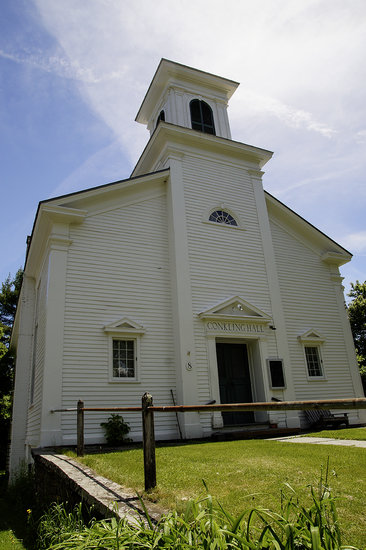
Enterprise file photo — Marcello Iaia
Conkling Hall last year got funds from the Kuhar Endowment for a stove and this year for a mini-split, leading to a town board discussion on new policies for procurement.
RENSSELAERVILLE — After an hour of discussion at its March 26 meeting, the Rensselaerville Town Board agreed to approve all 18 applicants for roughly $89,000 from the Kuhar Endowment Fund.
The only exception was a group wanting to create a dog park, which will have its grant money held in escrow until it finds a location for the park.
“It’s hard to approve fencing for a place that we don’t even know exists yet,” said Councilwoman Marymichael D’Ark.
Also, the grant to the town itself was increased to the amount Supervisor John Dolce said had been requested.
The town was surprised in 2022 to learn it had received a bequest of more than $800,000 from Jeffrey Bogue, who lived in Connecticut but had spent summers in Rensselaerville in his youth.
Bogue, who had no children, has relatives in Rensselaerville and one of them, his cousin Rosemarie Kuhar, now heads a citizens’ committee that reviews applications for annual grants with the final decision made by the town board.
Kuhar told the board on March 26, “Our recommendations would give just about $89,000 to 18 organizations.”
She also said the committee “did a lot of just brainstorming” and thought it would be good to make the applications “a little more complicated” to give the committee and board more information.
Further, she said, “since we didn’t hit our maximum,” the committee would like to have signs made so that recipients can post them, thereby generating publicity.
“We really felt bad that last year Tri-Village didn’t get any money, and this year it’s Medusa,” said Kuhar, referencing volunteer fire companies in town. The committee recommended “coming up with something that all three fire companies could share” with a maximum of $1,000 each.
Secondly, she said, “The cemeteries are really hurting for money to just mow, and it’s because nobody’s burying people anymore, so they’re not getting the bigger bucks for the full-time burials.” The committee suggested giving each cemetery $500 to go towards mowing.
As the town board members commented on various grant requests, they agreed a better process was needed as well as more publicity about the availability of the grants.
At the close of the meeting, Kuhar told the board, “All these people that were sitting here when you had your meeting, I reached out to every one of them personally, and that’s probably why you had people here … I don’t think a lot of people read the website,” she said.
History
Soon after Bogue died, Kuhar wrote a letter to the board, explaining who he was.
Bogue was born on Sept. 11, 1952 and died on Nov. 24, 2020 at age 68. Although he was born and raised in Connecticut, every summer as a teenager Bogue would visit his grandparents, John and Susan Kuhar, who lived on a farm outside the hamlet and owned dairy cows, Kuhar wrote in her letter.
“Jeffrey developed juvenile diabetes as a youth and fought the disease all his life but you never heard him complain,” Kuhar wrote.
In his youth, he played tennis on the village courts and, with his teenage friends, hiked to Lake Myosotis to swim. “I was jealous he could float while I was a sinker,” Kuhar wrote.
“Why did Jeff pick Rensselaerville to leave his estate to? Not sure anyone knows for sure,” she wrote, “but he did talk to me about his plans. I am not sure what the final legal papers stated but his initial plan had to do with honoring volunteers … One thing I know that had an impact on him is the amount of community volunteering he saw when he spent time with his grandparents.
“He saw Uncle Jim, my dad, respond whenever the fire siren went off. Jim also worked with Mrs. Elmore to create the present playground, create the tennis court, and flood the playground for ice skating in the winter.”
Bogue himself was a member of the historical society when he died, and had his mother’s paintings and carvings displayed at a historical society art show. Both of his parents and his wife are buried in the Rensselaerville cemetery, and his ashes were spread there after he died, Kuhar wrote.
A committee, with Kuhar at its head, was formed in 2023 to receive applications and to make recommendations to the town board on how to distribute the funds.
Applicants must be based in Rensselaerville. The committee does not accept applications from political or religious organizations, unless it is for a project that is not affiliated with political or religious ideologies, such as a food bank that is run by a church and benefits the entire community.
At the time the committee was formed, Kuhar said her overall philosophy on the fund was that it should “make all these little hamlets feel more like a community.”
The town announced the first recipients of the Kuhar Endowment Fund in April 2024.
The process was then paused by the state until, in February 2025, after the town board authorized the Community Foundation for the Greater Capital Region, a not-for-profit organization with a focus on philanthropy, to manage the $830,000 Kuhar Endowment Fund. This was the final step the town needed to take to satisfy a judge’s ruling that the money needed to be managed by an outside group for the town to use it.
Current issues
The most heated discussion on March 26 centered on Conkling Hall, which was built as a Methodist church in 1839 and has been used as a community meeting space since 1905. It is currently owned and run by the not-for-profit Friends of Conkling Hall.
The board’s discussion led to a consensus on the need for more information from grant applicants.
“They bought a stove last year, right? Here it is 14 months later, and they still can’t use that stove,” said Dolce. “It’s never been used. It’s not connected.”
“Give them the money so they can fix the vent so they can use the stove,” urged Councilman Peter Sommerville.”
“And then next year, they’re going to ask us for money again,” said Dolce.
Deputy Supervisor Brian Wood urged reaching a decision on the grants at the March 26 meeting since “the only way for us to talk legally about it is to have an open public meeting.”
Wood said of Conkling Hall, “My opinion is it’s a great program; it’s a great entity in the town. We should support it.” But, he went on, “You’ve got to have a plan …. We have to continue to improve our grant rules.”
Speaking from the gallery, a man who said he’d been involved with Conkling Hall for more than 30 years said that an engineer had drawn up a plan for the kitchen and that the quality of the stove was to set the direction for the kitchen. “We don’t want to nickel and dime this,” he said.
To make the stove safe and install it properly, he said, the wall needs to be tiled before an exhaust fan is installed. So this year’s request, for a mini-split, was to keep everything, including a heat and cooling source, on the back wall to keep up the building’s historic appearance, “which is really important in the hamlet.”
“I have no particular problem with any of these 18 requests,” said Councilman Randy Bates. He noted that most, if not all, of the applicants are volunteer organizations but that they should still be able to provide documentation for everything that is spent.
“They should give the town an invoice … and then we can pay that invoice,” said Bates, concluding, “I would like clarification on how we apply the procurement policy to these grants for accountability.”
Kuhar noted that some of the requests are not for objects being purchased for which there would be receipts.
“We could have it simple,” said Bates. “It could be really nothing more than a paragraph stating how the town will reimburse the participants in this fund.”
“Some of these organizations don’t have the money up front to do the project,” said Kuhar.
“Fine,” responded Bates. “But they can give us a quote and then we can approve it.”
Dolce then asked for a copy of a quote on the mini-split requested by Conkling Hall.
Bates said the process is evolving. “We’re trying to make it work going forward,” he said. “There’ll be challenges and modifications, etc. But we’re trying to build a model.”
“I’ll buy that,” said Sommerville. “But I still don’t see a problem with giving Conkling all the money because we already know what they need is way more. So let them knock something off and move forward.”
Ultimately, the board unanimously approved a multi-part motion made by Wood — to award the bids as recommended with the dog-park funds in escrow until the board agrees on a suitable plan.
“Recipients will be required to meet the town procurement policies,” his motion said. “Recipients who cannot pay up front for their grant funds must bring the approved quote to the town board for approval before the checks are approved.”
Further, his motion said, “No further money or grant funds will be issued without an approved grading tool and grant rules in place.”
And finally, the board agreed that the additional $2,500 in the fund is to be split evenly among the town’s five cemeteries “giving them a check for $500 with no need to provide proof of those funds.”