Berne extends solar moratorium till November
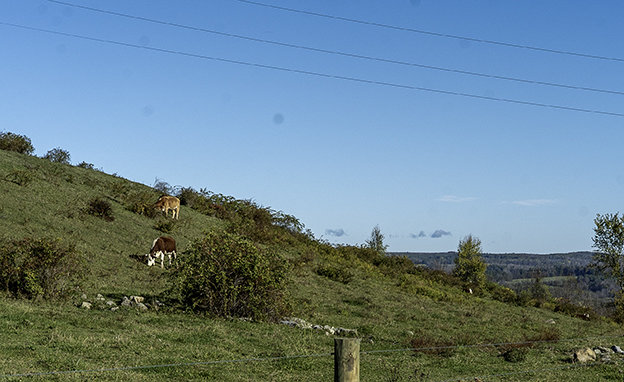
Enterprise file photo — Marcello Iaia
Jody Jansen envisions his cattle grazing alongside a solar facility. The Berne Town Board has extended, for another six months, its year-long moratorium on solar facilities.
BERNE — The Berne Town Board has extended its year-long moratorium on solar facilities.
The moratorium was enacted by the previous Republican-backed board on May 6, 2025 and was to last a year while a new law was drafted.
By a unanimous vote on March 11, the new board, made up of four Democrats and a Republican, extended the moratorium for six months, until Nov. 6, 2026.
Councilman Casey Miller, a Republican businessman, and Melanie laCour, a lawyer and a Democrat, are working on new legislation.
Miller said, “There’s way too much work” to complete before the original May 6 deadline.
LaCour said, “Berne has some of the best views around. We want to protect that …. Why would we allow people to use our beautiful land to not benefit us?”
When The Enterprise asked Supervisor Joseph Giebelhaus after the meeting what work had been done on the law since the moratorium was enacted last May, he said, “No changes have been made to the law.”
George McHugh, who sat at the dais as town attorney, said that battery energy storage units are dangerous. He also said he was tracking bills now pending in the state legislature on BESS and advised, “I think they're definitely going to be signed into law … It will take the heat off of us.”
Neither of the solar projects that were under consideration when Berne first enacted its 2025 moratorium involve battery energy storage systems.
A 4.25-megawatt solar facility proposed by TJA Energy in January 2024 would be located at the intersection of Switzkill and Canaday Hill roads.
A 3.8-megawatt solar facility proposed by RIC Energy in January 2025 would be at 28 Jansen Lane.
This is the town’s second moratorium on solar. The first was passed in early 2019 as the Berne Town Board worked on its original solar law. At that time, the nearby Hilltowns of Knox and Westerlo already had laws in place that allowed for industrial arrays and each town has such arrays in place.
Berne has no large-scale solar facilities.
Ronald Jordan, a resident who spoke from the gallery on March 11, told the board that Berne’s original solar law, “ditched by the last administration,” was carefully constructed and included setbacks.
His wife, Dawn Jordan, who was a councilwoman at the time, helped draft the law.
Ronald Jordan suggested to the new board that the original law would be a good place to start rather than starting from scratch. “A lot went into it,” he said.
The two Republicans on the board in 2019 opposed the first moratorium, eager to encourage solar development in town. After the GOP took control of the board, they amended the law to make it less restrictive.
Jody Jansen has been advocating for the RIC solar facility he wants to put on his farm.
He wrote in a letter to the Enterprise editor last October, saying, “As a fifth-generation family farmer in Berne, I believe it is time for our town to embrace smart opportunities that will contribute to our town’s revenue and support our taxpayers … This solar project is planned for one of the most suitable and secluded fields in town. It is designed to produce clean, fixed, discounted power for Berne residents that sign up for the electricity credits while bringing direct economic benefits to the town of Berne and our school district.”
McHugh asserted, “This energy is going south.” He also asserted, “The energy needs of the state of New York trump home rule.”
McHugh cited the 2025 case of Freeport Solar against the Town of Athens Zoning Board of Appeals. Freeport had planned to build a facility on 43 acres in a rural residential zone of the Greene County town but was denied a use variance.
The Athens board prevailed at the lowest level of New York’s three-tiered court system but Freeport won at the middle level when the Third Department Appellate Division in Albany ruled unanimously in its favor.
McHugh said of the state’s top court, “The Court of Appeals wouldn’t hear it.”
The Appellate decision turned on the state’s 2019 Climate Act, which set mandates for New York’s transition for renewable energy.
The court found that the unanimous State Quality Environmental Review found “no significant environmental impacts” from the Freepoint project.
The court noted that, while the state’s Town Law provides guidelines for use variance applications generally, applicants that are proposing to develop public utility infrastructure are subject to the “public necessity” use variance test, which sets a lower burden for establishing the applicant’s right to an approved variance.
“Given the foregoing,” the court ruled, “certainly one cannot quarrel with the premise that New York State’s goal of transitioning to renewable energy is designed to benefit the public at large, and this project is in line with that goal.”