Midst threat of federal rollbacks, state legislators push for laws to regulate PFAS
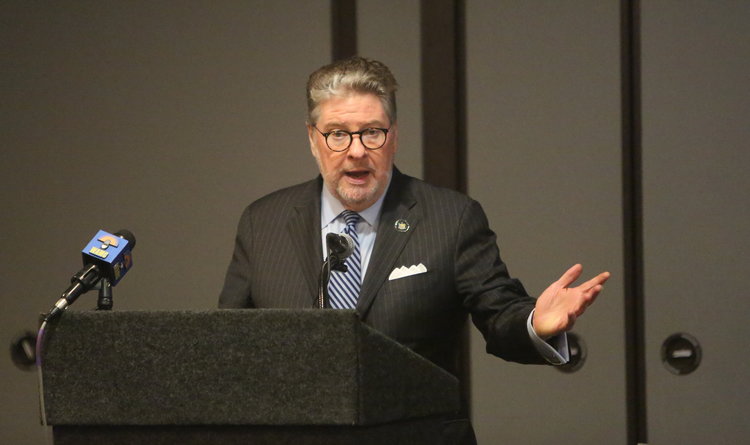
The Enterprise — Michael Koff
State Senator Peter Harckham speaks at a Feb. 11 event to advocate for legislation that would regulate PFAS.
ALBANY — The New York State Senate this week passed two bills related to the regulation of perfluoroalkyl and polyfluoroalkyl substances (PFAS), more commonly known as forever chemicals, because they don’t break down in humans or the environment.
These are two of a series of bills state legislators are advancing that seek to:
— Ban certain cancer-causing compounds from consumer products,;
— Require disclosure of industrial discharges containing the carcinogens;
— Impose a moratorium on spreading contaminated sewage sludge on farmland; and
— Codify federal drinking water standards into state law.
The group backing the legislation, PFAS-Free NY, a coalition of nearly two dozen largely environmental advocacy organizations, gathered on Feb. 11 at the state Capitol to lobby for the measures.
The legislative push comes as the Trump administration seeks to roll back Environmental Protection Agency limits on PFAS in drinking water that President Biden’s administration had set at near-zero levels.
PFAS were developed in the mid-20th century by companies like 3M and DuPont; they are known for their remarkable resistance to water, grease, and stains, as evidenced by their inclusion in products like Teflon and Scotchgard.
The chemicals do not break down; they are present in the blood of 97 percent of Americans, according to the Centers for Disease Control and Prevention. Exposure has been linked to kidney and testicular cancer, thyroid disease, preeclampsia, and low birth weight.
The legislation
There are four bills — two of which have already passed in the state Senate and await votes in the Assembly — that target PFAS:
— Consumer Product Ban
The Ban on PFAS in Consumer and Household Products Act passed in the Senate this week.
The bill would prohibit the sale of items containing intentionally-added PFAS; the product categories include: textiles, rugs, fabric treatments, cookware, ski waxes, architectural paints, cleaning products, and dental floss.
The legislation would require manufacturers to provide signed certificates of compliance to retailers, who would not be held liable for violations if they rely on those certificates in “good faith.” Penalties would be $1,000 per day for first offenses and $2,500 for subsequent violations.
— Discharge Disclosure
The PFAS Discharge Disclosure Act also passed in the Senate this week.
The legislation would require industrial facilities and publicly-owned treatment facilities to measure and report PFAS emissions.
Facilities applying for new State Pollutant Discharge Elimination System permits would be required to submit projected PFAS monitoring results. Once operating, they would conduct quarterly testing for one year and report results to the Department of Environmental Conservation within 90 days. Detection above threshold levels would trigger continued quarterly monitoring.
— Biosolids Moratorium
The legislation would impose a five-year moratorium on the land application and commercial sale of biosolids across the state. The prohibition would extend beyond cropland to parks, golf courses, and other non-crop applications.
The bill states that, once a quarter for one year, soil at every current and recent biosolid application site, drinking water wells within a half-mile of those sites, and surface water within one mile would be tested. Wastewater treatment facilities would test their biosolids quarterly for the full five years.
The legislation also proposes that, within 18 months of enactment, the DEC must build and maintain a public database of all PFAS testing data collected under the bill.
The legislation’s second major component would create a program to provide grants to farmers and landowners whose land exceeds PFAS thresholds. The money could be used for alternative cropping systems, remediation strategies, technological adaptations, transitions to alternative revenue streams including alternative land use, and costs associated with locating viable replacement farmland.
— Drinking Water Standards
The bill would codify federal PFAS drinking water limits into state law, setting maximum contaminant levels of 4 parts per trillion for PFOS and PFOA, and 10 parts per trillion for three other compounds: PFNA, PFHxS and HFPO-DA.
The legislation would require the state’s commissioner of health to establish a hazard index that addresses the cumulative exposure to multiple PFAS compounds. Public water systems would have until May 2029 to comply.