Albany County is under an air quality health advisory
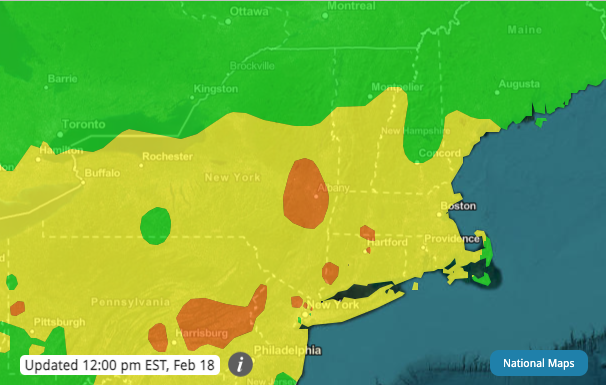
— From AirNow.gov
Altamont on Wednesday at noon had an air quality index reading of “unhealthy for sensitive groups” at 139, indicated in orange.
ALBANY COUNTY — People with heart or lung disease, old people, and children are being advised today, Feb. 18, to choose less strenuous activities — like walking instead of running — and to shorten the amount of time they are active outdoors.
This government warning comes because of a high count of particulate matter in the air.
The commissioners for the state’s departments of health and of environmental conservation have expanded their Air Quality Health Advisory for fine particulate matter from the New York City metro region to also include the Upper Hudson Valley.
Their advisory went into effect at noon today and will last until midnight.
Fine particulate matter consists of tiny solid particles or liquid droplets in the air that are 2.5 microns or less in diameter, which often come from processes that involve combustion, such as vehicle exhaust, power plants, and fires, and from chemical reactions in the atmosphere.
Exposure can cause short-term health effects, such as irritation to the eyes, nose, and throat, coughing, sneezing, runny nose, and shortness of breath. Exposure to elevated levels of fine particulate matter can also worsen medical conditions such as asthma and heart disease.
AirNow, working with the federal Environmental Protection Agency, has a website — AirNow.gov — where you can type in your ZIP code to get a current reading on the air quality; it also displays maps rating the air quality in a color-coded format.
The reading for Altamont at noon on Feb. 18 was 139 AQI, putting it in the orange designation, meaning “unhealthy for sensitive groups.”
The state’s health commissioner, James McDonald, explained in 2023, in the midst of Canadian wildfires causing high counts of particulate matter in New York state, that the air quality index, or AQI, monitors five factors: ozone, particulate matter, carbon monoxide, sulfur dioxide, and nitrogen dioxide.
Particulate matter, he said, is made up of particles smaller than 2.5 microns, noting, for comparison, that human hair has a diameter of about 50 microns.
“You can’t see it with your naked eye,” said McDonald, explaining that the invisible particles “can migrate down your respiratory tract.”
He advised wearing an N95 mask if the air quality index number is over 300. The mask, he said, filters the air you breathe, keeping particles out of your lungs.
Even a surgical mask will provide some protection, McDonald said, if you don’t have access to an N95 mask. “Use what’s the best mask you have available,” he urged.