The Altamont-Voorheesville Road was built with teams of horses and rocks from farmers’ walls
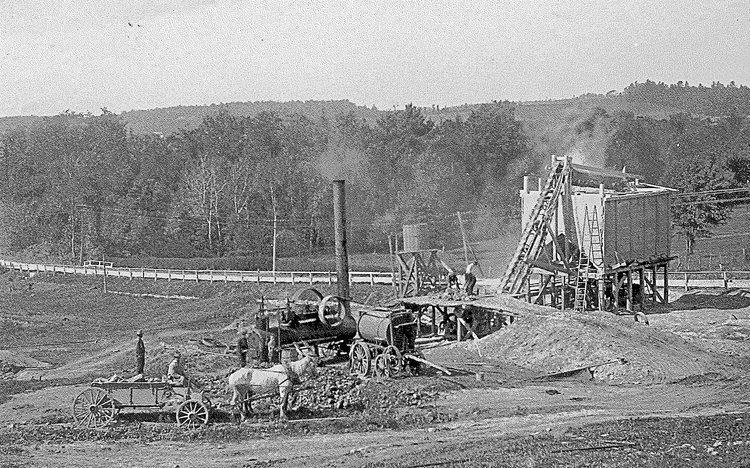
This real-photo postcard shows a farmer, on the left, carrying rocks from stone walls to the rock crusher in his horse-pulled wagon. In the center of the photo is the coal-driven steam machine powering the elevator that carries the stones to the top of the rock crusher. A water wagon is at center.
To the Editor:
A wise and influential Chinese writer, Lu Xun, pronounced Loo Shwoon, who lived from 1881 to 1936, once said, “For actually the earth had no roads to begin with, but when many men pass one way, a road is made.”
Many consider the roads we use every day to be the “arteries of civilizations.” Our roads link workers to jobs, producers and raw materials to businesses and markets. They are the backbone of trade and commerce.
Roads allow emergency responders to reach people quickly during crises and provide a path for us to reach healthcare, schools, and essential services. These pathways are “conduits for community engagement,” allowing people to visit loved ones and participate in local events.
So when the New York State Department of Transportation started to rehabilitate the portion of State Route 156, known as the Voorheesville-Altamont Road, in the summer of 2025, it got me to thinking about my younger days, spending time with a correspondent who wrote for The Altamont Enterprise.
That was Catherine Weidman who wrote a column titled “From Kay” during the 1970s and 1980s. It was about local people and history, primarily from the Voorheesville area, but also their connections to others all over the Helderberg region.
She was a neighbor of mine who lived on Koonz Road and was born in 1912 and died in 2003. Kay was an historian and she left me clips of many of her columns and a handwritten personal history of the life she and husband, Ken Weidman, experienced here, in the early to mid-20th Century.
She wrote of the road improvements at that time. But first, a short history. The road as we know it now was created from a rural dirt path connecting dispersed farms between Voorheesville and Altamont. It didn't always follow the exact same course we know now.
Before European settlement, many of our modern-day roads evolved from footpaths used by Native Americans. These routes developed into horse and wagon passages.
In fact, a portion of State Route 156 that connected to the Old Indian Ladder Road, which dissected the cliffs along the Helderberg Escarpment at Thacher State Park, was also known by that name all the way back to Voorheesville.
The road was an important link between the rural farmland of Voorheesville and Altamont especially before the railroad came through in 1863.
Later, Voorheesville became the junction of two railways, and Altamont with its own rail station grew as a Victorian-era destination.
The road then became not only a passage for locals, but also for tourists traveling to the Helderbergs for recreation.
What follows are fragments of the history that Catherine wrote, about the rebuilding of the Voorheesville-Altamont Road, as told by her husband Ken Weidman in the 1930s.
Weidman’s journal
This is from Catherine Weidman’s handwritten journal of local history.
The Voorheesville-Altamont Road took two years to build as it is now, between 1921 and 1922. Kenneth Weidman remembers all the length from Voorheesville to Altamont being torn up. He had to be driven by Model T Ford, by way of Tygert, Picard, and Martin Road to Voorheesville and the D&H train station to take a train to Milne High School in Albany.
The road contractor was Hopkins Co. with Mr. Crowley as superintendent and Bill Green assistant superintendent. Work was done by men and horses, no trucks. Dirt and stones moved by wagon and horses.
Contractor used 12 or 13 teams — lots and lots of horses worked on the road. They did not belong to the contractor.
People made money — farmers put their teams on the road if they owned horses. Herman Smith of Hennessy Road, next door to Weidman’s, traded horses and got a big grey to go along with his big grey to put a team on the road. Herman hired a man, bought a dump wagon, and worked a team all summer.
Once in a while, if his man didn’t show up, Herman would drive. He worked his farm and had a team on the road. Lots of drivers were bums. The contractor lived where Peter Ten Eyck lives now on the northern branch of Tygert Road.
The contractor wintered 25 or 26 horses in barns. Drivers went home in winter. Every team had a driver.
Bill Green, assistant superintendent, lived in the Old Comstock house in winter. House owned by John and Ken Weidman. Drivers gone home, also Barn Boss. We’d see 4 or 5 teams go out in A.M. Someone driving the first team — all the men on the first wagon — other 3 or 4 teams followed. No drivers. Like a parade in the A.M. One team was sharp shod in winter.
A team used to go to store and movies were held in the Odd Fellows Hall Voorheesville, now American Legion. Weidmans rode to movies at Voorheesville with the Greens — four people in a seat. One horse had a spring-halt. Mr. Green drove — stood in front to drive. Going home, when out of the village, Green blew the lantern out — said horses knew the way home.
Weidmans went to movies in the big sleigh with Greens.
The V’ville-Alt. Rd. was well built. Stones used were from stone wall fences on farms all the way up toward Andersons and Herzogs. We were paid a little bit, not much for stone walls. Gangs of men picked up stones and threw them into wagons.
A team of horses drew them, flat stones went on bottom — flat stones had to be set — the rest went to a rock crusher up a short bridge — then dumped them into a steam roller. Joe ran a big, heavy crusher powered by soft coal. Crusher worked all summer all the time.
Flat stones were set on edge by hand, then a little dirt put over and rolled over stones. That’s where steam roller Joe came in, crushed stone put over flat stones on edge, then another size crushed stone, then fine stone on top, then tar.
It's been a good road. Reason why — done with care. Up above Ten Eyck’s Indian Ladder Farms, they tried “to put one over” to make work go faster — so they just dumped stone out of wagons, put dirt over and rolled them when nobody was around to see.
The inspector came along with an auger and dug down in the roadbed, found flat stones not on edge and made the men take it all up again. Three quarters of a mile had to be taken up and the stones picked out and reset.
A big gang of men worked on the road then. Italians had shacks, lived by themselves and boarded themselves. Where the Waite Farm is up on Altamont Road, where a pond is, across from the house, is where the shacks were.
They were low shacks built against the embankment. One was for sleeping, another for eating. During the building of the road, I (Catherine Weidman) met a Greek laborer when I was 9. His name was Jim and he said he had a niece in Greece named Catherine. He took a liking to me, gave me a gift, red gingham for a dress.
When the tar came up through the road surface of the Altamont Road, Marion Young and Esther Crounse, as young girls, liked to play with the tar. One day they made tiny balls of tar and put it in their hair. Called it “lice.” Mrs. Young and Mrs. Crounse had quite a time getting the pretend bugs out of the girls’ hair!
Grateful
That is the Weidmans personal accounting of how the road we use today got its beginnings. Think about how much our conveyances, automobiles, have changed and the speeds we drive. The road surfaces are so smooth now. We are grateful to the builders of the roads, “The Asphalt Men,” and the current caretakers who rebuild and maintain our roads.
It has been said that road builders do more than lay asphalt. They build the pathways that define human interaction and economic growth.
New York State Route 156 was designated as part of the major 1930 state highway renumbering in New York, which reorganized the numbering system for state-maintained roads to improve consistency and signage.
State Route 156 is a 16.37-miles long connector between Route 443 in Berne to Route 85A in Voorheesville.
I’ll leave you with a quote about roads by Jean de La Fontaine that I personally like: “A person often meets his destiny on the road he took to avoid it.”
Timothy J. Albright
Meadowdale