‘Striking a natural balance’: Silver flies released to preserve Helderberg hemlocks
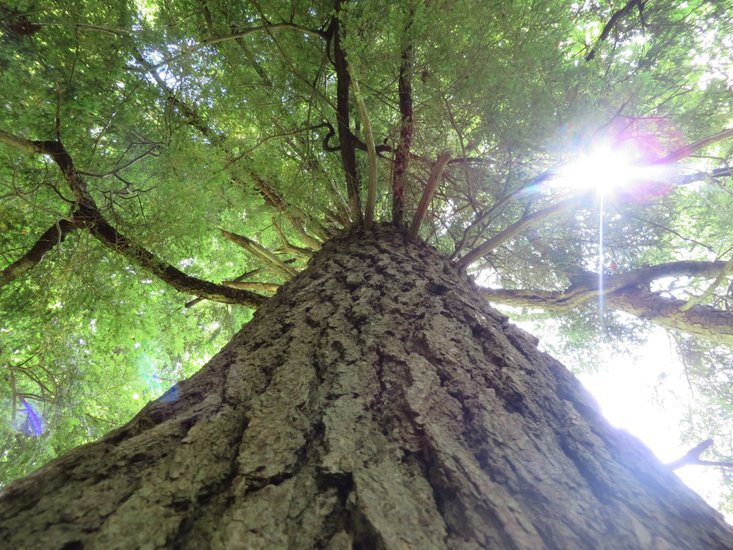
— Photo by Becky Sibner
Hemlocks can live up to 900 years and grow over 100 feet tall.
GUILDERLAND — Can a Pacific Northwest silver fly save eastern hemlocks here?
The Mohawk Hudson Land Conservancy on the first day of this month released silver flies into a stand of hemlocks on its newly acquired Crounse property. A second batch was released in the middle of April.
This is known as biocontrol — using natural predators rather than chemicals or cutting trees to curb the hemlock woolly adelgid, which can decimate hemlock forests.
Eastern hemlocks can live up to 900 years and grow over 100 feet tall.
Yet these huge, enduring trees are being threatened by an insect that is only one-and-a-half millimeters long: the hemlock woolly adelgid, known as HWA.
HWA arrived in the United States in Virginia in the 1950s and has been in New York state since the 1990s, arriving in the Adirondacks in 2017.
The conservancy’s stewardship director, Marshall Lefebvre, is overseeing the biocontrol project. He received an $85,000 state grant in 2024 to identify and control the aphid-like insect, an invader from Asia.
In a video he made about the hemlock woolly adelgid, Lefebvre displays a map that, over the years, shows the spread of HWA from south to north, “expanding like gangbusters as winters start to warm,” he says.
“They’re hard to find unless you know what you’re looking for,” Lefebvre told The Enterprise in 2024 soon after he secured the state grant. In the summer months, HWA appear as tiny black sesame-seed-shaped spots, but are most noticeable in the winter months with the appearance of tiny white cotton balls on the underside of branches.
Lefebvre said of hemlocks, “They are a keystone species, foundational for our natural living system.”
He went on to describe how essential hemlocks are to various ecosystems. Some examples: Hemlocks provide the shade over streams that make it possible for trout to live there; hemlocks are vital to 88 species of spiders; many bird species, such as the black-throated green warbler, rely on hemlocks to nest in.
Wild turkey and deer rely on the “microclimate” provided by hemlocks, said Lefebvre, explaining that temperatures around a hemlock are 5 degrees cooler in summer and 5 degrees warmer in winter than surrounding temperatures.
“The list goes on and on,” he said.
The conservancy has protected 562 acres of hemlock forests in the Helderbergs and trained 40 volunteers in hemlock management and survey techniques.
In March, conservancy staff along with researchers from the New York State Hemlock Initiative at Cornell University — where Lefebvre worked as a technician for five years before joining the conservancy in 2022 — to evaluate the Crounse property for continued hemlock conservation research.
The hemlock stands had healthy trees with abundant HWA, according to a release from the conservancy, making it an ideal location for biocontrol establishment.
“HWA is here to stay,” said Lefebvre in the release, “but there’s still a solid chance for striking a natural balance and preserving our hemlocks in the Helderbergs.”
‘Sense of place’
While the conservancy’s current focus is on forest health, the plan is to eventually open the 197-acre Crounse property to the public with the goal of eventually having it become part of Thacher State Park.
The acquired property runs from the top of the Helderberg escarpment, down a steep slope to front on the Altamont-Voorheesville Road, Route 156, sharing boundaries with Thacher Park at the top and the historic site of the Frederick Crounse home at the bottom.
The property contains about 2,000 feet of a tributary stream to the Black Creek that flows down from the escarpment to the wet lowland along Route 156.
Frederick Crounse and his wife, immigrants from Germany, were among the first European settlers in what is now the Altamont area. Their sons, Frederick and Philip, served in the Revolutionary War and the Crounse farm supplied food to the Continental troops in the Battle of Saratoga in 1777, a turning point in the war.
A later Frederick Crounse became Altamont's first physician.
The 197-acre Crounse property is part of a corridor the conservancy is trying to protect that would connect the Catskills to the Adirondacks.
At an event announcing the preservation of the parcel, Mark King, the conservancy's director, said, “Today, with this land protected, visitors will be able to stand on the escarpment and look across the same sweeping landscape and experience the same sense of place that people felt more than two centuries ago.”