Memoirist Linda Bakst explores what it means to be a Jewish American
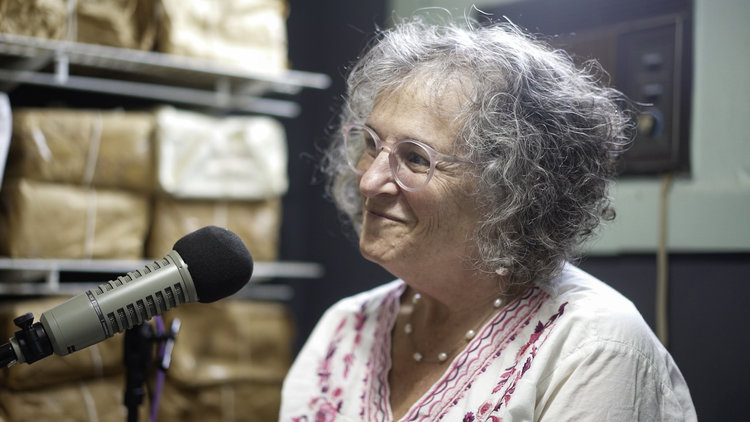
The Enterprise — Marcello Iaia
Linda Bakst discusses her first book, “More Than Matzoh Balls: My Search for Jewish-American Identity,” in this week’s Enterprise podcast.
“When I was a little girl, I thought I was a writer. I did,” says Linda Brody Bakst. “I wrote poems.”
Her grandfather loved those poems. He would carry them in his wallet and show them to his friends.
But something happened as she aged — Bakst doesn’t know what — that beat the confidence out of her when she left the warmly supportive world her parents and grandparents had created in the Brooklyn home they shared.
“I still felt like in my heart, I was a writer,” said Bakst. “I was always thinking of sentences. I was writing descriptions in my head of things, of conversations, events, scenery.”
She had lost the willingness though to share her words with the world — until now.
Bakst has just published her first book, “More Than Matzoh Balls: My Search for Jewish-American Identity.”
The cover of her book has a picture of her husband’s parents in a displaced persons camp. They met there after World War II. Their lives in Poland had been destroyed by the Nazis.
When Bakst turned 55, she said, “I returned to writing.”
She had a conversation with herself, saying, “Linda, if you’re going to be a writer … it’s now or never, you know, and now what are you so afraid of?”
Bakst concluded, “It felt like something had lifted from me.”
And so it began. She took a writing course at the University at Albany and she started a memoir blog called “Stories I Tell Myself.”
The blog, she says in this week’s Enterprise podcast, “is all over the place” but she felt something coalescing around her Jewish-American identity.
That is what, a decade later, became the center of her book. In her book, she layers intensely felt chapters about her own life journey, against carefully researched chapters on the experiences her husband’s family suffered during the Holocaust.
The juxtaposition is sometimes mind-blowing. A chapter on Bakst planning her wedding — brought to tears on a difference with her to-be mother-in-law on choosing gowns for her eight bridesmaids — runs right next to a chapter on her to-be father-in-law, at about the same age, being conscripted into the Russian army.
The weaving together of those narratives creates a tapestry of the Jewish experience
Bakst writes that her story as a Jewish American is both unique and universal. Most Americans, she says “don’t have to go back too far to find an immigrant” in their family tree.
“There’s a struggle on how much do you assimilate? How much do you hold on to the traditions?”
Bakst went on, “What’s unique, I think, about being Jewish is that being Jewish is a lot of different things … Being Jewish is a religion … and it’s also an ethnicity; it’s a culture. There’s the food, there’s Yiddish language, there’s Hebrew.”
One of her goals in writing the book, Bakst said, is for people who are not Jewish to read it. “People may have a picture, a fairly stereotypical picture of what a Jewish person is,” she said, “and there’s a whole range of the way it’s expressed.”
The book traces her own evolving relationship with Judaism. After she and her physician husband had children — Leah and Daniel — they went to synagogue regularly. Her husband wanted them to feel at home in a synagogue anywhere in the world.
But on the Saturday after the terrorists’ attacks of Sept. 11, 2001, Bakst felt alienated in her synagogue. “You’re inside and everybody else is outside, whether it’s a physical building, a church or a mosque or a synagogue.”
Making outside groups into “the other,” she said, “felt alienating.” Remembering that Saturday after 9/11, Bakst said, “In my heart of hearts, I felt, I don’t know if this is for me.”
With Jews being “a very small minority in the world and a very small minority in this country,” Bakst said, one of the great tensions is “wanting to continue the tradition.”
She went on, “There’s a fear that we’re going to disappear — and not disappear because of somebody exterminating us — but through assimilation.”
Both of her brothers married women who were raised as Christians and both of her children married Christians, too. Her son’s wife converted to Judaism and her daughter is an atheist.
“It didn’t splinter our family ….,” said Bakst. “We are there for each other.”
Her two grandchildren, to whom she dedicated her book — “the next generation, with love and hope” — are each being raised with Jewish traditions.
Bakst wants her grandchildren to understand their legacy: “resourcefulness from my husband’s family” and from her own family — both of her parents were teachers — “really valuing education, really valuing curiosity.”
“Our present administration has fascist tendencies,” said Bakst, which she finds “deeply problematic.”
Bakst says that “nobody’s life is neat and tidy” and that “everybody has felt like an outsider.”
She says, “We need to understand that about each other …. And be maybe a little more, well, compassionate and also open to each other.”
Bakst hopes her book teaches this: “That we all evolve over time, that the search for identity and the search for belonging is one that is ongoing, and that not to give up on. You know, if you don’t feel like you’ve found it yet, keep looking.”
“I’m still looking,” she said.
****
“More Than Matzoh Balls: My Search for Jewish-American Identity,” a 269-page paperback published by Kitsap Publishing, is available through Amazon for $19.95.