Guilderland sets four hearings inspired by updated comprehensive plan
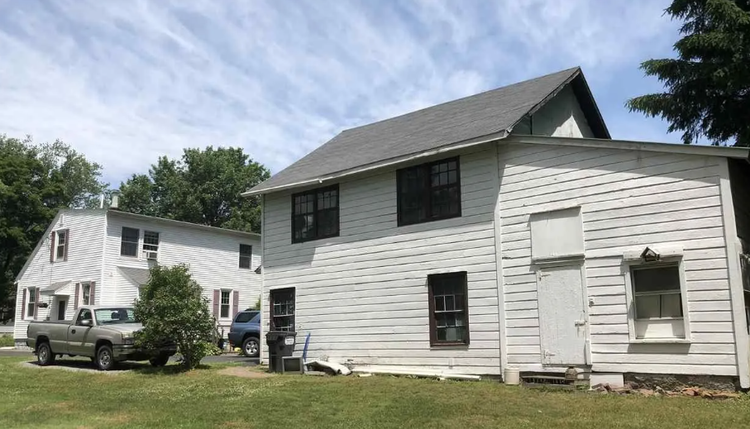
When Willow Street resident Terence Hoyt told the Guilderland Town Board in March that he wants to put an apartment in this 1860s barn behind his home, Supervisor Peter Barber told him legislation to allow ADUs would be “very near the top” of code changes inspired by the town’s updated comprehensive plan. A hearing on zoning for Accessory Dwelling Units has now been set for June 16.
GUILDERLAND — The Guilderland Town Board used its April meeting to advance a number of policy initiatives.
On April 21, the board agreed to set public hearings for four proposed local laws:
— A moratorium on battery energy storage systems, known as BESS;
— The codification of the Albany Pine Bush Preserve Commission’s involvement in future development decisions;
— Amendments to town rules for building in environmentally sensitive areas; and
— Zoning for Accessory Dwelling Units.
“We set four public hearings,” Supervisor Peter Barber said near the end of the meeting. “That’s pretty good.”
“All on comp plan items,” Councilman Jacob Crawford replied, “which is even better.”
In November 2025, the board adopted an updated comprehensive land-use plan, replacing the plan the town has followed for more than two decades.
BESS
During the April 21 public comment period, Robyn Gray, who chairs the Guilderland Coalition for Responsible Growth, told the board that residents had been receiving solicitation letters from energy developers offering “anywhere between ten- and thirty-thousand dollars a year rent” to install shipping-container-sized batteries on their properties.
Gray said there have been instances of systems catching fire, even exploding.
She told board members she had considered adding a battery to her residential solar array but abandoned the idea.
“I don't want them in my house. Second of all, I don't want them in my yard,” she said. “Because if they blow, it’s not only going to affect me, it’s going to affect my neighbors.”
Gray sought to tie BESS proposals and approvals to the build-out of artificial intelligence data centers — which consume large quantities of electricity and water — and warned that unregulated battery permitting could become the entry point for AI siting in Guilderland.
“A farmer gets his letter in the mail; he’s having a tough time. Oh gee, I could get thirty-thousand dollars a year if I let him do this? Oh sure, I’ll do it,” said Gray, surmising a farmer’s reaction to a BESS proposal.
Supervisor Peter Barber told Gray the town was already moving on the issue, proposing to enact a temporary ban on BESS installations. Later in the meeting, the board set a May 19 public hearing on Barber’s proposed four-month moratorium.
Climate smart
Gray also took the board to task for the clear-cutting of trees in town, particularly within and adjacent to the Pine Bush study area, where a developer’s plan to build hundreds of apartments along New Karner Road amid the fragile ecosystem stalled recently due to a disagreement over what constitutes buildable land.
Gray said project developer Markstone Group’s proposal would require removing substantial Pine Bush woodland, also citing the Barth Meadows subdivision across from Tawasentha Park, where she said its developer “clear-cut a huge swath of trees that really was not necessary to put his road in.”
Gray said, “If we’re supposed to be climate-smart, if we’re trying to preserve what we have, why are we allowing this? Where are the controls? Who is monitoring?”
Later in the meeting, Barber moved to schedule a June 2 public hearing to codify the town’s existing practice of referring to the Pine Bush Technical Committee any Pine Bush-area applications that fall under the State Environmental Quality Review Act.
“The town planning board and the zoning board already do that,” Barber said, “but we’d rather just put it in the code.”
Setbacks
In February, the Guilderland Zoning Board of Appeals denied a Dunnsville Road couple’s request to add a second story to their home, which sits entirely within a 250-foot setback to the Bozen Kill, the watercourse that feeds the Watervliet Reservoir, the town’s primary source of drinking water; town law prohibits building within the designated setback.
At the time, applicant Daniel Greagan told the board he and his wife, Kara, have a two-bedroom home, one child, and another on the way, “so I’m out of bedrooms.” The Greagans’ existing house, a timber-log kit home, cannot safely support a second story, the board was told, while a pool eliminates building on one side of the lot, the septic system eliminates the other.
Following the zoning’s board denial vote, Greagan asked what his appeal options were, and was told he was told he could file an Article 78, the legal mechanism for challenging a municipal determination, which Greagan said at the time he would pursue.
While a lawsuit never materialized, it appears something got done.
On June 2, the board will hold a public hearing to amend the town’s zoning code, establishing structural setbacks from the Watervliet Reservoir and its tributaries, and providing an approval path for applicants who reside in the setback area, requiring them to submit an engineered report affirming the project would not threaten the reservoir or its watercourses.
ADUs
The fourth public hearing, on Accessory Dwelling Unit zoning, was set for June 16.
Barber said drafting the proposed ADU legislation was harder than the other public-hearing items, and the additional time was meant to give the planning office room to finish a defensible draft.
ADUs were a primary recommendation of the comprehensive plan update.
ADUs — typically additions to homes or small backyard structures for relatives to live in — are championed statewide by housing advocates as a low-impact way to add rental supply in single-family neighborhoods and to let aging homeowners house a caregiver or generate rental income without building a separate house. But ADUs are resisted by neighbors concerned with parking, sewer capacity, and the gradual densification of established streets.
The town has already fielded inquiries, Barber said, citing a Willow Street resident who wants to convert a barn.
Town Planner Kenneth Kovalchik is reviewing how other municipalities handle ADUs and identifying where Guilderland's rules should depart from those models, Barber said.
“The devil's in the details on all this stuff,” Barber said.