BESS project wins key approval in New Scotland
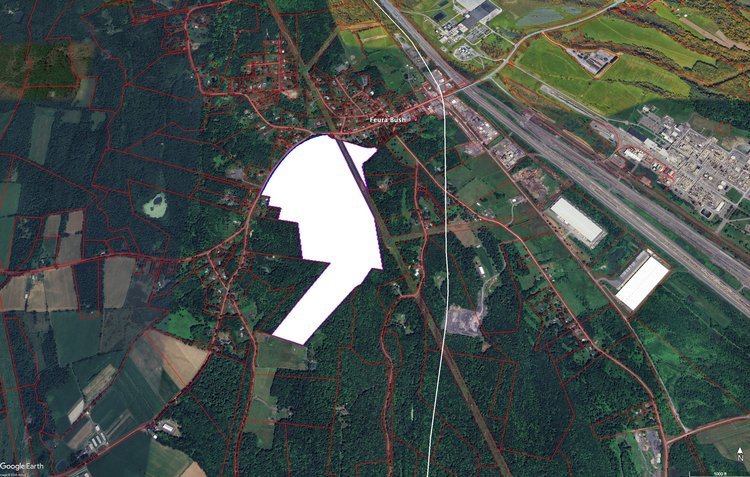
— From Google Earth
A large-scale renewable-energy storage facility proposed on a small portion of a 137-acre property at 1543 Indian Fields Road, pictured in white, recently received a major regulatory win.
NEW SCOTLAND — The New Scotland Planning Board earlier this month determined that a large-scale battery storage facility proposed for Indian Fields Road would not adversely impact the environment, clearing a major hurdle in the project’s approval process.
The adoption on April 7 of a negative declaration for the State Environmental Quality Review allowed for a public hearing to be set for May on a proposed subdivision of land the project needs for procedural purposes, and set the stage for a potential final decision in June.
As RIC appears poised for final project approval some time in the next couple of months, a separate BESS proposal for 37 Wormer Road continues to raise board concerns. The five-megawatt facility proposed by New Leaf Energy on land owned by New Scotland Councilman Adam Greenberg was presented to the town two months after RIC’s initial proposal.
No action was taken on New Leaf’s application on April 7, as board members cited the company’s need to:
— Address concerns raised about the energy storage facility’s cooling fans exceeding allowable noise levels;
— Show the reliability of an on-site pond to be used for fire suppression;
— Comply with the town’s policy for replacing felled trees; and
— Fulfill a legal agreement that would lock in New Leaf’s operational, financial, and environmental commitments to the town.
RIC Energy first came before the planning board in July of last year seeking approval to install a five-megawatt battery energy storage system (BESS) on seven acres of the New Scotland Beagle Club’s 137-acre property at 1543 Indian Fields Road in Feura Bush.
Five shipping-container sized batteries, each measuring eight feet high by six feet wide and 30 feet long, would stockpile solar energy collected during the day and send it to the grid during peak-use evening hours.
The renewable-energy storage facility is designed to discharge a maximum of 20,000 kilowatt-hours — roughly equivalent to the average daily electricity consumption of almost 700 homes — over the course of four hours.
Safety concerns
With BESS facilities both near and far garnering major media attention for catching fire, being extinguished, only to smolder for days, fire safety has been top-of-mind for board members since RIC first came before them 10 months ago.
The company worked with both the board and local fire departments, updating and refining its hazard-mitigation and emergency-response plans, and holding training sessions with the Onesquethaw and Selkirk fire departments covering BESS-specific safety testing, defensive tactics, water needs, and isolation procedures.
On April 7, the board was informed that its lone outstanding technical question had been largely resolved, as members were told that the town and RIC were now in agreement on a fire-department water-storage solution.
RIC, the board was told, proposed providing the Onesquethaw volunteer fire department with $200,000 — with another $40,000 available in case of cost overruns — to be used to construct a 20,000-gallon water tank.
While still a large number, the quarter-million-dollar set-aside will be significantly less than a previous request by the board to install a 50,000-gallon tank, whose increased costs Chairman Jeffrey Baker described as having become “astronomical.”
Keeping with the safety theme, board member Dan Byrnes said new information had recently been made available about a downstate BESS fire of which the board had been very aware.
The incident occurred in December at a BESS facility in the village of Warwick, in Orange County. The fire was confined to a single Powin-branded battery container, according to the village, which also said the energy-storage system was not authorized to be online.
Byrnes asked about air-quality testing from Warwick, but nothing new was known about the results.
The lack of testing results framed a new issue for board members: the thought of not having all the pertinent information available to make an informed decision on the project’s impact on the environment.
But Baker eased those concerns stating that, if any new information were to come out, the board could rescind its negative declaration. Not 10 minutes later, a copy of the report was found online, stating hydrogen cyanide levels stayed below federal limits, and no readings were found downwind for three days following the fire.
“I haven’t read this, obviously, but I’m comfortable proceeding with the neg dec along the lines that we’ve been talking about,” Baker told board members, who voted unanimously to adopt a negative SEQR declaration.