With public funding gone, Hilton barn project drags on
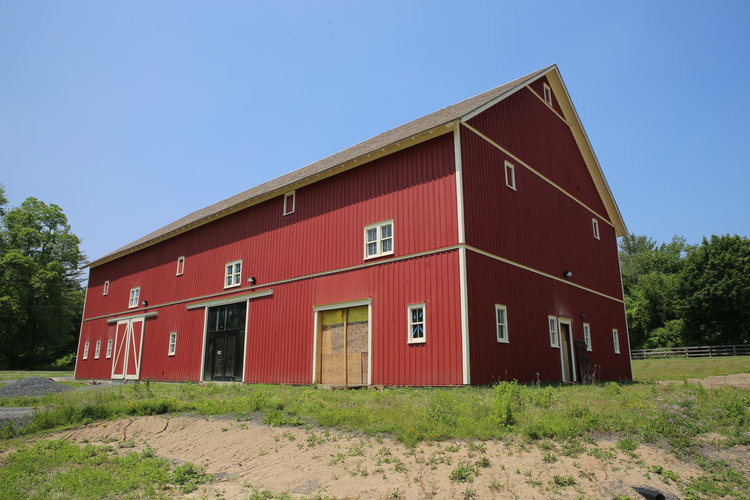
Enterprise file photo — Michael Koff
The town of New Scotland spent $294,000 to move the historic Hilton barn in 2016.
NEW SCOTLAND — With hundreds of thousands of dollars already expended on the project, it’s likely to take hundreds of thousands more to get the Hilton barn over the finish line.
Ten years after the town moved a historic barn across Route 85A to save it from demolition, the project faces a looming impasse: The exterior is finished, the money is gone, and fully half of the 7,200 square-foot building remains an unfinished shell sitting on bare ground with no heat, no plumbing, no electrical systems, and no floor.
The 125-year-old barn had an initial cost of $1.2 million, but then COVID happened, costs soared, and change orders were approved.
The cost of relocation alone — paid for with state grants and developer money paid into a town fund in lieu of providing open space — ate up nearly a quarter of the estimated budget.
It was thought in 2019 that half of the remaining $822,000 in project costs would be covered by a $411,000 matching grant from the state's Capital Region Economic Development Council, while Councilman Adam Greenberg said at the time that in-kind services, such as the town’s highway crew working on trails, would count toward the matching funds, adding that the town had over $250,000 in its developer-funded parks account — which Supervisor Douglas LaGrange said earlier in 2019 was being drained of $36,000 to help pay for moving the barn.
But that $822,000 figure — prior to additional change-order costs —would be quickly wiped away with the awarding of two major contracts with an initial aggregate cost of approximately $975,000.
The single largest award, $529,200, went to Sanz Construction of Staten Island t0:
— Remove, retain, and replace the barn’s existing siding;
— Install new wood double-hung windows, wood doors, and a storefront entry system;
— Install bathrooms;
— Reinforce areas of the concrete floor; and
— Perform associated electrical and mechanical work.
Two years after the award, the town approved roughly $150,000 in change orders after holes and deterioration were found in the upper-level siding.
Prior to the Sanz overages, board members agreed to pay slate-roof installer Mid-State Industries of Schenectady, which won the job with a $444,411 low base bid, an additional $61,000 for changes.
Approximate total so far: $1.48 million.
By the end of 2025, the town had allocated about $285,000 of the $600,000 it had received in American Rescue Plan Act funding toward the project.
Throw in another $20,000 for additional architectural oversight due to construction deadlines not being met, another $233,000 for site work, to say nothing of the potential legal costs that could be incurred from a lawsuit filed by a worker at the barn, and the publicly-available cost of the project stands at about $1.7 million.
Barn interior
It was amid this fiscal foundering on April 8 that the New Scotland Town Board found itself in a lengthy back-and-forth with Jesse Sommer over another financially fraught problem: the interior fate of the barn.
Sommer, a former town resident and sometime columnist for this newspaper, told board members, “I have a strong desire to establish what I would call the Helderberg Whiskey Lounge” as one of the barn’s first tenants.
“Where I’m not really just talking about a bar where things can get rowdy,” Sommer said. “You’re talking about a slightly more curated, higher-end experience.”
While Sommer’s whiskey lounge proposal was self-serving, it would also serve as the catalyst for a much larger structural discussion, as he proposed that the town board transfer control of the barn to a new independent entity — either through lease to a not-for-profit or by chartering a development corporation.
Under either model, the new entity — not the town board — would run a private capital campaign to raise hundreds of thousands of dollars more needed to finish work inside the barn.
The exterior of the building is fully stabilized, Sommer told board members. “It’s complete right now. You’re not going to get rained on if you’re inside the barn.”
But the interior is a different tale altogether.
One half of the building is nearing completion and is expected to be finished within a month or two. That section features a utility room, restrooms, and a horseshoe-shaped hallway that wraps around the bathroom core.
But the remaining 3,600 square feet of space is an unfinished shell, effectively untouched since the barn was moved to the site in 2016. There’s no heat, no interior plumbing, no electrical system, no insulation, no interior framing, and the floor is bare ground.
Sommer’s plans, board’s views
Councilwoman Bridgit Burke voiced a direct concern that a venue centered on alcohol would fail to attract the entire community and would “pretty much leave out minors altogether.”
Drawing a contrast between a whiskey lounge and a new ice-skating rink on site, Burke said, “Town facilities need to be forums designed for the entire family, rather than exclusively catering to those over 21,” clarifying that she has no issue with a standard restaurant that serves alcohol but views a dedicated “whiskey bar” as a fundamentally different environment.
Sommer pushed back.
He said he took “very strong personal offense” to the suggestion, arguing that alcohol is a standard part of the dining experience and noting that local families routinely bring children to establishments serving alcohol, Northern Barrel and Blackbirds Tavern — both in New Scotland — among them.
The remaining board members’ reactions mixed interest with exhaustion.
LaGrange said he was “tired of this,” referring to dealing with the barn’s development for the last 10 years. Without a clear path forward, he said, the town risks losing the momentum it has built.
Councilman William Hennessy noted that, while funding restrictions won’t allow the barn to be used as a museum, it can have a restaurant, as during the original grant application process, the unfinished side was specifically earmarked for a “café-type use.”
And while he welcomed the conversation about future uses, Hennessy emphasized that it’s “premature to talk about such uses” right now. His priority is closing out the current phase: partially finishing the interior, completing landscaping, and finalizing the paperwork to close out the state grants.
LaGrange said he wants to talk with town attorney Michael Naugton to examine how a leasing arrangement or development corporation would work, inviting Sommer to return for future meetings