After FMS boilers fail, students are learning remotely
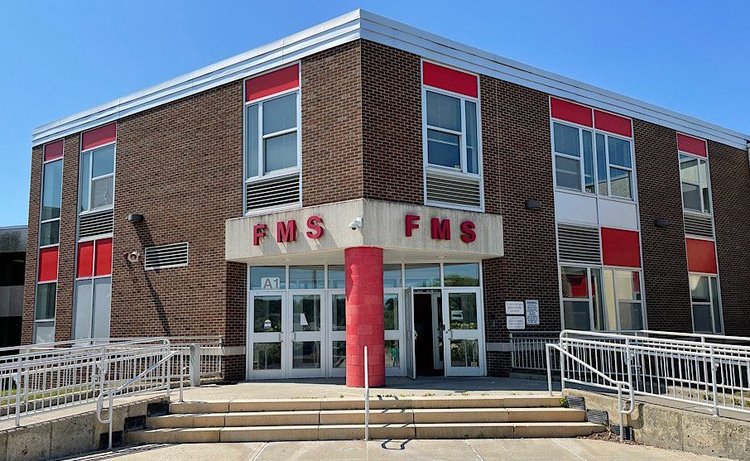
The boilers have failed at Farnsworth Middle School so students are learning remotely.
GUILDERLAND —Farnsworth Middle School students studied from home today and will again tomorrow. What happens next depends on the weather and on how fast a temporary solution can be found to heat the school.
Farnsworth is heated with three Lochinvar boilers — two were purchased in 2021 and the third in 2022 — and all three have had their cores fail, according to Guilderland school Superintendent Daniel Mayberry.
The core heat exchanger, he explained, “is essentially where you heat up the water … You’ve got the heating element and the water that flows around it; it’s that that has cracked and the water leaks out of it.”
He believes the boilers cannot be repaired but is hopeful that, since they failed just four or five years after being installed, well short of an estimated 15- to 20-year life expectancy, that warranties will apply.
“We’re working with the company to figure out what exactly the failure is and why and what the resolution’s going to be,” said Mayberry.
Lochinvar’s corporate headquarters in Lebanon, Tennessee did not respond to an Enterprise request for comment ahead of press time.
The state requires that schools be heated to at least 65 degrees. Temperatures in Albany reached a high of 40 degrees on Monday with a high of 49 is forecast for Tuesday, according to the National Weather Service.
Students were asked to move their musical instruments on Friday because cold temperatures can “wreak havoc” with stringed instruments, Mayberry said. “There are a limited number of spaces that are not on the boiler system for heat so they were moving the instruments into a space that could be better maintained temperature-wise.”
Mayberry went on, “We had to make a rapid decision about what to do when we determined that there was no way that we could heat the entire building to what is required by New York state …. With roughly 1,000 students, there’s no quick resolution to an alternative location at this point.”
Guilderland, like school districts across the state, had experience with remote learning because of the pandemic shutdown. Each student has a Chromebook from the school and, Mayberry said, “There’s a lot of classroom resources that are online for this purpose so that the students have continuous access to their curriculum material … It makes it not an easy transition, but an easier transition.”
Instructions posted to the district’s website outline a day of remote learning, starting with watching FMS TV News followed by logging in to check assignments and then attending live class sessions as teachers provide instruction from their homes.
Parents are asked to “help students choose a quiet, comfortable workspace” and to “encourage them to stay on top of assignments and communication” as well as supporting “a healthy balance between school work and free time.”
The school’s sports schedule has not been canceled and coaches are communicating with student athletes about their teams’ practice plans.
Asked if many students are home alone since both parents work, Mayberry said, “It all depends on the family and the situation, but some of them are, yes. So unfortunately, we do recognize that this is a disruption to all of our families.”
Middle-school students are in grades six, seven, and eight, ranging in age from 11 to 14.
The district offered to provide hotspots for homes that don’t have internet and “a handful” of households asked for hotspots, Mayberry said.
“Unfortunately,” Mayberry went on, “the forecast is not warming up the way we would like it to.” He was unsure on Monday what would happen after Tuesday, which is a second learn-at-home day.
“We don’t really want to go day by day,” Mayberry said, “but we’re working on some alternative solutions to heating the building.”
Clifford Nooney, director of physical plant management for the district, is “trying to find an alternative that will be basically a Band-Aid to get us through to the end of the year,” said Mayberry, declining to elaborate on what that might be.
“He’s casting far and wide, not for a permanent solution,” Mayberry said, “but something temporary to get us through till the much warmer days toward the end of the month of May.”
As the Guilderland School Board discussed next year’s budget proposal with administrators on March 31, members were wary of keeping large reserves when student-facing programs and jobs were being cut to balance the budget.
“We talk about these, like, hypothetical boilers a lot,” said board member Meredith Brière.
“They’re not hypothetical,” Mayberry and Andrew Van Alstyne, the district’s assistant superintendent for business, responded simultaneously.
“They’re real,” said Mayberry. “So, you know, if you work at FMS, they’re real.”
The district’s repair reserve would not be sufficient to replace a failed boiler, said Van Alstyne.
“The boilers,” continued Mayberry, “are hundreds of thousands of dollars and the repair reserve is $67,000, roughly.”
On Monday, Mayberry reiterated what he has said several times throughout this year’s budget process, “The gap is due to the difference between costs that we have as a district and the amount of revenue that we are allowed to generate due to the tax-levy-cap formula.”
He concluded of the situation at Farnsworth, “We are working on a solution to get all of our students back in the building as quickly as we possibly can.”