Governor pushes auto-insurance reform
The Enterprise — Michael Koff
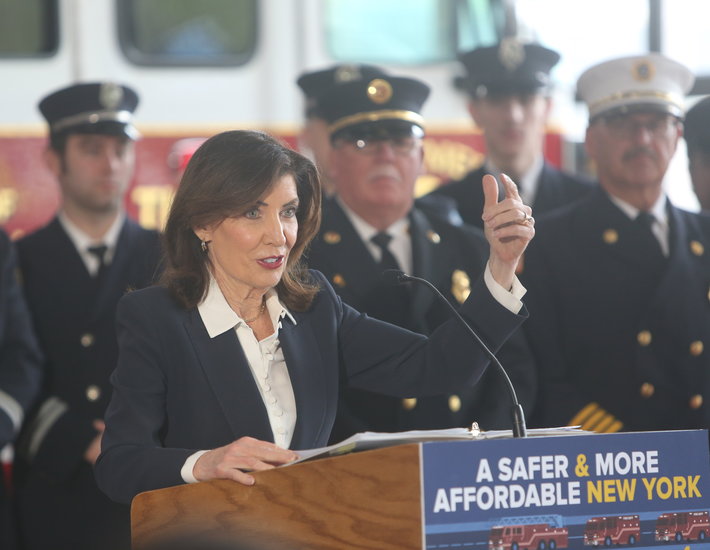
“We should put an end to a system that is rewarding this dangerous behavior,” said Governor Kathy Hochul of staged car accidents. She spoke on Friday morning at the Westmere firehouse.
GUILDERLAND — Sixteen days after the state budget was due, Governor Kathy Hochul held a press conference at the Westmere firehouse to stump for proposals she says will bring down car-insurance rates.
A row of uniformed volunteer firefighters stood behind her — both literally and figuratively. Leaders of the statewide Firefighters Association, Fire Coordinators Association, and Association of Fire Chiefs all spoke in favor of Hochul’s proposals.
Those who oppose the gridlocked measures — one of several issues holding up the state budget — include consumer advocates and trial lawyers who maintain the proposals would make it harder for injured parties to sue, would increase insurance-companies’ profits, and that there is no guarantee insurance costs will be lowered.
Hochul addressed some of those concerns on April 17 as she promoted what she called “common sense” measures.
She said that the Westmere department pays over $12,000 a year for auto insurance, which has increased $2,000 a year over the last five years.
She noted the state has over 1,600 volunteer fire departments staffed by nearly 91,000 volunteers. The increased costs for insurance, Hochul said, mean that it is more difficult to cover other expenses.
“We in New York have some of the highest auto insurance rates in America, averaging $4,000 a year per vehicle,” said Hochul. “And that’s $1,500 more than the national average. … No one has ever questioned this before until now. And that’s what I do. I question the status quo. I ask why. I said, ‘Why is this so expensive?’”
Hochul asserted that the high rates are because of “runaway litigation costs” and “staged accidents …. We have about 1,700 staged accidents. These are criminals …. It’s really brazen what people are getting away with.”
Hochul said the volunteers she spoke to at the Westmere firehouse were called away from their family dinner tables for these staged accidents.
“We should put an end to a system that is rewarding this dangerous behavior,” said Hochul.
Her proposals, she said, would make it easier to prosecute staged accidents, strengthen penalties for law-breakers, and reform tort laws to “protect the people who play by the rules and stop the abuse in the personal-injury system.”
Insurance carriers reported 43,811 incidents of suspected motor vehicle insurance fraud to the state’s Department of Financial Services Insurance Frauds Bureau in 2025, according to the governor’s office, representing an 80-percent increase in five years.
Hochul’s legislation would allow prosecutors to pursue criminal penalties for anyone organizing a staged accident, not just for the driver. And the time frame for prosecuting fraud would be extended.
It would also strengthen efforts to prosecute doctors who sign off on fake medical diagnoses, allowing huge payouts. And it would take action on New York drivers who illegally register their cars in other states.
Payments would be capped for drivers who are uninsured motorists, who are convicted of driving while impaired, or who are committing a felony or fleeing one at the time of an incident.
Hochul’s legislation would also limit the damages a driver could get if he or she is mostly at fault for an accident, and it would reform the serious-injury threshold by proposing objective medical standards for what qualifies as a serious injury.
Hochul said there is evidence that such legislation is effective, citing the state of Florida.
“They enacted the very laws that I’m trying hard to get through in the state of New York and their premiums went down dramatically,” she said.
Anyone involved in an accident, Hochul said, would still be entitled to fair compensation for damages.
“But they’re not entitled to millions of dollars in additional compensation from suing victims when they cause the accident or a drunk driver goes through a red light, causing an accident.
“Why should that person be a beneficiary of a jackpot payout?” the governor asked.
Support
“We see the real-world consequences of dangerous behavior on our roads,” said Donald Farrell, first vice president of FASNY. “Staged auto accidents do not just raise insurance costs; they put lives at risk — including the lives of our emergency responders and innocent motorists.”
FASNY, he said, strongly supports Hochul’s reforms. “They take direct aim at staged-crash rings and fraudulent claims, which happens far too often through the state. These claims waste resources, drive up premiums, and divert emergency crews from genuine emergencies.”
He concluded, “Reducing fraud means protecting lives, protecting families, and making the rules safer for our first responders and the public we serve. Just as important, these reforms will help address concerns for working families, including tens of thousands of volunteer firefighters that protect our communities every day.”
Volunteer firefighters often respond to accidents and fires and go to training in their own private vehicles, said William Streicher, director of the Fire Coordinators Association, which represents 57 counties.
“They don’t ask anything in return,” he said, “but right now the costs they are facing are simply unsustainable. Auto insurance is a major burden for volunteers who rely on their personal vehicles to respond to calls and training …. Every added cost discourages participation and puts pressure on our already strained volunteer system.”
“Every time something costs money,” said Bruce Heberer, chief executive officer of the New York State Association of Fire Chiefs, “it takes away from our fire protection, it takes away from our mission in the fire service. We also want to make sure that our responders are safe and continue to be safe.”