People with paralysis will learn archery at the Heldeberg Workshop
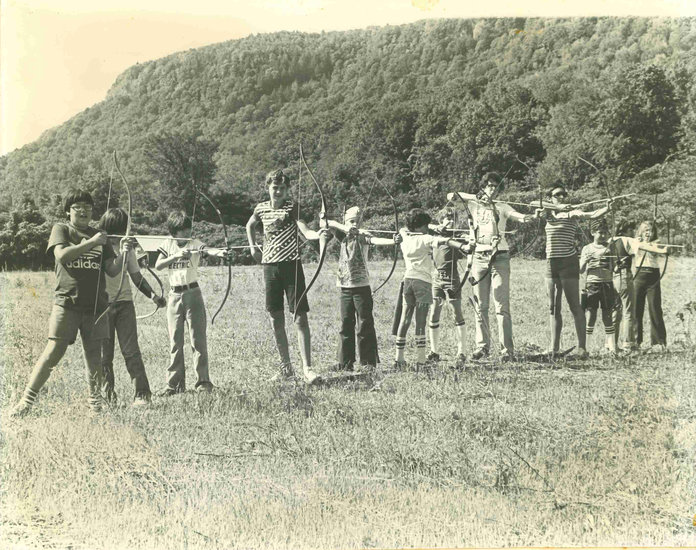
— Photo from Heldeberg Workshop Archives
The Heldeberg Workshop has long taught archery to kids. Now it will teach archery to people with paralysis.
NEW SCOTLAND — Come fall, five people who live with paralysis will have a chance to become archers.
A series of lessons will be taught at the Heldeberg Workshop thanks to a $24,999 grant from the Christopher & Dana Reeve Foundation secured by Dorothy Matthews. The foundation carries the name of the actor most famous for his role as Superman; Reeve was paralyzed in 1995 in a horse-riding accident — he died in 2004.
Matthews was inspired to apply for the grant after the workshop held its first maple festival last year. After years of planning, a sugar shack was built on the workshop property from trees felled on the land.
“The sugar shack was a long time in the making,” said Matthews, “and we had a festival a year ago and one of the people who came was in a wheelchair.”
The path to the sugar shack is muddy in the spring and Matthews was concerned that people in wheelchairs couldn’t get there although last year’s visitor made it in her army-issued vehicle.
“I thought, well, that’s great, but what about other people who don’t have a really expensive wheelchair and aren’t able to access our facilities?” recalled Mathews. “So we got an estimate.”
It came to $37,000 to upgrade the main road, which would allow people using wheelchairs access not just to the sugar shack but to the performing arts stage and to the archery field as well.
Matthews described the current road as rough with a lot of ruts “especially in the spring or if we have a wet summer.”
The plan, she said, is to bring in “tons of gravel” that will be leveled “with a vibrating roller so it will be a much sturdier, more solid surface.” There will also be six large parking spaces designated near the archery field.
“Then I thought, well, the Christopher Reeve Foundation might be a good place to go to see if we could get support for that idea,” said Matthews.
As she wrote the grant application, Matthews kept in mind the purpose of the Heldeberg Workshop. “It’s not only to provide access to such a beautiful facility but also to provide experiences that people could have,” she said. “So I thought, well, wheelchair archery would be a fantastic thing to be able to offer people.”
The foundation thought so, too. Under its Quality of Life program, more than 4,100 grants totaling $50 million have been awarded since the program’s inception.
“These grants represent more than funding — they represent freedom, possibility, and dignity for individuals living with paralysis,” said Dan McNeal, director of the Quality of Life Grants Program at the Reeve Foundation, in a release announcing the grant.
“At the heart of our mission,” McNeal went on, “is a commitment to improving everyday life for our community. We’re proud to support organizations nationwide that are expanding access and creating programs built on accessibility, care, and respect.”
The Matthewses
Dorothy and her husband, Michael Matthews, both biologists, have been on the workshop board for decades. He is a wildlife biologist, retired from his work at the state Department of Environmental Conservation.
She’s a microbiologist, retired from teaching for 37 years at Russell Sage college.
Their three children grew up attending workshop programs, which is where their elder daughter became interested in rocks. She’s now a geologist living in Texas.
Their younger daughter works for the foreign service. After being stationed in Rome for two years, she’s now in Papua New Guinea. Their son, a middle-school administrator in Troy, is an outdoorsman and fitness specialist, currently climbing the 46 Adirondack High Peaks with his 9-year-old son.
Matthews has been busy in her retirement, working with the Helderview Garden Club, the New Scotland Historical Society, and being with her six grandchildren who range in age from 2 to 9.
But she’s especially proud of the grant-writing abilities she’s developed in applying for funds for the workshop. Among other grants, she secured an $8,000 grant from the Preservation League of New York State to fund a cultural landscape report.
Walter Richard Wheeler, senior architectural historian at Hartgen Associates, produced a 159-page report that, as Matthews described it this week, “really revolutionized the way we think about the workshop because we had an expert who came and looked at how the property was used by human beings since before the Europeans came and really with a broad historical view of what happened on the land and the founders of the workshop and their ideals.”
When the board members first reviewed the report in 2023, several people described the workshop land as “magical.”
“We hear that a lot,” said David Wallingford, who chairs the workshop’s board. “This is the place dreams are made of.”
The 237 acres that make up the workshop property include 20 miles of hiking trails, a pond, a wetland, a waterfall, meadows, and the slope of the escarpment, providing access to diverse ecological and geological sources.
That property is part of the Helderberg Conservation Corridor, protected through the Mohawk Hudson Land Conservancy. The workshop’s land is part of a 3,700-acre corridor, stretching from the Black Creek Marsh to John Boyd Thacher State Park.
Beginning with Jean Pauley — unable to answer her son’s science questions — who led three other “founding mothers” in the 1960s to set up summer classes in Voorheesville’s high school, the Heldeberg Workshop now offers year-round courses in science, nature, theater, art, and high adventure with more than 1,000 children attending classes each summer.
Wheelchair archery
USA Archery is the National Governing Body for the Olympic sport of archery, responsible for training, selecting, and supporting U.S. teams for international competition and supports a para archery program.
“Archery is a sport that is open to everyone; it is inclusive of all ages, genders and abilities,” says USA Archer on its website. “Athletes with physical or cognitive impairments, who may otherwise be dissuaded from participating in sports can participate in archery alongside athletes without any disability.
“Whether your goal is to just get out and socialize or be active, or to make a U.S. Paralympic or World Championship Team, archery is a sport that lends itself to any need,” it goes on. “Simple adaptations to archery programs can break the stigma associated with disabilities and remove the barriers to conversations and interactions among groups of people who might otherwise be separated.”
“They have videos to train instructors on dealing with people who need an adaptation to enable them to practice that sport,” said Matthews. “Some people take it very seriously.”
Heldeberg Workshop will have an instructor, Chuck Dente, who has had experience teaching archery to people who need adaptations.
Michael Matthews, a lifelong hunter and archer, knew Dente through his work at the DEC.
“This is a process,” said Matthews of developing the program. “You come up with an idea and then you realize, well, there’s a lot of things that need to be done to actually be able to successfully bring your idea to fruition.”
The workshop board has been very supportive of the wheelchair archery program, Dorothy Matthews said. The board voted to take money from the workshop’s general fund to cover the $12,000 difference between the Reeve Foundation grant money and the $37,000 needed to level the road.
That still left a need that was filled by an “angel donor,” Matthews said.
Using the current workshop outhouse is “a very intimate experience,” she said. “It’s like being in a telephone booth.”
The donor gave $10,000 for a wheelchair-accessible bathroom to be built near the archery field, since the lessons may last for hours, she said.
This week, Matthews along with her husband and Dente will visit the home of Paula Leonard, widow of Mike Leonard — another angel donor of sorts.
Lyndon “Mike” Leonard taught archery at the workshop for many years and served as a member of its board of directors. He was a New York State Archery Chairperson for the Empire State Games and earned numerous medals from state archery events himself, including two Bronze medals from the National Senior Games.
Born in 1948, he served for four years with the U.S. Air Force as a Blue Beret during the Vietnam War. He taught industrial arts at Berne-Knox-Westerlo for 30 years and was an avid archer, hunter, and angler. He died in 2018.
“He had an extensive collection of bows,” said Matthews, “and I think he also made his own arrows. His wife has offered to give us the equipment we might need.”
Matthews went on, “That will give us good quality bows rather than the ones that we have that the children use for their archery classes.”
The plan then is to reach out to Sunnyview Rehabilitation and to STRIDE Adaptive Sports to recruit five people who want to learn archery come September.
The schedule has not yet been set — lessons may be given over five consecutive days or split over two weekends.
In preparation for writing the grant, Matthews attended a seminar that taught her “people oftenover-promise.”
“The Christopher Reeve Foundation is not looking for pie in the sky,” she said. “If it benefits five people, that’s good enough for them. … It means five individuals will learn something new. And their caretakers will also benefit in a variety of ways.
“They’ll have a reprieve. They’ll have the satisfaction of having their loved one participate in an event that they may really enjoy.”