Voorheesville sends second letter to Hochul about Norfolk Southern
The Enterprise — Michael Koff
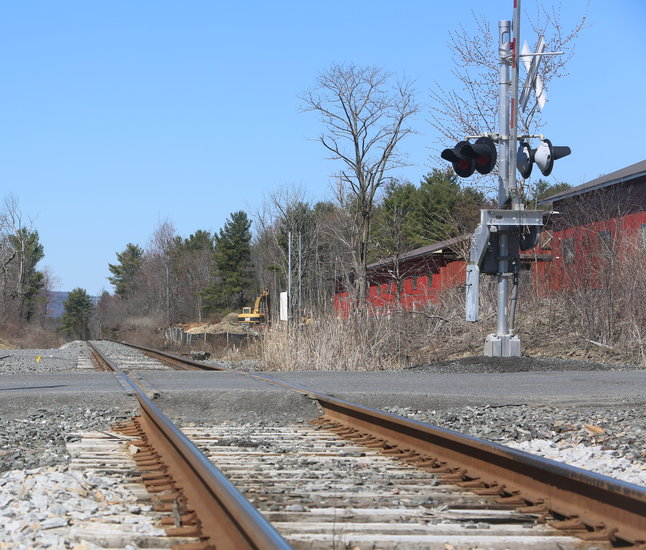
Norfolk Southern has started work on its crew-change facility in Voorheesville over objections from the village.
VOORHEESVILLE — The village of Voorheesville has doubled down on its dispute with Norfolk Southern.
The village is once again asking Governor Kathy Hochul to add Norfolk Southern Railway — the recipient of a $5 million grant to upgrade the rail line running through the heart of the village — to the state’s list of non-responsible, debarred, and otherwise ineligible contractors, a designation that would bar the freight carrier from future state funding.
Mayor Rich Straut’s second letter to the governor in less than three months, dated March 24, builds on his February missive, documenting what he describes as a pattern of broken promises and falsified property records. His complaint builds on claims of the freight carrier’s insistence of blanket exemption from local building codes, environmental permits, and zoning regulations while constructing its crew-change facility — all the while worsening public-safety conditions.
Both letters document train blockages at village crossings — but the conditions have worsened. In February, Straut wrote that a westbound Norfolk Southern train blocked the School Road crossing for approximately 20 minutes, with no advance notice to public-safety agencies.
By March, the most recent stoppage had blocked traffic for more than 45 minutes — again without notice — in a village where stopped trains can sever emergency access across multiple grade crossings.
To date, $3.3 million of the 2022 grant has been dispersed.
Governor Hochul’s office did not respond to an Enterprise request for comment.
Norfolk Southern did not immediately respond to a request for comment.
The state awarded the Passenger and Freight Rail Assistance Program grant to Norfolk Southern for safety and service-reliability enhancements along the 15-mile Voorheesville Running Track — which begins in Duanesburg and wends through Altamont to connect to a CSX line in Voorheesville.
The grant agreement, Straut writes, requires the company to comply with all applicable federal, state, and local laws and regulations.
Norfolk Southern, the mayor argues in both letters, has done none of that.
History
The crew-change facility is a product of Norfolk Southern’s push to capture the car-moving freight market between New York and New England. The railroad’s crews start as far west as Binghamton — 130 miles from Voorheesville — and by the time they reach the village, they are near the end of their federally-mandated work shift.
Norfolk Southern then travels on 161 miles of CSX-owned track between Voorheesville and central Massachusetts, but cannot stop anywhere along that route. Voorheesville is the last opportunity for a crew swap before the train enters CSX territory, the company has claimed, where it must keep moving without interruption through to the other side of Massachusetts.
To meet these demands, Norfolk Southern in July 2025 paid JC Pops Industrial $450,000 for an acre of land at 1 Countryside Lane to build its facility. The village has claimed the purchase an “illegal carveout” of JC Pops’ 5.7-acre parcel, arguing it required formal subdivision review and left the remaining property noncompliant with minimum lot-size requirements.
In September 2025, the railroad sent the village a letter stating it was “about to commence construction of a building that will support railway operation” and claimed it was exempt from local land-use regulations. The village issued a stop-work order the same day. Norfolk Southern sued in federal court.
On Dec. 3, a judge enjoined the village from applying its zoning code in a manner that would have blocked construction of the facility, but specifically stated that the order did not extend to the village’s water system and was limited to the village’s ability to enforce the stop-work order it had already issued.
Pledges ignored?
Under the terms of a January stipulation and order of dismissal, according to Straut’s letter, Voorheesville may not enforce its zoning code against the crew-change facility, but Norfolk Southern must also seek water, sewer, and other municipal connections through the same process as any other commercial enterprise, including any customary terms and conditions.
Straut’s March 24 letter argues that the company, which has started work at the site, has gone far beyond the scope of what the federal court authorized.
Norfolk Southern's agents, Straut wrote, have now claimed exemption from the New York State Building Code itself, including the basic requirement to secure a building permit for new structures and associated plumbing and electrical work.
The railroad has also refused to obtain a stormwater-management and erosion-and-sediment-control permit, the mayor wrote, and has not sought a SPDES (State Pollutant Discharge Elimination System) permit the village believes the scale of land disturbance would require.
Straut argues that, in administering the state building code and stormwater law, the village effectively acts as an agent of the state, meaning whatever federal preemption Norfolk Southern may claim, the railroad accepted millions of state dollars based on representations in its grant application and a written commitment to comply with all applicable laws and regulations.
“Nevertheless, Norfolk Southern now takes the position that, having received the Grant, it can ignore its pledges to adhere to any of those requirements,” Straut wrote.