Governor declares a war on potholes, announces paving projects
— Photo from the NYS Governor’s Office
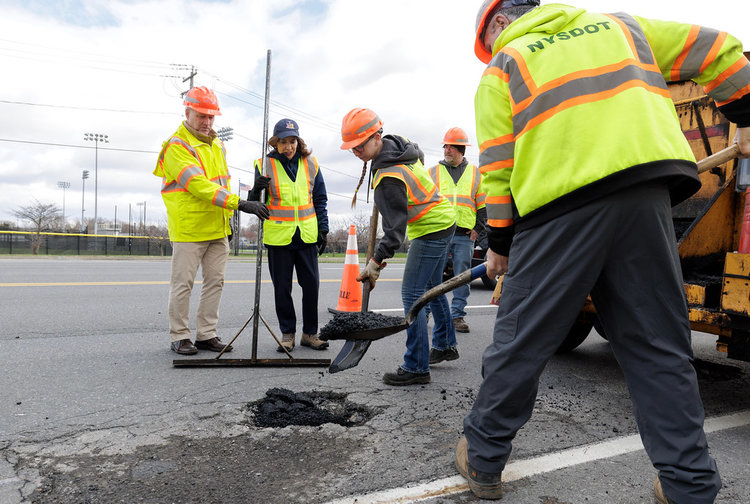
Kathy Hochul, at a press event on April 6, watches a DOT crew fill a pothole before filling one herself.
In springtime, a governor’s thoughts turn to — potholes and paving.
Governor Kathy Hochul held a press conference on April 6 to announce what she called an unprecedented initiative after a hard winter to pave state roads and fill potholes.
“Potholes, your days are numbered,” Hochul said after filling one herself under the tutelage of a Department of Transportation crew.
“This week we're planning on eliminating over 44,000 potholes statewide,” Hochul went on. “By the end of the month, 175,000, by the end of the year — if we hit last year’s number — it’s 1.3 million, but I think we’re going to go even higher than that.”
She also said, “This will be the biggest year in state history for road paving. I’m here to say that we understand the pain and frustration of drivers.”
In the Capital Region, these major paving projects are slated to start in the coming weeks:
— 113 lane miles from Western Avenue to Exit 11 on the Adirondack Northway in Albany and Saratoga counties;
— 23 lane miles on I-90 from Exit 1 (87 Split) to Exit 5A (Corporate Woods Boulevard); and
— 2.4 lane miles on Route 385 in Athens.
Priority locations in the Capital Region for this week’s pothole-filling push include:
— Central Ave/State Route 5 in Albany and Schenectady counties;
— “The Box” (routes 787, 90, Northway, 7 area); and
— State Route 443/Delaware Avenue.
In April, 215 crews will place more than 8,000 tons of asphalt to fill an anticipated 175,000 potholes statewide, according to a release from the governor’s office.
Motorists are urged to call 1-800-POTHOLE (1-800-768-4653) to report potholes on any state-owned highway, including the Thruway, except in New York City, where motorists may report potholes by dialing 311.
Potholes on county or town roads, city and village streets, or private roadways should be reported to the appropriate owner.
Potholes are formed primarily due to infiltration of water into pavements through cracks in the surface. Cold weather causes the water to freeze, creating a bulge in the pavement.
When the temperatures warm above freezing, the pavement surface returns to its original level. Subsequent freeze-thaw cycles weaken the pavement material and a pothole forms.
The process repeats itself during subsequent freeze-thaw cycles and potholes become worse and more numerous. Heavy traffic also contributes to the creation of new potholes and the worsening of existing ones.