‘Welcoming presence’: Bronze statue will meet hikers at end of Long Path
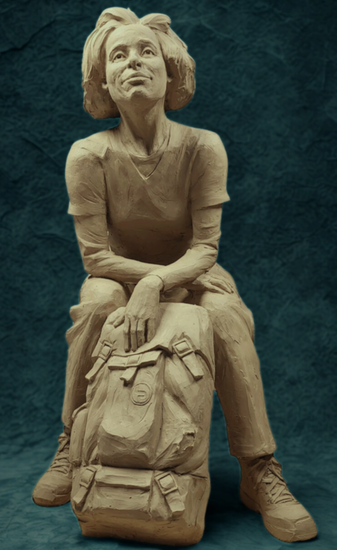
Sculptor Craig Campbell has created this model of “Journey at Rest,” which will soon be on display in Altamont so villagers can suggest names for the hiker.
ALTAMONT — A vision is taking shape for the end point of the Long Path in Altamont.
A sculptor, Craig Campbell, has been selected and made a model of the life-size woman who will permanently be at rest near the village green, her backpack at her feet, her face turned upward.
A public unveiling of the bronze statue is slated for September but, in the meantime, a maquette, or model, of the statue will be placed in various spots around the village as Historic Altamont, which commissioned the statue, is hosting a naming contest for the woman.
“For local residents and visitors, the sculpture is envisioned as a familiar and welcoming presence over time,” said Jodi Wey, who spearheaded the project, in a release. “For hikers completing the Long Path, it will offer a place to pause, take photographs, and mark the end of their journey.”
Last June, after Historic Altamont received a $25,000 grant through Albany County from federal pandemic funds, to cover the design phase, Wey told The Enterprise, “It’s not going to be just a garden-variety statue that’s quieting the mind but something that really engages you and gets you thinking.”
The Long Path begins in Manhattan near the George Washington Bridge and wends its way north, to the Helderberg escarpment, concluding in Altamont where Historic Altamont built a kiosk across from the village green. The $30,000 kiosk was also funded through county pandemic grants.
“Our hiking friend,” said David Bourque, president of Historic Altamont, of the planned statue, “will provide an Instagram moment” for walkers completing the Long Path.
He also said, “It’s going to cost three times what the kiosk cost.”
Wey was inspired by the statues she saw as she walked the Camino de Santiago on the cusp of her 50th birthday. The trail, which leads to a shrine for the apostle James, was first followed by pilgrims in medieval times but is now popular with hikers, cyclists, and tour groups.
Wey made the month-long journey by herself, walking 12 to 14 miles a day for 30 days, spending her nights in a series of pensions, family-owned guest houses, which she described as similar to B&Bs.
Wey, who is an emergency veterinarian, said, “I was able to get away from work commitments, family commitments.”
She said of the statues she saw along the way, “They added so much to the experience of walking a long trek and just a reflective experience, the spiritual journey, the physical journey, and the challenge. It really made the whole experience more magical to just experience humanity through the form of art … public art installations that dotted the path and made it even more exciting to reach the next destination, the next small town.”
Wey wrote in her grant application to the county, “Public art has the ability to capture our attention, electrify our spirit, and elevate our humanity.”
She also wrote of the proposed statue, “While set on no specific gender, age, or face in mind for the hiker, the sculpture would capture the spirit of a well-worn hiker, whose thoughtful and serene expression hints at their inexhaustible wit.”
Wey got what she envisioned last June: a life-sized figure called Journey at Rest.
“It’s a hiker that is worn but extremely resilient, and has this look of, ‘I’m tired. I just did a really long adventure, but my mind is not tired. I’m engaged. I’m reflecting’ … It’s just kind of a positive message of the resilience of the human spirit.”
Weyhad said in June, “We’re trying to find someone who can bring that to life … so it has a spark to it … just kind of witty humor.”
The selected sculptor, Craig Campbell, wrote in a blog post earlier this month, “At its heart, sculpture is about connection — between the artist and the viewer, between the artwork and its environment, and between people and their shared stories …. Sculpture is more than an object — it is a living expression of creativity and connection.”