Guilderland zoning board sued over fence decision
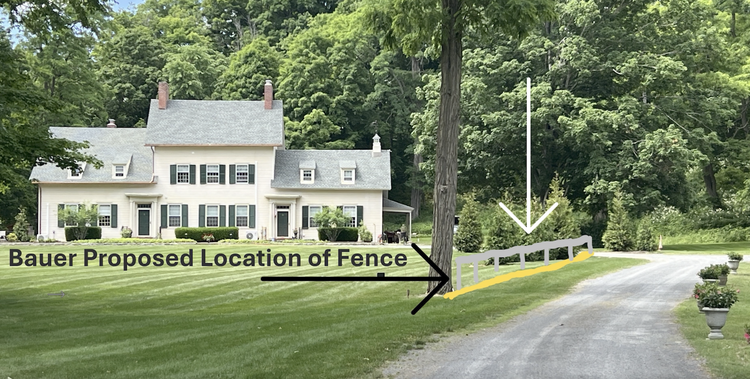
— Still from Matthew Reuter’s submittal to the town of Guilderland
A lawsuit was recently filed against the Guilderland Zoning Board of Appeals after it agreed with the owner of the historic Norman Vale home that its neighboring property owner should not be allowed to install a fence along a shared driveway.
GUILDERLAND — After voting to disallow a homeowner his right to install a fence on his property because its location would impede the “viewshed of [a] historic home,” that owner has filed suit against the Guilderland Zoning Board of Appeals.
The board’s unanimous Feb. 4 vote overturned a building permit issued for a fence running along a shared driveway between the historic Norman Vale home and property at 3 Norman Vale Lane. The board reasoned the fence would obstruct the historic view of Norman Vale and found the property owner, Douglas Bauer, could not articulate a reason for erecting the barrier.
On March 6, Bauer filed an Article 78 complaint — the legal mechanism for challenging a municipal determination — seeking to have the zoning board’s decision annulled and his building permit reinstated. The town declined to comment.
The dispute centers on the parcel at 3 Norman Vale Lane, owned by Bauer, who purchased the broader Norman Vale property out of foreclosure in October 2017. Bauer subsequently subdivided the estate into three lots, keeping two of the lots for himself, building modern homes on each of the subdivided parcels, and selling the historic house in 2023 to Matthew Reuter.
Reuter’s historic home and Bauer’s modern home share a driveway off of Nott Road. It was Reuter who asked the zoning board on Feb. 4 to reconsider the issuance of the building permit.
In September 2025, Bauer was issued a permit to install 130 feet of four-foot high decorative metal fence along Reuter’s side of the shared driveway, which is on property owned by Bauer, who also received permission to install a six-foot tall wooden fence along the rear property boundary.
Reuter subsequently filed an appeal, arguing that the building inspector’s decision failed to account for his home’s historic designation. His appeal argued that Bauer had filed an incomplete permit application because it didn’t specify the fencing material; that Bauer needed a variance; and that the fence would violate an easement agreement between property owners.
The determination
The zoning board, in its interpretation, noted that the town’s zoning code generally allows for the type of fence Bauer was proposing, but voted unanimously to rescind the permit based on:
— Town code defining a “historic structure” as one individually listed on the National Register of Historic Places, which Norman Vale is, and “existing features which would add value to residential developments” — including historic locations — “shall be preserved, insofar as possible, through harmonious design of the subdivision”; and
— An August 2018 New York State Office of Parks, Recreation, and Historic Preservation letter related to subdivision of property that recommended maintaining “a direct link/view between the historic building and the road,” establishing tree-line buffers, and avoiding obstruction of buildings or driveways in front of the house.
Bauer’s contention
Bauer in his court filing contends the zoning board determination was unlawful for four reasons:
— The decision was arbitrary and capricious.
The zoning code’s fence provision, Bauer argued, is unambiguous: a decorative fence under four feet in height, which is what he was proposing, is permitted in a front yard. The code contains no exception for proximity to historic structures.
“Indeed, the Zoning Code does not define the term ‘historic structure,’” the suit asserts. Bauer seeks to narrow the scope of Guilderland’s code to just chapter 280, which governs zoning in town.
Guilderland’s code defines a historic structure as any structure that is:
“(1) Listed individually in the National Register of Historic Places (a listing maintained by the Department of the Interior) or preliminarily determined by the Secretary of the Interior as meeting the requirements for individual listing on the National Register;
“(2) Certified or preliminarily determined by the Secretary of the Interior as contributing to the historical significance of a registered historic district or a district preliminarily determined by the Secretary to qualify as a registered historic district;
“(3) Individually listed on a state inventory of historic places in states with historic preservation programs which have been approved by the Secretary of the Interior; or
“(4) Individually listed on a local inventory of historic places in communities with historic preservation programs that have been certified either:
“(a) By an approved state program as determined by the Secretary of the Interior; or
“(b) Directly by the Secretary of the Interior in states without approved programs”;
— The zoning board exceeded its jurisdiction.
Bauer asserts town code §280-54(B) grants the zoning board authority to interpret “any provision of this chapter,” meaning chapter 280, which is titled “Zoning.”
The board, Bauer claims, instead, based its determination on two entirely separate chapters of the code, Chapter 177, titled “Flood Damage Prevention,” and Chapter 247, titled “Subdivision of Land.”
The board had no authority to invoke those chapters, the petition argues, and its attempt to do so exceeded the jurisdictional grant set forth in New York State Town Law §267-a(4);
— The zoning board violated the state’s Town Law.
The third ground tracks the previous statute.
New York’s Town Law, Bauer claims, limits a zoning board’s appellate jurisdiction to decisions made by administrative officials enforcing the zoning ordinance, not the building code, not the subdivision law, and not flood-prevention regulations; and
— The determination lacked substantial evidence.
Bauer claims that no evidence was proffered to show that the proposed fence would actually impair the viewshed from Nott Road.
His petition claims that photographs of the area show the proposed fence location is not situated between the historic house and the road, and that a row of trees already partially obstructing that sight line was planted not by Bauer but by Reuter.
The board, Bauer claims, accepted Reuter’s characterization of the permit without ever reviewing the actual approved permit.