Plan for 210 housing units on New Karner Road clears first hurdle
— From plans submitted by Pine Bush Park LLC
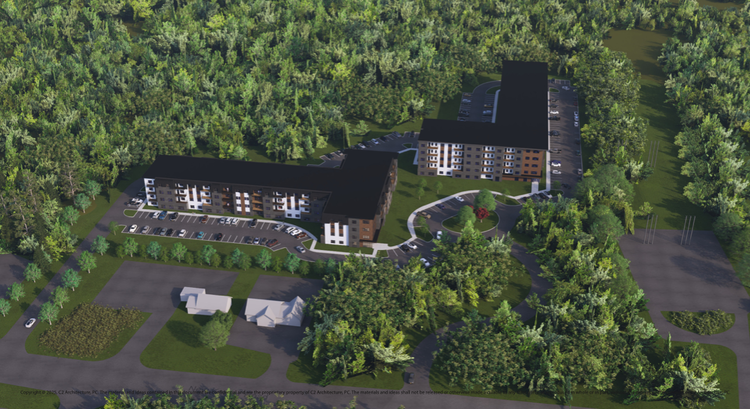
A rendering of the two buildings that would have a combined 210 apartments, accessed from New Karner Road (Route 155). Two single-family homes already exist next to the road.
GUILDERLAND — In a split vote on March 3, the Guilderland Town Board allowed a proposed Planned Unit Development for New Karner Road to proceed to the planning board.
Deputy Supervisor Amanda Beedle cast the sole dissenting vote after raising concerns about traffic.
The town’s planner, Kenneth Kovalchik, recommended the PUD, citing ways in which the proposal follows recommendations of Guilderland’s recently updated comprehensive plan.
Three people objecting to the proposal also cited the new comprehensive plan as they stated the importance of preserving the globally rare pine bush.
The area is currently zoned as Business Non-Retail Professional. The development on roughly 51 acres would cover three adjacent parcels at 20, 22, and 24 New Karner Road, just north of its intersection with Route 20.
The center parcel, at roughly 40 acres, is bisected by the Kaikout Kill and would not be developed; rather, it would be rezoned as Open Space and conveyed to the Albany Pine Bush Preserve Commission.
The project, which would use about 11 acres, or 22 percent, of the 50 acres would consist of 210 units in one four-story building and one five-story building. Thirty-two of those units, or 15 percent, would be designated as workforce housing, reserved for households making between 80 and 120 percent of the area median income.
In 2017, the town board had approved a Planned Unit Development on the same site that was to include 96 units for independent senior living, 56 units for assisted living, and 40 units in a memory-care facility. Similar to the current proposal, about 40 acres was to be conveyed to the Pine Bush commission.
In 2021, that proposal, still a PUD, was amended to remove the senior-living units and make them affordable senior-living units instead while keeping the memory-care and assisted-living units.
In a memo to the town board, Kovalchik said he recommended accepting the PUD application because of the need for affordable housing in town, because the board previously approved a PUD for the site, because most of the trees along New Karner Road would be preserved as a buffer, and because 78 percent of the land would be conveyed to the Pine Bush commission.
Parts of the updated comprehensive plan that were cited included preserving natural resources and habitat, expanding opportunities for housing types other than single-family dwellings, and adding inclusionary zoning for affordable housing.
Michael Vaillant, a senior engineer with Lansing Engineering, spoke to the board on behalf of the developer, Pine Bush Park LLC.
Supervisor Peter Barber said that, while he appreciated the donation of land to the Pine Bush, he asked if the buildings could be “stretched out” so their height would be reduced.
He acknowledged that expanding the footprint of buildings to lower their height is a “mixed question” because the footprint of a building usually has the greatest impact on the environment.
Barber also called the 15-percent workforce housing “a good start,” noting the need in Guilderland.
Councilman Jacob Crawford said, “Typically, if we were looking at a PUD, I would be asking about commercial space, but this is a bit more unique because there’s not a whole lot of direct access to [Route] 155.”
Traffic
Beedle said she traveled that “horrific part of 155” every day, describing navigating to a “small plaza” as “an absolute nightmare.”
Kovalchik said a roundabout is proposed at Washington Avenue Extension.
Kovalchik surmised that the traffic would have been heavier with the 2017 proposal since assisted-living and memory-care units would have required staffing.
“So, with this, it’s straight multi-family,” said Kovalchik. “There’s no commercial.”
Alanna Moran, a principle engineer with Lansing, said, “We will be completing the traffic evaluation for the proposed project.”
A trip-generating estimate, she said, showed that, based on 210 units, about 80 trips are anticipated during the morning peak hour and about 86 trips during the evening peak hour.
If there were 20 single-family homes, she said, “You’d be looking at about 200 trips.”
Moran said there are about 18,000 vehicles traveling on the road daily.
“What we’re going to be looking at, though, is gaps in traffic. So we’ll actually measure the amount of time between each vehicle to confirm that, for the number of trips estimated at this site, that we can safely enter and exit the roadway here.”
“I can tell you,” said Beedle, “that one point of egress near that little shopping plaza is absolute death.”
“We’re going to look at all of that to make sure that it’s a nice safe space for people to enter and exit, because that’s what the applicant wants to do — they want to have a nice, safe place for their residents.”
Pine Bush
Kovalchik said the 50 acres is recommended for “full protection” by the Pine Bush Preserve Commission; that designation means the property is to be conserved in its entirety or to the maximum extent practicable.
The commission’s technical committee is reviewing the application, Kovalchik said. “It will be referred back as part of their SEQR coordinated review,” he said of the State Environmental Quality Review.
Kovalchik also noted that the Kaikout Kill bisects the center property. “So there’s steep slopes on either side,” he said. “There will be an angle of repose and the safe-slope setback to that.”
Consequently the piece proposed for development “is right up on New Karner Road — it actually forms kind of a semi-circle around existing development,” he said.
Neil Gifford, conservation director for the Pine Bush commission, wrote in a Dec. 18, 2025 letter to Kovalchik, “Full Protection Area 3 is valued for its existing and/or restorable pitch pine- scrub oak barrens, threatened and endangered species, aquatic resources, and the site’s ability to link and buffer adjacent preserve lands. Consequently, the proposed development is likely to have significant adverse impacts on the Albany Pine Bush Preserve Commission’s (APBPC) ability to create and manage a viable preserve.”
Gifford also wrote that the proposed project may exceed several of the criteria the state has set out to determine significance.
“These include potential adverse changes to vegetation, the creation of a material conflict with a community’s current plans or goals as officially approved or adopted; and a substantial change in the use, or intensity of use, of land including agricultural, open space or recreational resources, or in its capacity to support existing uses,” Gifford wrote. “As such, it appears that the proposed action may have significant adverse environmental impacts.”
The board received three public comments, all from people saying they had planned to speak in person at the March 3 meeting but decided to write instead because of the bad weather and difficult driving.
Alex Brownstein wrote, “The record currently before the Board does not appear to contain a detailed analysis addressing potential significant impacts to habitat fragmentation, endangered or threatened species, cumulative impacts to the Pine Bush ecosystem, or secondary growth effects.”
He also wrote, “There does not yet appear to be any supporting ecological impact assessment or mitigation framework.”
Russell Ziemba wrote that he very much opposed the PUD because it was removed from amenities, not on a bus line, not near sidewalks, “but most importantly because it is in a recommended full protection area by the Albany Pine Bush Preserve commission.”
He also wrote, “The Comprehensive Plan for the Town did not identify this area as appropriate for massive residential buildings, that don’t relate positively to the neighborhood, and it did not identify this area as a location for a PUD.”
Lynne Jackson, a founder of the not-for-profit advocacy group Save the Pine Bush, urged the town board not to accept the application.
“The Town board put a tremendous amount of work into the new Guilderland Comprehensive Plan,” Jackson wrote. “Save the Pine Bush was very pleased at how the Plan articulated the importance of preserving the Pine Bush ….
“The proposed development does not meet the goals for Pine Bush preservation as stated in the Comprehensive Plan. A PUD is completely inappropriate for this area ….
“Though the developer plans to donate a large part of the parcels to the Commission, the proposed development will still greatly affect the Pine Bush ecosystem due to continued fragmentation.”
Before the 4-to-1 vote, Barber said, “This is the real simple step in the process … it just allows the planning board now to actually do the hard work.”
“Dig in and dive deep,” said Crawford.