GCSD plans to pause on purchase of electric buses, and to put up capital-reserve prop
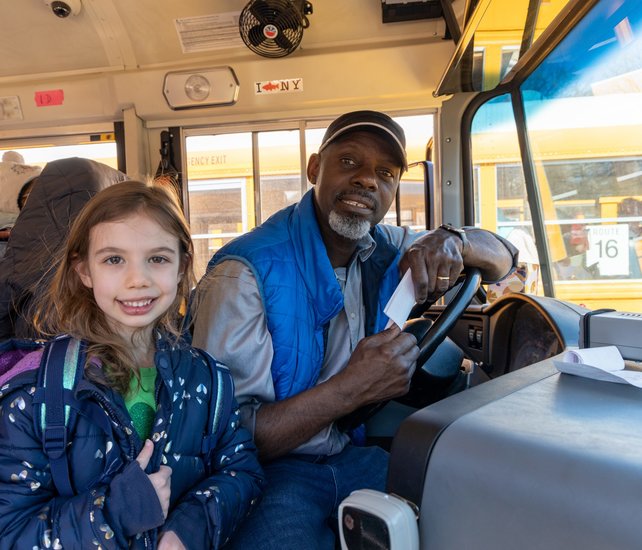
— Photo from guilderlandschools.org
A shortage of bus drivers has pressed Guilderland mechanics into driving, straining their ability to meet maintenance requirements, the district’s transportation director says.
GUILDERLAND — In hearing the latest on the development of next year’s budget, the Guilderland School Board learned at its meeting this month that the district plans to pause in its purchase of electric buses.
Also, the district plans to put on the May ballot a capital-reserve proposition that would allow a maximum of $20 million in funding.
Board members heard from Assistant Superintendent for Business Andrew Van Alstyne in January that a rollover budget — in which staff and programs remain the same as this year — would total $134 million, an increase of close to $7 million or 5.3 percent over this year’s spending plan, leaving a $3 million gap.
Transportation
The school board will vote at its next meeting, on March 10, on a $1,748,782 proposition for purchasing vehicles. The lion’s share is for five 65-passenger buses at a cost of $899,090.
Voters will have their say on May 19.
The need for five new big buses has to do with the bus-driver shortage, according to the district’s transportation director, Inho Suh.
The majority of the district’s mechanics are driving school buses in the morning and afternoon, Suh said, as are the office staff including Suh himself.
According to November’s Economic Policy Institute’s report, school-bus driver employment nationwide is still 9.5-percent lower than in 2019, before the pandemic.
School bus drivers tend to be significantly older than the typical worker and their wages are far lower than most other workers, according to the institute’s analysis of Current Population Survey microdata but the November report found that increased wages for drivers was helping to attract more drivers.
The state’s Department of Transportation requires that school buses get preventative maintenance every 2,000 miles, Suh told the board.
Even though Guilderland’s mechanics “are on the road significantly,” he said, they have to maintain seven vehicles a week to DOT standards.
“It is making it more challenging,” said Suh. “I would also add that, given that we’ve brought in all of the routes in-house, our vehicles are traveling much farther, much faster.”
The ideal time to do the preventive maintenance is about 30 days, he said. “We are pushing that to 45,” he said, which is not sustainable.
Suh displayed a chart showing that, for each of the past four years, the DOT pass rate for Guilderland school buses has been over 99 percent.
In addition to the five large buses, Suh also proposes buying three 35-passenger buses for a total of $364,941, two 29-passenger buses that accommodate wheelchairs for a combined cost of $290,468, and a Chevy Tahoe for $69,283.
Additionally, Clifford Nooney, who oversees maintenance for the district, has proposed buying a tractor for $80,000 and a mower for $45,000.
Van Alstyne gave a “big picture” look to explain to the board why the district is pausing in its use of electric uses.
Currently, the district has 107 vehicles: 75 big buses, 19 small buses, eight wheelchair buses, three minivans, and two Suburbans. Of those, two are electric, 21 run on diesel, and 84 use gasoline.
Two years ago, the public voted to buy two electric buses, which are now in service. Last year, the vehicle-purchase proposition included five electric school buses, but those buses have not yet been delivered.
“All seven vehicles are essentially cost neutral for the taxpayer,” said Van Alstyne of the electric buses.
However, he said of the state funding that made those buses functionally free, “We’ve exhausted that incentive.”
An electric bus, Van Alstyne said, costs about $300,000 more than a conventional bus; Guilderland’s proposal for five new big buses works out to about $180,000 each. The price gap between conventional and electric buses has not closed as anticipated, Van Alstyne said.
Also, for Guilderland to power more than the seven buses would require a significant investment in infrastructure for charging the buses, Van Alstyne said.
He noted this was considered as the current capital project proposal was worked on but was ultimately rejected.
“It got to the point where that was going to eat up a huge portion of the capital project for buses that we weren’t sure when we would purchase,” said Van Alstyne, asking, “What happens when charging technology advances?”
The state originally mandated that schools purchase only zero-emission buses after July 1, 2027 but, Van Alstyne noted, waivers are now available pushing that deadline back until 2029.
However, the state has not altered its mandate to have all transportation emission-free after July 1, 2035.
Board member Meredith Brière asked if an analysis had been done on the long-run costs of diesel and gas-powered buses compared with electric buses. She noted she has “far less maintenance” on her electric car.
Van Alstyne said studies tend to show lower maintenance and operation costs for electric buses but cautioned the studies were often done by electric-vehicle advocates.
Van Alstyne added another “cautionary note” — “a presumption right now that electricity will continue to remain relatively cheap.”
Suh answered Brière, “No one really has the exact data … because this is fairly new.”
He also said, “Given my previous position, I’ve had a number of conversations throughout our state … The state was expecting the electric cost would be lower. That is not what we’re discovering right now …. If we were to electrify the entire state, there isn’t enough electricity to power that.”
Suh worked as Guilderland’s transportation director from August 2021, replacing Danielle Poirier who was director for nine years after Christine Sagendorf retired, until he left to work for the State Education Department as the director of pupil transportation. In February 2024, Craig Lipps became the district’s transportation director.
Suh left his state post in December, returning to the Guilderland job.
Suh also told Brière, “The infrastructure cost would be absolutely significant. And that is the number-one reason, throughout New York, why districts are slowing this process.”
Board member Kim Blasiak said, “This was a mandate that was created before the data.”
Board member Nina Kaplan asked of the buses approved by voters last May that Guilderland has yet to receive, “With the five that still aren’t here yet, are they still definitely coming?”
“They are not ready for delivery yet,” said Van Alstyne, speculating that one reason the cost of buses hasn’t come down is because production hasn’t gone up.
Districts across the state are waiting for electric buses, some for over a year, he said.
Guilderland is currently working on a plan to develop chargers for the five yet-to-arrive buses, Van Alstyne said. The district is using Level 2 chargers — the middle of three levels — and plans to use the electric buses on the smallest routes, Van Alstyne said.
“Is it like a done deal?” asked Kaplan, inquiring whether the district has to acquire the five new electric buses.
“We’ve received the incentive,” Van Alstyne responded. “They are cost neutral to take possession of. I think it makes sense to go forward with the purchase.”
Suh said the State Education Department will consider giving the two-year waivers to districts that have experience with electric school buses — “so that is a factor,” he said.
He spoke to the vendor this week, Suh said, and was told the five electric buses will likely be delivered “in July or August if our chargers are in place, so that is what we’re moving towards.”
If the chargers are not ready, the buses will not be delivered, said Suh.
He concluded, “Everybody is trying to catch up with the law … The governor never reached out to State Ed or DOT for their suggestions about this mandate.”
Van Alstyne commended Suh for his expertise, having worked as the state’s director of pupil transportation. “He brings back with him a wealth of knowledge about transportation across the state and country that is … very valuable as we try to go through this,” said Van Alstyne.
Capital reserve
Van Alstyne also gave the board a “big-picture strategy” on fund balance and reserves. He explained that there are four categories of fund balance:
— Appropriated, which is included in the budget to reduce property taxes;
— Assigned, which is carried over in the budget to pay year-end bills;
— Restricted, also called reserve funds, which is set aside to pay for legally authorized categories of expenses. Guilderland, for example, has reserves for tax certiorari, retirement contributions, workers’ compensation, and unemployment; and
— Unassigned, which is for emergencies. The state requires that the unassigned fund balance not exceed 4 percent of the following year’s budget.
“The single greatest danger a district can get itself into financially is using one-time funds to cover recurring expenses,” said Van Alstyne.
He also stressed, “Reserves are not just kept to be funded in perpetuity and never spent. One of the other takeaways from today is that we ideally would have a budget surplus as part of a long-term, healthy financial plan.”
He went on to say that a school budget is a roadmap of how to accomplish the district’s mission “to educate all kids, make them future-ready.”
Because Guilderland is “big on shared decision-making,” Van Alstyne said, administrators from across the district have been meeting with the district office team to collaborate on developing the budget.
He also thanked the community for participating in an onlineThoughtExchange on budget priorities and noted that board members will give directions on the budget as well as finally adopting it.
Van Alstyne displayed a graph showing that Guilderland has been closing the gap that had existed with its Suburban Council peers, which had a larger percentage of their budgets held in reserve. Guilderland’s biggest dip was in the 2023-24 school year when the district had to make tax returns after Crossgates Mall and other businesses were successful with court challenges.
Guilderland now has 18.8 percent of its budget held in reserves compared to the average of 19.5 percent of the other Suburban Council districts.
One kind of reserve allowed by state law is a capital reserve to be used for building or site improvements. Guilderland’s current capital reserve was authorized in 2017 for a maximum of $10 million in contributions. The 2025 Future Ready Capital Project uses $4.5 million from the capital reserve.
The capital reserve has functionally reached its maximum contribution level, Van Alstyne said.
The school board’s Business Practices Committee, he said, “met and discussed capital-reserve scenarios, and … chose to recommend to the board that we put forward on the May ballot a capital-reserve proposition with a 10-year lifespan for a maximum funding amount of $20 million and expand the allowable uses.”
The allowable uses would include improvements to buildings and sites as well as vehicle purchases. Adding vehicle purchases would be useful, Van Alsyne said, if the district has to transition to buying more expensive electric buses.
Funding would come from existing reserves and from the district’s fund balance.
In answer to board member Rebecca Butterfield’s question if voting for the proposition would add to taxpayers’ burden, Van Alstyne said, “No.”
He noted that $20 million is “just the maximum level of funding so we are not committed to putting any money into it.” Over 10 years, that would be less than 2-percent of the budget each year,hecalculated.
The board will decide at its March 10 meeting whether to add this proposition to the May ballot.