Guilderland ZBA denies building in reservoir tributary setback
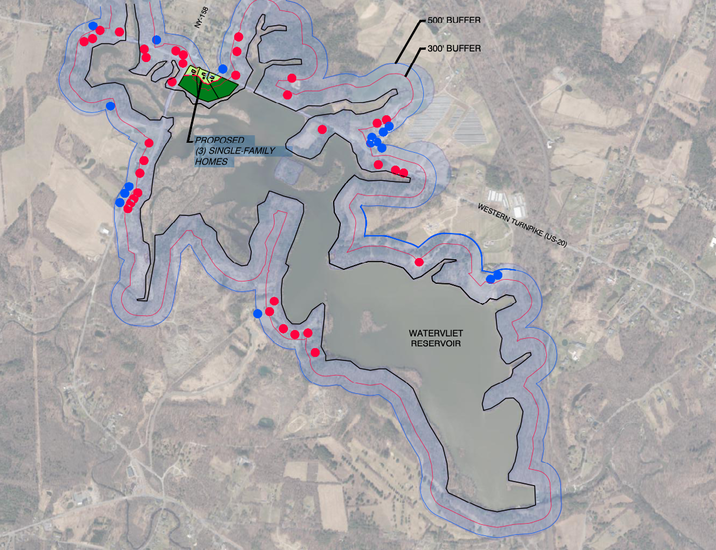
— Map from 2024 variance application
Two buffers protect the Watervliet Reservoir. The red line delineates a 300-foot buffer established a century ago while the blue line delineates a more recent 500-foot buffer. The Guilderland Zoning Board of Appeals recently denied a Dunnsville Road couple’s request to build an addition onto their two-bedroom home, which sits entirely within a 250-foot setback of a tributary to the Watervliet Reservoir.
GUILDERLAND — The Guilderland Zoning Board of Appeals recently denied a Dunnsville Road couple’s request to build an addition onto their two-bedroom home, which sits entirely within a 250-foot setback to the Bozenkill, the watercourse that feeds the Watervliet Reservoir, the town’s primary source of drinking water
On Feb. 18, applicant Daniel Greagan told the board he and his wife, Kara, have a two-bedroom home, one child, and another on the way, “so I’m out of bedrooms.” The Greagans’ existing house, a timber-log kit home, cannot safely support a second story, the board was told.
Greagan proposed combining the two lots he owns at 6493 and 6497 Dunsville Road, demolishing an existing, deteriorating detached garage and constructing a new residential addition off the front corner of the family’s existing home.
The issue Greagan ran into was the town’s zoning code does not allow construction within the 250-foot setback to watercourses — in this case, the Bozenkill — feeding the Watervliet Reservoir. And as the board weighed Greagan’s request, using a balancing test required by New York state, it became clear that the outcome would not be in his favor.
On the first factor — whether granting the variance would produce an undesirable change in the character of the neighborhood or a detriment to nearby properties — the board’s chairwoman, Elizabeth Lott, drew a distinction: The addition itself would likely not alter the neighborhood's character, Lott said, but the question of detriment extends beyond the immediately adjacent parcels.
“The bigger question is whether there would be a detriment to properties that rely on safe drinking water,” she said, noting that the Watervliet Reservoir serves as the town’s source of drinking water.
On the second factor — whether the benefit sought could be achieved by a feasible alternative — the Greagans said there was none. The timber-log kit construction precludes a second story, the board was told, and, while a pool eliminates building on one side of the lot, the septic system eliminates the other.
Greagan was asked if he’d considered abandoning the existing home altogether and building a new structure outside the 250-foot buffer, closer to a barn on the property.
“So your question is: Did we consider abandoning our $350,000 investment into our current home to reconstruct a new home from the ground up somewhere else on the site?” Greagan said. “We did not.”
He added that such a relocation would introduce its own setback issues and bring the structure closer to neighboring properties.
“These are the hard decisions that we’re asked to make," Lott said before making a motion to deny the variance, which was unanimous.
Following the vote, Greagan asked what his appeal options were. He was told he could file an Article 78, the legal mechanism for challenging a municipal determination, which Greagan said he would pursue.