Villages receive federal dollars for infrastructure projects
The Enterprise — Melissa Hale-Spencer
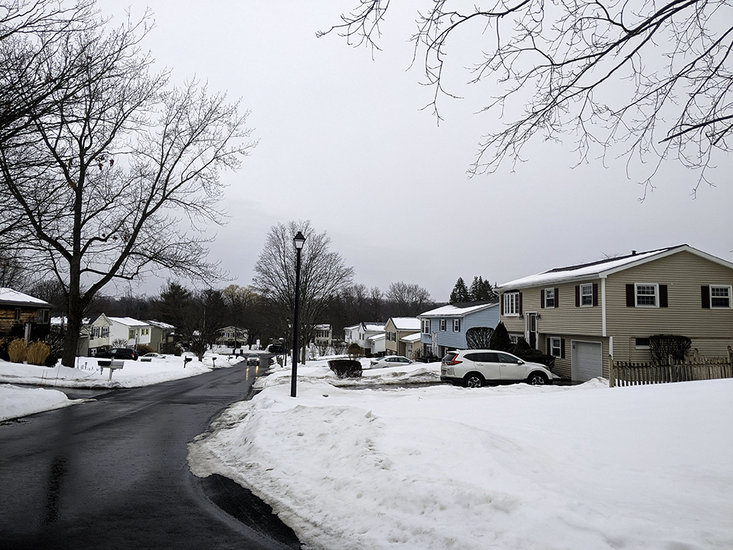
The 60-year-old sewer system in Voorheesville’s Salem Hills neighborhood will be getting an upgrade due to a $300,000 grant from the federal government.
ALBANY COUNTY — The villages of Altamont and Voorheesville were among 15 local municipalities, not-for-profits, and universities to recently receive federal dollars for infrastructure projects.
Altamont was awarded $1.1 million in funding to help improve its wastewater treatment plant on Gun Club Road, while Voorheesville received $300,000 to help pay for sewer upgrades in the Salem Hills neighborhood. The funding announcement was made by Congressman Paul Tonko, who voted against two of the three bills involved in the funding.
Ralph Ambrosio, who is running against Tonko to represent the 20th District, sent a release to local media, saying, “The funding passed via HR 7148, and Paul Tonko voted against all versions of the bill including final passage.”
Asked if Tonko voted against the appropriations bill that secured the funding, Jonah Cohen, the congressman’s press secretary, told The Enterprise by email, “The funding for these 15 projects came from three different consolidated appropriations bills - H.R. 7148 (signed into law on 2/3/2026),” which Tonko voted against and included Voorheesville’s funding, “H.R. 6938 (signed into law on 1/23/2026),” which he voted for and included Altamont’s funding, and “H.R. 5371 (signed into law on 11/12/2025),” which Tonko voted against.
Cohen continued, “For two years, Congressman Tonko fought hard to secure the inclusion of all 15 Community Projects as part of the FY26 government funding packages. When congressional Republicans made passage of the final budget package (H.R. 7148) contingent upon funneling billions more in taxpayer dollars toward Donald Trump’s masked army of ICE agents with no strings attached, Congressman Tonko voted no on the final package in order to prevent further terror from being imposed on communities here in the Capital Region and beyond.
“That vote in no way diminishes the support the Congressman provided and continues to provide for these worthy projects, and he looks forward to working closely with each recipient to implement this funding in a way that benefits every member of our Capital Region community.”
Altamont
The $1.1 million in federal funds will be used to install an ultraviolet system to treat the village’s sewage.
Mayor Kerry Dineen did not “have a final cost” when asked by The Enterprise, but said that Altamont will be responsible for 20 percent of the cost of the project. Altamont in June approved a resolution to bond the project for $4.7 million.
About two-thirds of Altamont’s wastewater treatment facility on Gun Club Road is a decade old; the remaining third is over 40 years old.
The village uses chlorine on the effluent, or sewage discharge, that leaves its wastewater treatment facility. Prior to the now-decade-old upgrades, the effluent flow was constant, but now the release is in batches throughout the day.
This makes it difficult for workers to correctly regulate the sodium bisulfite needed to remove the chlorine, so the batch is over-injected, which caused the state to step in about three years ago.
The state recommended the village switch to an ultraviolet system and remove the sodium bisulfite and chlorine entirely because, for the chlorine to interact with the effluent in the plant, the effluent has to be held in the plant for a set amount of time for the chlorine to act.
The old “clarifier,” from the 1930s, which was converted to a contact tank to hold water, is now rotten and falling in on itself. A clarifier is a large tank where all the sewage is broken down by bugs that in turn create sludge; the sludge then is hauled away either to Albany or Schenectady.
Following Altamont’s upgrades, new clarifier tanks were built and the old clarifier tank from the 1930s was converted to a “contact” tank. In the new system, effluent goes through the filters and chlorine is injected to kill any bacteria. But the chlorine needs time to kill the bacteria, so the effluent sits in the contact tank until the chlorine reacts with the bacteria in the water.
With the current treatment system, chlorine is injected into the water to kill E. coli and other bacteria. With the UV system, ultraviolet light tubes will be inside a unit that the water passes through so the UV light can kill the bacteria.
Voorheesville
The $300,000 in federal funds will help pay for infiltration and inflow work, mostly in the Salem Hills neighborhood.
Voorheesville’s estimate for the work was approximately $400,00, according to Mayor Rich Straut, who said the village’s “match will come from sewer reserve.”
The project description submitted to the Appropriations Committee in 2024 said, “This project will help improve sewer infrastructure that has been identified as a leading community and regional weakness. Existing inflow and infiltration problems are compromising the capacity of the sewer system and preventing new development in Voorheesville and surrounding communities.
“Specifically, this project will fund final design, bidding, and construction of priority sewer collection upgrades and related engineering reports. This will include replacing approximately 3,600 linear feet of 60-year-old asbestos concrete pipes. New PVC pipes will be installed for wastewater collection systems at the treatment plant.”
When asbestos concrete pipes break down over time, they can release cancer-causing fibers into the water, according to the federal Environmental Protection Agency.
Dr. Arthur Frank, a medical doctor with a Ph.D. in biomedical sciences and an expert in asbestos-related diseases at Drexel University in Philadelphia, told The Enterprise in 2021 that people think of asbestos only as being dangerous to inhale but it is also dangerous to ingest, he said.
“Most things in humans that cause cancer, not everything, but most things, we have something we call the 20-year rule,” Frank said. “It takes at least about two decades before you start seeing cancers.”
“So the latency for asbestos cancers is 20 years or more,” Frank said.
Frank says there’s growing research that shows ingested asbestos has been linked to esophageal cancer, stomach cancer, and small and large bowel cancer, as well as kidney cancer.
Asbestos fibers have even been shown to cross through the placenta of a pregnant woman into a developing newborn, he said.
Mayor Rich Straut said during the Voorheesville Board of Trustees’ April 2024 meeting that the village has trouble securing traditional grants, by which he meant the funding was means-tested.
“Basically the median household income is usually a problem for us, to meet those requirements,” Straut said. Voorheesville’s annual median household income is approximately $111,000, about $27,000 over the national average.