Voorheesville asks governor to claw back $5M grant to Norfolk Southern
— Enterprise file photo
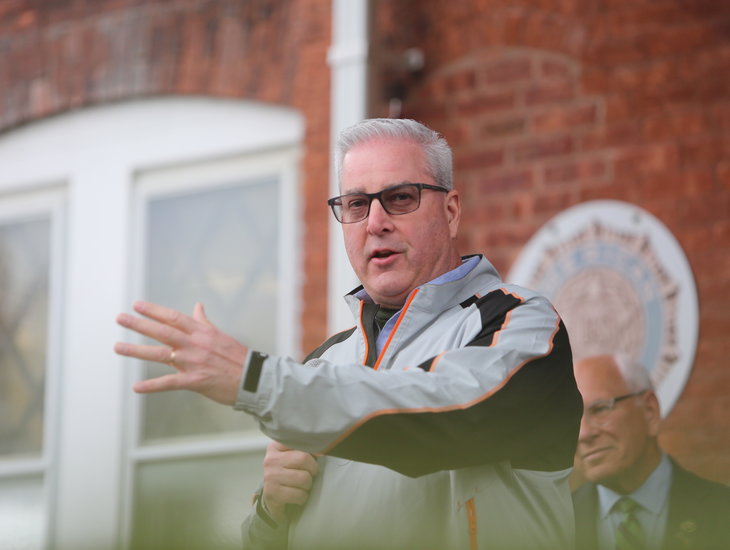
Voorheesville Mayor Rich Straut.
VOORHEESVILLE — The village of Voorheesville is not giving up on its fight with Norfolk Southern.
Mayor Rich Straut in a Feb. 9 letter to Governor Kathy Hochul asked that “Norfolk Southern be added to the State of New York’s list of non-responsible, debarred, or otherwise ineligible contractors, and precluded from applying for future grants of New York State taxpayer dollars.”
Straut continued, referencing a $5 million grant for Norfolk Southern to rehab 15 miles of track along the Voorheesville corridor, “The Village also believes that the State should seek to claw back the grant funding it has already awarded to Norfolk Southern.”
The letter is the latest salvo between the village and the freight carrier, coming on the heels of Voorheesville’s defeat in federal court, where Norfolk Southern successfully blocked the village from enforcing its local zoning laws against the railroad’s construction of a crew-change facility.
Norfolk Southern responded to Enterprise inquiries with this statement, “The claims raised in the letter by the village are without merit. The village raised substantially the same allegations in federal court litigation with Norfolk Southern; the court carefully considered these issues and ruled against the village, finding no basis to conclude that Norfolk Southern was violating its obligations and holding that federal law preempted the village’s attempt to interfere with the project.
“Norfolk Southern values its partnership with the State of New York and has consistently acted in accordance with applicable law and regulatory requirements. The company remains committed to safe, responsible operations and to working with communities while continuing to provide the reliable rail service local economies and businesses depend on.”
The governor’s office did not respond to a request for comment.
The dispute traces back to 2021, when CSX proposed acquiring Pan Am Systems. The village raised concerns with federal regulators that the junction and reactivated Norfolk Southern line would worsen longstanding quality-of-life and safety issues.
In December 2021, the village, CSX, and Norfolk Southern reached a settlement in which the railroads agreed to minimize impacts on the village and to meet with local public-safety personnel. In exchange, the village withdrew its opposition. The regulator’s April 2022 approval of the CSX-Pan Am merger was made expressly subject to that settlement.
The state in February 2022 provided Norfolk Southern with $5 million to be used “toward safety and service reliability enhancements, including the rehabilitation of 15 miles of track along the Voorheesville corridor, grade crossing resurfacing, the installation of welded rail, and other enhancements.”
In his letter, Straut argues that Norfolk Southern's conduct runs contrary to both the evaluation criteria for the Passenger and Freight Rail Assistance Program (PFRAP) grant and the terms of the grant agreement itself.
He goes on to cite PFRAP criteria that call for consistency with local municipal plans, project-specific public and stakeholder outreach, and coordination with other public and private investments. Straut also invokes the Smart Growth Public Infrastructure Policy Act, which requires funded projects to involve community-based planning and strengthen existing communities.
Straut then points to a section of the grant agreement that he says requires Norfolk Southern to comply with all applicable federal, state, and local laws and regulations.
He also cites an executive order governing vendor integrity that requires the state to evaluate whether parties that contract with New York are responsible based on past performance and compliance with statutory provisions relating to debarment — the formal exclusion of a vendor from doing business with the state due to misconduct or violations.
To date, Norfolk Southern has spent $3.3 million of the $5 million grant funding.
Past
In 2000, Canadian Pacific, which bought the Delaware and Hudson Railway Company in 1990, decided that, rather than expending significant resources repairing and then maintaining a railroad bridge over the Normanskill, it would abandon the line it used to move freight between Albany and the Northeastern Industrial Park in Guilderland — today, those 10 miles make up the Albany County Helderberg-Hudson Rail Trail.
Instead, Canadian Pacific decided to bring back into service the running track between Voorheesville and Delanson, which at that point hadn’t been in use for a decade.
In 2015, Norfolk Southern bought the 282-mile former Delaware and Hudson line from Canadian Pacific. The acquisition allowed Norfolk Southern to extend its system from central Pennsylvania through Binghamton (where a Norfolk Southern line that runs all the way to Chicago previously terminated) and from Oneonta to Delanson, where the line splits east toward Schenectady and south to Altamont and Voorheesville.
SMS Rail Lines began leasing the 15.5-mile Voorheesville Running Track in 2007. Norfolk Southern terminated that agreement in 2021.
Norfolk Southern’s upgrades were tied to CSX’s proposed takeover of Pan Am Railways, in which Norfolk Southern had a 50-percent stake. Norfolk Southern raised concerns to the STB, which has economic regulatory oversight over the nation’s railroads, and eventually everyone save for the village got what they wanted.
Present
Norfolk Southern, according to Straut’s letter, first started to run its allowable twice-a-day trains, on Jan. 13, east toward Massachusetts, at about 4:30 in the morning.
The first westbound train came through at approximately 8:50 a.m. on Jan. 14, Straut writes, and blocked traffic at the School Road crossing for approximately 20 minutes, forcing vehicles to seek alternative routes.
Norfolk Southern has continued running trains through the village without having completed its crew-change building and without contacting the village or local public safety officials, the letter states — a direct “contravention” of the railroad’s commitment to meet with public-safety personnel.
In his letter to Hochul, Straut writes that Norfolk Southern had previously told the village that, to minimize disruptions, the freight carrier’s trains would travel through the community at approximately 25 miles per hour.
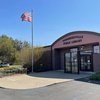
Instead, the mayor writes, the railroad company intends to use the crew-change facility, across the street from the Voorheesville Public Library, as a location where its 1.7-mile-long specialty trains will be brought to a complete stop and crews swapped out.
Norfolk Southern requires the crew change because its train crews, which depart from as far west as Binghamton, approach their federally mandated hour limits by the time they reach Voorheesville, 130 miles later. Since the railroad cannot stop along the 161 miles of CSX-owned track it uses between Voorheesville and Massachusetts, the swap must happen before trains enter CSX's territory.
Straut writes that, as trains are brought to a stop, paused at the facility, and then brought back up to speed, surface crossings within the village could be blocked for extended periods, potentially cutting off portions of Voorheesville, including youth sports facilities at 1 Countryside Lane, from emergency services.
Straut’s letter also relates the village’s concern about how Norfolk Southern acquired a portion of the 1 Countryside Lane property for its crew-change building. Norfolk Southern paid $450,000 in August for the approximately one-acre site, which it carved from JC Pops Industrial’s 5.7-acre parcel.
The village considers the acquisition an illegal carveout, arguing it required formal subdivision review that Norfolk Southern bypassed. The remaining JC Pops property, the village contends, now violates minimum lot-size requirements for the industrial zone.
But Straut goes further, alleging that property transfer documents filed with Albany County contained false information. He writes that the RP-5217 Real Property Transfer Report and the TP-584 Combined Real Estate Transfer Tax Return falsely described 1 Countryside Lane as vacant land and were filed under the existing tax map designation for 1 Countryside Lane rather than for a new parcel.
The RP-5217 report, Straut writes, also falsely stated that a planning board with subdivision authority existed for the transaction.
Had Norfolk Southern accurately described what it was doing, Straut writes, the forms presumably would have been rejected by the Albany County Clerk.
He notes that no 911 address has been issued for what Norfolk Southern has called “approximately 86 School Road” because, he writes, the property does not actually exist.