Planners raise questions, get answers on fire as they review 2 BESS proposals
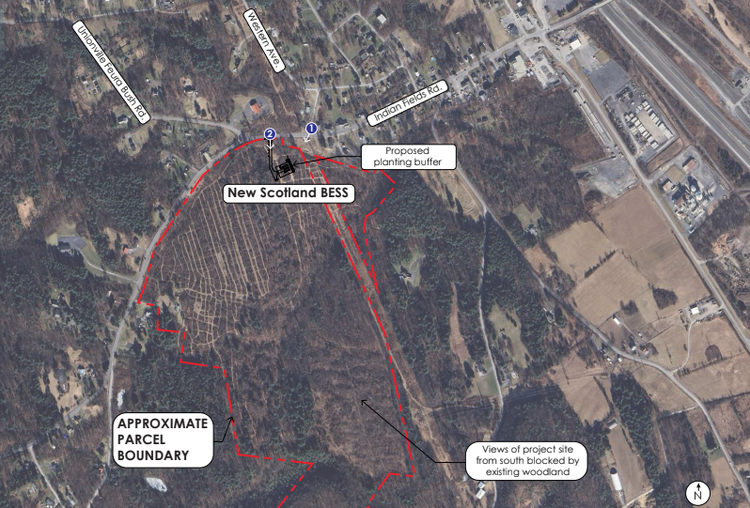
— From RIC Energy submittal to the town of New Scotland
The proposed Indian Fields Road site of a battery energy storage system.
NEW SCOTLAND — Following multiple election-time meetings dominated by residents expressing faux outrage coupled with legitimate concerns, the New Scotland Planning Board’s Feb. 3 meeting was a return to the mundane drudgery of doing its job.
The board is currently reviewing two proposals for battery energy storage system (BESS) facilities in town.
At 1543 Indian Fields Road in Feura Bush, RIC Energy is seeking permission to install a five-megawatt BESS on seven acres of the 137-acre home of the New Scotland Beagle Club.
The proposed project would involve the installation of five Tesla-made units that stockpile renewable energy collected during the day and send it to the grid during peak-use evening hours. Each unit measures eight feet high by six feet wide and 30 feet long.
The batteries are designed to discharge a maximum of 20,000 kilowatt-hours — roughly equivalent to the average daily electricity consumption of almost 700 homes — over a four-hour period.
At 37 and 128 Wormer Road, on properties owned by Councilman Adam Greenberg, New Leaf Energy is looking to install two five-megawatt, 20,000-kilowatt-hour systems.
New Leaf initially proposed three BESS installations but scaled back its proposal following feedback from National Grid, which determined the capacity of its lines could not accommodate 10 megawatts of power from the 128 Wormer Road site.
The current proposal would involve the installation of 12 Tesla-made units.
Recent BESS fire in Orange County
Top of mind for board members on Feb. 3 was a fire that occurred at a BESS facility in Orange County in December.
“So the other new development since we’ve last been together is apparently these things are still catching fire,” Chairman Jeffrey Baker said to the project team from RIC.
“My first question about that is: What kind of a system was it?” Baker said. “Who made it?”
The incident occurred on Dec. 19 at a BESS facility in the village of Warwick.
The fire was confined to a single Powin-branded battery container, according to the village, which also said the system was not authorized to be online, something almost assuredly not to happen in New Scotland.
Paul Rogers, a principal with RIC consultant ESRG, told board members he was on site in Warwick just a of couple hours after the conflagration started.
He described the fire as “ironic” in that it occurred during heavy rain with heavy winds, and that a previous fire at the same facility had occurred under similar weather conditions. It was the third fire to take place in Warwick across separate BESS facilities owned by the same company, Convergent, in two years.
Rogers said the local fire department response was largely observational; no hose lines were unfurled or charged, and that the visible fire burned itself out within four to six hours. Rogers characterized containment of the fire within a single cabinet and said that it didn’t spread to neighboring units as “proof of concept” that the failure “worked the way it was supposed to work.”
Asked if, on a dry day, the fire could have spread to the surrounding landscape, Rogers said that no BESS fire in the United States had ever spread beyond the perimeter of an installation, adding that maintenance of storage sites included vegetation management around the facility.
When discussion moved to battery-unit safety, board members were told that all three Warwick fires occurred in the same unit, a Powin Centipede that Rogers described as resembling a double-door refrigerator, which makes water infiltration — thought to be the cause of the most-recent Warwick BESS fire — more likely.
Rogers drew a distinction between Powin Centipede and other batteries on site shaped like shipping containers, noting the storage systems shaped like shipping containers had no problems.
Baker asked Rogers about the shipping-container style Teslas proposed for the Beagle Club. “The cabinets here have doors that open … the external doors, are they sealed differently so that they're more watertight?” Baker asked.
“Yeah, they have to be sealed watertight,” Rogers said. “Actually, that's one of the things that is required to get their listing, a 9540 listing.”
A 9540 listing is a “testing method designed to meet stringent fire safety and building code requirements for battery energy storage systems,” according to the test’s designer, Underwriters Laboratories, the independent, not-for-profit safety organization that sets fire and electrical-hazard standards for most industries.
When Baker asked specifically about the safety record of the Tesla Megapack, Rogers said he was not aware of any fire incidents involving the units. He cited approximately 40 fire-free Tesla installations he was aware of operating in New York City, which has a rigorous approval program that involves a year-long review process.
With the planning board making additional requests of RIC and New Leaf, no actions were taken on their applications.