Electricity rates on the rise as gas price doubles and as new plants haven’t replaced old
The Enterprise — Marcello Iaia
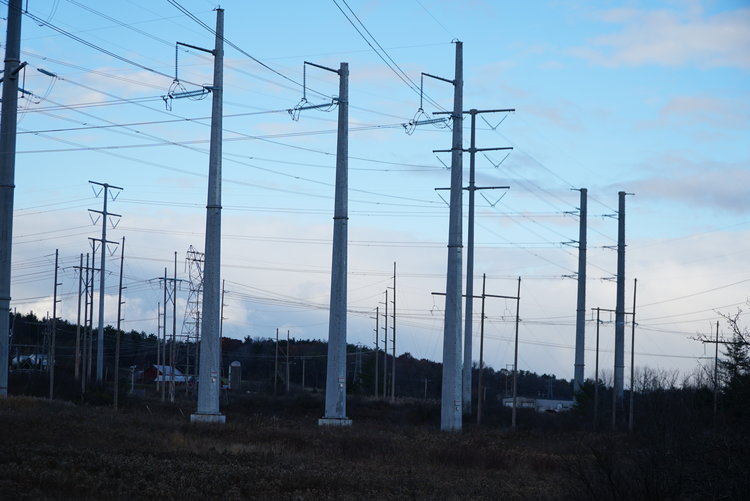
National Grid’s electrical substation in New Scotland. Between 2019 and 2024, according to the New York Independent System Operator, national average retail electricity prices have increased 23 percent.
RENSSELAER — With a complete overhaul of New York state’s energy infrastructure still years away, residents’ electricity needs continue to be met by what’s become a costly global commodity.
According to a recent report from the New York Independent System Operator, the not-for-profit responsible for operating and administering the state’s wholesale electricity market, the wholesale price of natural gas — which is responsible for approximately half the state’s electricity generation — has more than doubled in the past year.
Between 2024 and 2025, natural gas prices at the Transco Zone 6 hub, a natural-gas pricing hub and delivery point that serves the New York City metropolitan area, rose from $2.10 per million British thermal units (MMBtu) to $4.64 per MMBtu.
Wholesale electricity prices in New York state over the same period, increased nearly 78 percent, from $41.81 per megawatt-hour (MWh) to $74.40 MWh.
The increase, according to NYISO, is landing directly on residential utility bills. Between 2019 and 2024, according to NYISO, national average retail electricity prices have increased 23 percent.
The price spike is reflective of a structural shift in the American natural-gas market. According to NYISO, the United States now exports more gas than its residential customers consume — 16 billion cubic feet per day in exports compared to 12 billion in domestic residential use.
In New York state, the cost increases are a consequence of the pricing mechanics tied to the state’s wholesale electricity market, where the last and most expensive electricity generator needed to meet demand sets the price for all other participants.
For example, if the grid needs 20,000 megawatts and the 20th plant online is gas-fired, that plant's fuel costs effectively dictate the price paid to every generator on the system.
Because natural gas-fired generators are the primary fuel source for roughly half of the state’s electricity, they often “clear” the market, meaning their production costs dictate the price for the entire grid.
Interconnection lag
The state mandate that 70 percent of New York’s electricity be generated by renewable sources — solar, wind, hydroelectric — by 2030 has contributed to an interconnection lag, with more capacity being taken offline in recent years than placed online.
Since 2019, one-hundred-and-six renewable and clean-energy projects representing approximately 14,300 megawatts of capacity have cleared the state's regulatory process — but just seven, totaling nearly 3,500 megawatts, have broken ground, according to NYISO. The remaining 10,800 megawatts have been stalled by permitting delays and/or supply-chain constraints.
Since 2019, the state has deactivated 4,315 megawatts of generation capacity while adding only 2,275 megawatts of new supply.
This gap between retiring capacity and stalled replacements has forced grid operators to lean harder on the state’s oldest electricity generators, which cost more to run. These older units burn more fuel to produce the same output as modern generators; their escalating maintenance costs are factored into wholesale market bids and passed on to consumers.
The NYISO report states that new demand is coming regardless of generation capacity, as data centers and semiconductor manufacturers are expected to add 2,500 megawatts of demand over the next decade. Additionally, building and transportation electrification — a policy centerpiece of the state’s climate law — is forecast to add another 6,500 megawatts of demand by the winter of 2034-35.


This story has legs!
"Because natural gas-fired generators are the primary fuel source for roughly half of the state’s electricity, they often “clear” the market, meaning their production costs dictate the price for the entire grid."