Norfolk Southern’s lawsuit against Voorheesville dismissed, crew-change facility to proceed
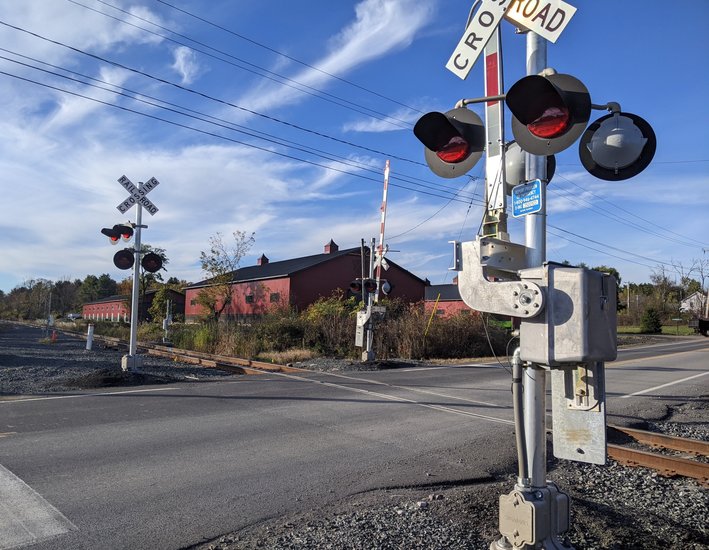
Enterprise file photo — Melissa Hale-Spencer
The future site of Norfolk Southern’s crew-change facility.
VOORHEESVILLE — The Norfolk Southern lawsuit filed against the village of Voorheesville over the freight carrier’s construction of a crew-change facility off of School Road has been dismissed in its entirety.
The Jan. 30 order from Chief Judge Brenda K. Sannes finalized a Dec. 3 preliminary injunction that prevented the village from interfering in construction of the facility.
The order also stated that Voorheesville had withdrawn the stop-work order that initially halted Norfolk Southern’s project, and that the village is obligated to provide “facility services,” like water and sewer, in the same manner as it would for any other commercial enterprise.
Norfolk Southern claimed it needed the complex specifically in Voorheesville because, as part of its expanding freight operations between New York and New England, the carrier operates over 161 miles of CSX-owned track but cannot stop for crew changes along that route.
Since crews departing from Binghamton — 130 miles west of Voorheesville — approach their federally-mandated hour limits upon reaching the village, the swap must occur there; otherwise, trains cannot legally complete the journey to Massachusetts, the carrier claimed in earlier court filings.
Norfolk Southern said that it doesn’t comment on litigation.
Voorheesville Mayor Rich Straut was not happy with Friday’s outcome.
“I would have been happy if the judge saw things our way,” Straut said, “but we’re evaluating what we do next because I’m still not satisfied with the outcome.”
Straut said, “Our determination was that taking a legal course was probably not going to get us to where we think we should be. But in my view, there may be some other tacks that we can take, so we’re evaluating all that.”
Straut said he’s working to convene a meeting with other stakeholders because Norfolk Southern never conducted that kind of outreach.
“They didn’t talk to anybody,” Straut said, adding he’d already been in touch with Guilderland and New Scotland and wanted to bring the school districts and sheriff’s office into the fold as well.
“We’re going to try to basically get everybody together who might be impacted by a stoppage or a road closing and try to come up with a plan,” Straut explained. “Like, if this happens, what do you do? If there’s an emergency on the side of the tracks and you can’t get across, what do you do? Is there a way to maybe set up a warning or an acknowledgment that the train’s here and it stopped, so you might want to find another route and plan for those routes?”
The mayor said, “We’re in the exploratory phase of that. I wish it was a different scenario, but it isn’t.”
Norfolk Southern’s trains began running through the village a few weeks ago.
Asked if there had been any resident concerns, Straut said, “I haven’t heard from the public on it, but we’ve watched it, and I know they’ve come through a few times.”
Straut also said, “I find it pretty interesting that I think they’re proving right now that they can run these trains without a true change facility … There have been times when it seems like it’s taken 20 minutes to get through the village. That’s a concern. There are times when they’ve stopped and blocked the roads for a pretty significant amount of time.”
Construction was allowed to move forward following the earlier order, on Dec. 3. The next day, Norfolk Southern filed to have the remainder of the case dropped.
What wasn’t decided at the time, but has now been decided with the Jan. 30 dismissal of the suit, were concerns raised by the village over a settlement agreement among itself, Norfolk Southern, and CSX, along with a third-party suit filed against JC Pops, owner of the land where the facility is to be built.
Norfolk Southern paid $450,000 in August for approximately one acre at 1 Countryside Lane, carved from JC Pops Industrial’s 5.7-acre parcel near the Voorheesville Public Library.
The village declared this an “illegal carveout,” arguing the land modification required formal subdivision review — which Norfolk Southern bypassed while simultaneously requesting a waterline extension. The village further contended the remaining JC Pops property now violates minimum lot-size requirements.
By targeting JC Pops rather than the railroad directly, Norfolk Southern asserted, the village attempted to circumvent the 1995 Interstate Commerce Commission Termination Act, which exempts railroads from local land-use regulations.