Berne board resolves to audit safety, train workers, allow public comments
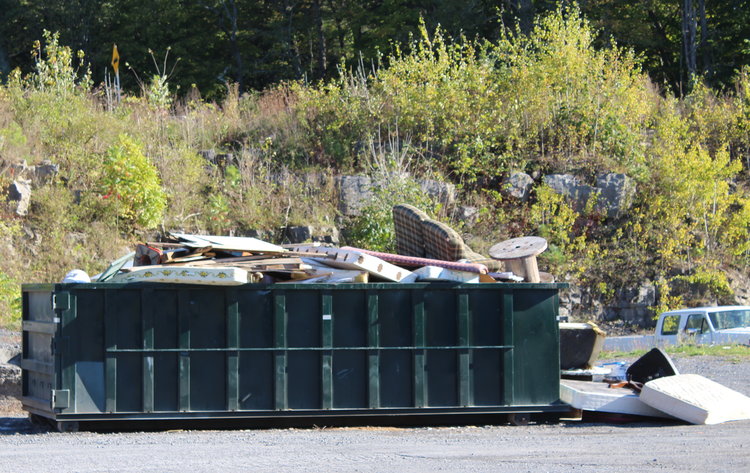
Enterprise file photo — Michael Koff
An overflowing dumpster is pictured at the Berne transfer station. The town is forming a committee to evaluate how it handles solid waste. The committee will be made up of the town clerk, one town board member, one patron of the transfer station, and one non-patron. The town spends $200,000 annually on solid waste, said the supervisor, adding, “It’s going to get worse.”
BERNE — On Jan. 14, the town board here passed a handful of resolutions following the slew it passed on New Year’s Day to fill gaps in town policies and practices.
The new supervisor, Joseph Giebelhaus, was the author of all the resolutions and they all passed unanimously.
He said his first fortnight at the helm of a new board had been trying.
“I feel like I’m there sun up to sun down,” he said of fulfilling his town hall duties.
The board agreed to hire Needham Risk Management Resource Group for a town-wide safety audit and to develop a required safety program.
“They would identify what training modules we need,” said Giebelhaus.
“It needs to be done,” said Councilman Brian Bunzey in voting for the resolution. “We already lost one man.”
Highway worker Peter Becker was killed on Oct. 21, 2020 after a dump truck propped up on a pneumatic jack fell on him at the town transfer station, after which the state’s Public Employee Safety and Health Bureau found the town’s highway department to be in violation of seven different regulatory items; each violation was considered “serious.”
The board also adopted a 10-page document outlining rules of order and procedures for town board meetings.
“It is incredibly important,” said Councilwoman Melanie la Cour who introduced the resolution. When she was first appointed to the board, la Cour had tried to get the board to allow public comments at meetings, which the supervisor at the time, Dennis Palow, hadn’t allowed.
The public comment will have parameters, said la Cour.
Giebelhaus suggested a three-minute limit with a single person speaking for an entire group “just to keep the meeting moving.”
“We want to hear your views …,” he said. “We want to keep the meeting moving … keep it civil.”
The board also resolved to authorize training for staff and to reimburse staff for those expenses.
“It’s very important employees for the town get their training … You learn the proper way to do it,” said Michael Vincent from the gallery.
A long-time member of the Berne Planning Board, Vincent retired from a career with the state’s parks department.
“They’ll learn the proper way to flag, to put up signs,” he said of the training.
Giebelhaus also said he’d put out a request for proposals for information-technology support.
“Without a contract, we can be vulnerable,” he said.
He spoke, too, of the need to develop a more substantial policy handbook, saying there is currently “confusion amongst employees and residents.”
“I saw some very disturbing purchases being made …,” said Giebelhaus. “It’s kind of scary … I suddenly understand why we’re broke.”
He also said a committee will be set up to consider the best way to handle solid waste in town. The committee will be made up of the town clerk, one town board member, one patron of the transfer station, and one non-patron.
The town spends $200,000 annually on solid waste, said Giebelhaus, adding, “It’s going to get worse.”
The committee may decide to run the center, as now, from the general fund or may decide to develop a system of user fees.
Both Bunzey and Councilman Scott Duncan volunteered to serve on the committee; Giebelhaus said they could “wrestle it out.”
Giebelhaus said that the city of Albany will be closing its Rapp Road facility, which Berne uses, in 2028. The city is looking to build a large-scale transfer facility, said Giebelhaus, with waste shipped out of the region.
The new highway superintendent, Allen Stempel, said the $1,000 threshold the board had set for purchases without board approval was “really constricting.”
Duncan suggested creating categories with varying thresholds.
Stempel also said of the highway workers, “They opened their arms and everything’s going good …. It’s an everyday challenge to keep the fleet running … Everybody does a good job.”
Giving a long list of expensive needed repairs he had discovered throughout town, Giebelhaus said, “I learned this week we built a road to the town park without an easement.”
He said he found that about $20,000 had been spent on the road on private property and that he will try to negotiate an easement.
At the end of the public session, the board voted to go into executive session to discuss two disciplinary issues.