Podcast: The tale of two generous men and a bygone era
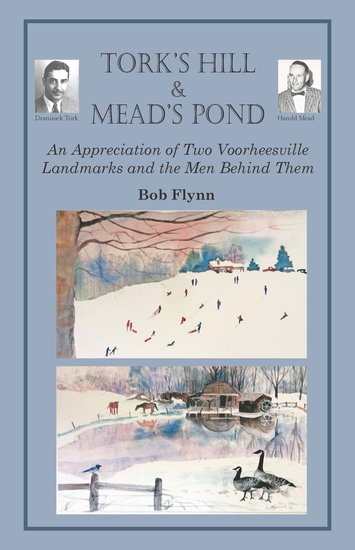
Paintings by Diane Shedd Wozniak, which inspired Bob Flynn to write his book, are on its cover.
VOORHEESVILLE — It was a painting that inspired Bob Flynn to write a book.
Artist Diane Shedd Wozniak is like a Grandma Moses for Voorheesville, capturing village life with simple realism in luminous colors, often hearkening back to an earlier era.
Two of Wozniak’s paintings grace the cover of Flynn’s book.
One is of Tork’s Hill where sledders stand out against pure white snow, with a house perched on the horizon. Dom Tork would stand at the front window of that house to watch the sledders below.
The other painting is of a farm pond with a horse and cow in the background near a barn, and two geese in the foreground along with a blue jay perched on a weathered fence post. Snow surrounds the pond, its ice reflecting barn, trees, and pink sky.
“What spurred me was Diane Wozniak’s drawings and her paintings,” said Flynn in this week’s Enterprise podcast.
“About two years ago,” he recalled, “she had a post on Facebook and it included her drawing …. And I saw all the comments … People loved it.”
Flynn reached out to those people and ended up interviewing more than two dozen who, like himself, had fond memories of skating on Mead’s Pond or sledding on Tork’s Hill.
His book focuses on the two men who used their private land to create what he terms “winter wonderlands” where kids could gather.
Dominick Tork was born in 1917 in a house on Voorheesville’s Grove Street, the sixth of seven children. His father had come from Italy and opened a grocery store on Main Street.
Dom, who served in the Army Air Corps in World War II, came home to Voorheesville and was, in Flynn’s telling, “one of a handful of people who just had a lot to do with the growth of the village … he owned the Mobile station for years and years and years. He was on the school board for years — just very involved with the community and loved doing that.”
When Dom Tork bought the hill across the street from the school, which then served every grade, he built a house on top and loved to watch children who came to sled every winter.
Harold Mead also grew up in Voorheesville — his father was a railroad station manager — and, after getting a degree in Ithaca to teach physical education, came home to do just that. In addition to being a teacher, he coached all sports and taught drivers’ education
Coach Mead flooded the pond near his barn, on the outskirts of the village, so kids could skate and he even added lights for nighttime skating and music piped from his barn.
In his book, Flynn notes that Mead had rescued foxes, deer, and peacocks and describes his place as “a safe haven.”
“I was just the conduit … It’s all about those two men,” Flynn said of his book.
But, really, his book is about more than just those two men. It is about an earlier time when kids played outside — even in cold winters — and when there was a sense of community, a sense of place, and a sense of trust.
Flynn’s parents moved to Voorheesville in 1960 in what was then a new suburban development across the street from where the Hannaford market is now.
“We used to ride our bikes everywhere or walk down into the village,” Flynn recalled. He would play baseball or stickball in the street with his friends or fish in the nearby Vly Creek.
“Every time I think of growing up there in the village, it just brings a smile to my face,” said Flynn, who lives now in Virginia not far from historic Williamsburg.
After graduating from Voorheesville’s high school, Flynn went to Florida Southern College where he studied journalism and broadcasting. He spent his career in the newspaper business, primarily as a page designer and editor.
As a kid, he delivered newspapers and recalled, again, the sense of trust in his boyhood.
For most customers, he left their newspapers “between their doors,” Flynn recalled, but some customers left their doors unlocked.
“I would just kind of take a step in and toss it on their kitchen table,” he said. “You can’t do that now … People invited me to kind of do that and were accepting of it … I can’t say enough good things about it.”
Tork and Mead, as Flynn portrays them, were emblematic of that trust, opening their land to kids, some of whom they didn’t even know.
“With all of the possible legal issues,” said Flynn, you couldn’t do that today. “But at that time, no one thought about it ….
“I’m sure some people maybe suffered some minor injuries there,” he said of Tork’s Hill. One of his sisters chipped her tooth there, he said.
“You never thought of going to sue …,” said Flynn. “Someone probably may have broken a bone here or there … They thought, ‘Well, it’s our responsibility. We’re the ones that decided to go down that hill. No one forced us.’ It is, I think, even more remarkable when you compare it to this day and age.”
****
Bob Flynn’s paperback, “Tork’s Hill & Mead’s Pond: An Appreciation of Two Voorheesville Landmarks and the Men Behind Them,” printed by The Troy Book Makers, is for sale online at Amazon and locally at Northern Barrell, Pretty Alright Breakfast Club, Indian Ladder Farms, Romo’s Pizza, the Book House of Stuyvesant Plaza, Market Block Books as well as at the Voorheesville Village offices, the New Scotland Historical Association, and from the author.