Healthcare costs help to drive VCSD’s $1.3 million budget gap
Enterprise file photo — Michael Koff
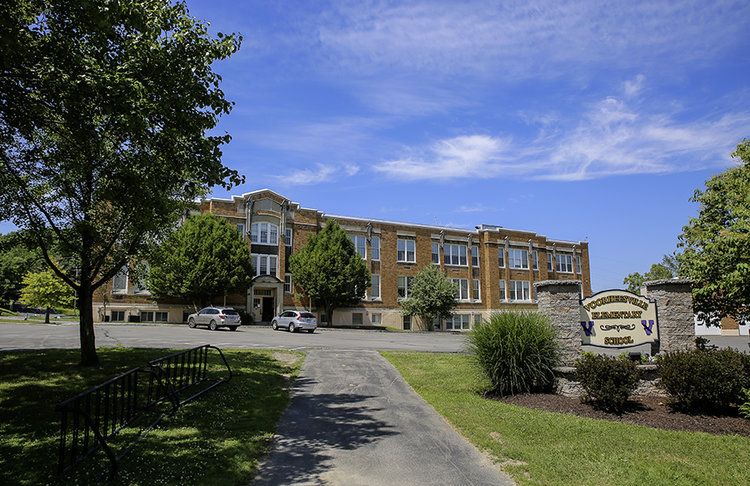
Voorheesville Elementary School may house high-needs students in kindergarten and first grade next year, which would save money since the district currently pays to educate those students elsewhere.
NEW SCOTLAND — The Voorheesville Central School District is looking at a $1.3 million budget shortfall heading into next year.
The budget, presented during the school board’s March 2 meeting, shows the district spending $36,481,272 in 2026-27 compared to expected revenues of $35,156,00, a 7.8 percent, or $2.54 million, increase over this year.
Voorheesville expects to levy property taxes to the maximum amount allowed by law: 4.81 percent, allowing the district to collect $23,323,530 in property taxes.
Currently, after the equalization rate has been applied, property owners in municipalities served by Voorheesville schools — New Scotland, Guilderland, and Berne — pay a school tax rate of $14.60 per $1,000 of assessed value.
To close the $1.3 million gap, the district expects to pull reserve funds from three sources:
— $400,000 from the Employer Retirement System reserve;
— $350,000 from the debt service reserve, which is a fund that accumulates when capital project bond expenses come in lower than the bonded amount. This fund currently holds between $700,000 and $750,000, the board was told on March 2; and
— $575,272 from the unassigned fund balance, the district’s general financial safety net. The district has historically maintained its unassigned fund balance at about 4 percent of its total budget, but that figure has dwindled to about 2 percent in recent years.
Expenditures
At $27.5 million, salaries and benefits combined account for nearly 75 percent of next year’s total budget: salaries are projected at about $17 million, a 5.9 percent increase over this year, while employee benefits are estimated at $10.6 million, an 8.3 percent increase.
Board President Rachel Gilker observed that health care, rather than education, is now “driving the bus.”
“So it becomes outsized, it drives the budget instead of education driving the budget,” Gilker told her fellow school board members on March 2. “And, you know, the goal of supporting staff in a meaningful way through their salaries driv[es] the budget so that you retain the people that make up the district. You’re instead retaining the insurance company. And those are important parts of people’s lives. Medicine is part of the health-care system. But it’s driving the bus now, whatever bus it is, diesel or EV.”
For 2026-27, the district is looking at a year-over-year increase in employee health-insurance premiums of somewhere between 13 and 14 percent — 12 percent for prescription plans, 10.5 percent for CDPHP plans, and 14.8 percent for Highmark plans; collectively, the benefits line item adds approximately $1 million to the district’s expenses in one budget cycle.
Cold comfort offered by Gilker was that health-care premiums in general have been rising higher than Voorheesville’s expected increase. The New York State School Boards Association, Gilker said, “said something along the lines of, over the past 30 years, it’s been about 17 percent on average per year for health-care increases.”
Other major expenditures for next year are expected to be:
— Board of Cooperative Educational Services at $3.5 million, a 2.52 percent increase;
— Contractual expenses, $2.3 million, up 3.57 percent; and
— Debt service on existing bond obligations at $1.9 million, a 6.42 percent increase.
High-needs students
In a departure from current practice, Voorheesville has decided to bring high-need special-education students in-house, a move driven more by arithmetic than by pedagogical philosophy.
The initiative came about because the district expects four high-need kindergartners to enroll for the 2026-27 school year.
Voorheesville has historically sent such students out-of-district, to BOCES or a private program costing $75,000 to $125,000 per student per year.
Rather than add approximately $400,000 to the district’s expenses, Voorheesville plans to establish a self-contained K-1 special-education classroom at the elementary school, which will operate at the state-approved 12:1:1 ratio, meaning 12 students will be served by one teacher and one aid.
The new class will also allow Voorheesville to bring back at least one student currently in an outside placement, recovering an additional $100,000 or so in costs.
And, with there being a shortage of such programs across the Capital Region, the idea is that Voorheesville could turn its high-needs program into a revenue generator, Superintendent Frank Macri told board members, eventually accepting high-need students from neighboring districts.
UPK
The budget process has also revived discussion about Voorheesville’s ability to relaunch its universal pre-kindergarten (UPK) program.
In March of last year, the district announced it would not be able to offer a pre-K program for this school year. In an email to parents it said it “could not secure an affordable community-based provider during the required bidding process.”
Voorheesville’s pre-K provider at the time, Christ the King Early Childhood Center, was “undergoing a restructuring process and has declined to submit a bid to continue UPK services for the coming year.”
The possible program revival comes as the state plans to nearly double its per-pupil allocation, from $5,400 to $10,000. Voorheesville has issued a request for proposals to local community-based organizations to run a UPK program, paid for entirely by the state.
The district would serve as the funding conduit but provide no classroom space or staffing from its general fund. At $5,400, no community organization could make the numbers work; at $10,000, the hope is they can, but only if the enacted state budget proffers the full amount.
But the state funding comes with additional concerns.
If a district accepts funding for three consecutive years, pre-K becomes a mandatory offering. So, hypothetically, if a community organization lacks capacity, the overflow and its associated costs fall to the district.