All aboard: Voorheesville Quiet Zone a go
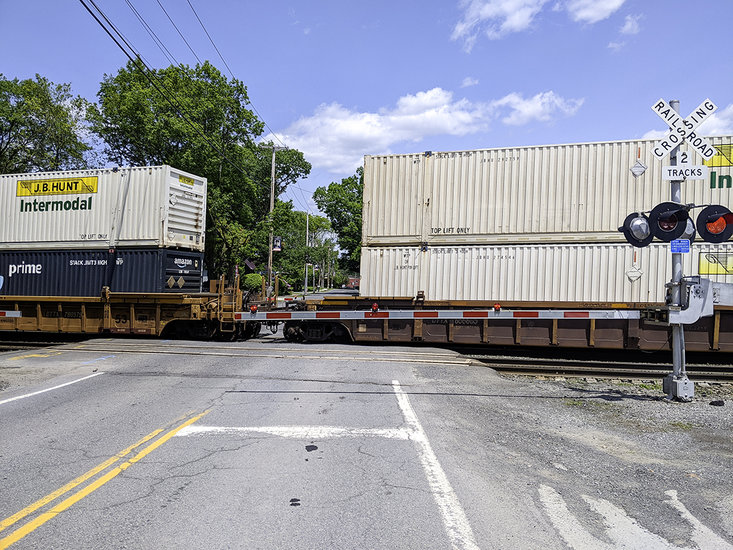
Enterprise file photo — Melissa Hale-Spencer
The Voorheesville Quiet Zone should be in place by the end of summer.
VOORHEESVILLE — With the stroke of a pen earlier this month, Albany County Deputy Executive Michael McLaughlin in just a few seconds actualized the village of Voorheesville’s nearly 14-year pursuit of peace and quiet.
McLaughlin was affixing his signature to an agreement the county entered into with CSX on Dec. 12 to maintain the safety-gate systems due to be installed this summer, according to Mayor Rich Straut, at the Main Street and Voorheesville Avenue railroad crossings.
The four-quadrant gate systems, in addition to preventing cars from attempting to maneuver around the crossing stop arms — a feat attempted three times in the past two years — mean train engineers will no longer have to blow their whistles as they travel over the county-owned roads.
Advocacy of Voorheesville’s soon-t0-be Quiet Zone began in 2012, driven by residents’ complaints about the noise from dozens of trains passing through the village daily.
The citizens’ Committee for a Quiet Zone in Voorheesville took up the cause, citing impacts on local businesses attempting to develop Main Street; potential decreases in property values; and public-health concerns, particularly the noise at a nearby playground.
It then took six years of beginning in earnest to get to the point where optimism abounded at the thought of obtaining project funding in another two years. At least that was the thought in 2018. It would take until 2024 to secure the funds.
In the six years from when the state allocated the money and finally distributed it, Voorheesville found itself situated between two of the country’s largest railroad operators in a $601 million attempt to further consolidate the nation’s transportation industry.
In 2021, CSX and Norfolk Southern were tripping over one another as they planned to route mile-long, double-decker trains through Altamont and Voorheesville as part of the freight carriers deal to allow CSX to purchase Norfolk Southern’s 50-percent stake in Pan Am Railways.
For Voorheesville, this meant not just more trains but the potential collapse of its long-sought Quiet Zone before it even materialized. The prospect of additional train traffic from a second major freight carrier prompted Voorheesville to file its own objection to the deal with the Surface Transportation Board in July 2021.
The move brought both railroads to the negotiating table. In a Dec. 16, 2021 letter of agreement, filed with the board on Dec. 23, 2021, the village agreed to withdraw its opposition in exchange for specific commitments regarding the Quiet Zone.
In November of last year, the county approved a $289,000 payment to CSX for installation of the project, which, according to the construction agreement signed by both parties, was supposed to be completed by Dec. 22, 2025.
Maintenance fees
By late 2022, a year after Voorheesville rescinded its objection to the deal, CSX informed the village and county that ongoing maintenance for the two four-quadrant gate systems would cost approximately $50,000 per year, and that the village and county would be responsible for paying.
“That came out of left field because there was no mention of maintenance” in the December 2021 agreement between the village and freight carriers, Mayor Straut told The Enterprise in 2022. “I would have thought that would have been kind of laid out at that time.”
The demand for $50,000 annually in Voorheesville — at about $25,000 per crossing — appeared significantly higher than maintenance costs reported at other locations. Cartersville, Georgia's agreement with CSX, approved in July 2024, set an initial $26,768 per year for five crossings, averaging about $5,350 per crossing. A BNSF agreement in Oregon started at over $18,000 for a single crossing. Four-quadrant gates typically cost $10,000 to $20,000 per crossing annually to maintain, according to industry estimates, versus $1,000 to $5,000 for simpler median installations.
The village pushed back, while CSX, for two years, continued to insist it would take $50,000 to maintain the crossings. Then, in May 2024, the railroad returned to the table with a revised proposal: $10,246 per crossing per year, split between Voorheesville and Albany County.
Liability landscape
While the annual maintenance fee will be a hit to village coffers, it was Voorheesville’s insistence on not assuming additional risk associated with the Quiet Zone that will pay off for years to come.
Establishing a Quiet Zone fundamentally alters the liability landscape.
By silencing the train horn, the public authority assumes a greater share of the risk if an accident occurs. While Federal Railroad Administration rules may pre-empt lawsuits based solely on the failure to sound the horn in a compliant zone, they don’t eliminate liability.
The focus shifts to the adequacy and maintenance of the alternative safety measures. Municipalities can be sued if these measures are deemed insufficient, improperly designed, or malfunctioning, creating a new duty of care.
This is what makes Albany County’s maintenance agreement with CSX all the more perplexing.
A typical maintenance agreement, from Class I freight carriers goes something like, “Industry shall indemnify and save harmless Railway, Railway’s parent, subsidiary and affiliated companies, and its and their respective directors, officers, agents … from and against any and all claims, demands, losses, suits, judgments, costs, expenses … and liability,” and here’s the kicker, “except to the extent that such loss of or damage to such railcar or lading, or both, is caused by the negligence of Railway.”
These companies assume no responsibility up until the point where it’s completely obvious something was their fault.
CSX contract with county
CSX’s contract with Albany County, which did not immediately return a follow-up request for comment, agrees to “indemnify, defend, and hold harmless” the company from “any and all suits, claims, liability, losses, damages, expenses, and costs (including reasonable attorney's fees)” incurred by or asserted against it.
But the difference between CSX and, say, for example, BNSF, Union Pacific, or Norfolk Southern is that Albany County has no obligation to defend CSX if it engaged in “intentional, wrongful acts,” which proving in a court of law is a difficult feat.
Albany County protection of CSX from claims involving personal injury, death, or property damage places the county between a rock and hard place under three distinct horn-related scenarios:
— The county established the Quiet Zone, eliminating routine horn use in the process. So, if an accident were to occur and a plaintiff argues that the absence of a train horn contributed to the collision, the county must defend CSX and potentially pay damages, even though CSX operates the trains;
— CSX blows the horn at a Quiet Zone crossing in an “emergency situation” or “in compliance with CSX or FRA rules and regulations.” If an accident were to occur and a plaintiff argues that the train horn was sounded improperly, too late, or too loudly, the county must defend CSX and pay damages, even though, once again, Albany County has zero control over when CSX engineers blow horns; and
— The Quiet Zone designation is lost, revoked, or terminated, and trains resume sounding horns “in the ordinary course.” If an accident occurs, the plaintiff could argue the resumption of horns surprised or confused them, leaving the county to deal with the fallout.

Hi Sean, thanks again for another solid piece covering a complicated story line and long history so well. I would like to add a word of thanks here also to Steve Schreiber who has led the effort to upgrade the safety of these tracks here in the Village, which I believe to be two of the busiest grade-level railroad crossings in the Northeast.