Ellen Manning is helping to preserve the sense of place in McKownville
The Enterprise — Michael Koff
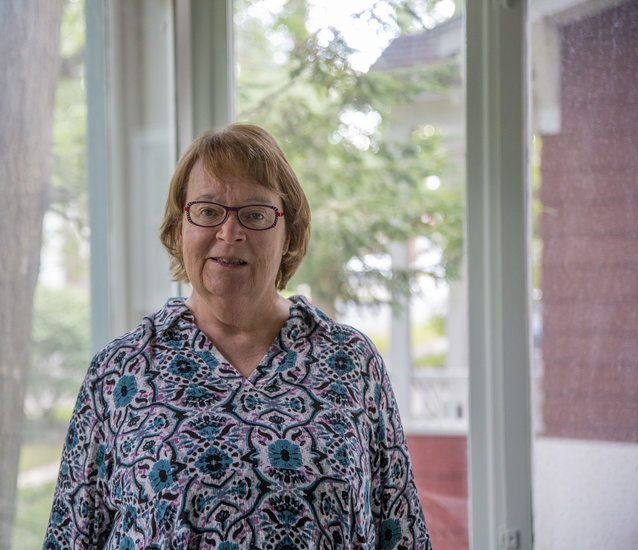
Ellen Manning has a leafy backdrop as she stands in her Norwood Street home.
McKOWNVILLE — “We try to protect our little neighborhood,” says Ellen Manning, president of the McKownville Improvement Association.
The association, which is almost a century old, is on the brink of achieving a new form of protection — having part of McKownville listed on the state and national registers of historic places.
Manning hypothesizes in this week’s podcast that what has kept the association active since 1924 is that McKownville is sandwiched between commercial and institutional development.
Over the decades, the residents have banded together to maintain their neighborhood’s identity.
An early Albany suburb, McKownville runs from the city line to the Northway, on both sides of Guilderland’s major thoroughfare, Route 20.
The land now occupied by the uptown campus of the University at Albany was once the pastoral Albany Country Club. If the historic district is approved, it will be called “McKownville-Country Club Highlands Historic District.”
The Country Club Highlands development was approved in 1912. The historic district will encompass about 106 properties, Manning said, including some on the north side of Western Avenue, most of Waverly Place, and parts of Norwood, Glenwood, Parkwood, and Elmwood streets.
The application for the district has been in the works since 2017 when staff from the State Historic Preservation Office visited the neighborhood and immediately saw its historic value, Manning said, characterizing it as typical of early 20th-Century urbanization.
She noted that the early 1900s is when transportation — the automobile — and expanding utilities made living on the outskirts of a city feasible. Basically, since then, Manning said, the neighborhood has stayed intact and maintained its cohesiveness.
The architectural styles are typical of popular home construction in the early 20th Century, ranging from Colonial revival to Arts and Crafts bungalows. The streets are lined with century-old trees and the neighbors know one another, Manning said.
She called research conducted by McKownville volunteers “remarkable” as they documented the history and wrote descriptions of individual buildings. Manning noted such work is often done instead by hired consultants.
On Sept. 14, residents whose homes would be in the historic district are invited to a public meeting, which will be held virtually. Details are posted to the association’s website.
Residents then have a period of time in which they can object to the designation. If no more than 50 percent object, Manning said, the application in December will be presented to the New York State Board for Historic Preservation.
Manning, whose home would fall within the district, sees no downside to the designation. “It does not keep property owners from doing what they want,” she said, adding there are no state or federal restrictions placed on a designated house.
The designation would add a measure of protection since state or federal funds could not be used to demolish the buildings, Manning said.
She went on, “It gives us some civic pride; it shows our neighborhood as being special.”
Manning herself moved to McKownville in 1998. She had lived in Albany all of her life and was always aware of the neighborhood, having gone to McKown’s Grove as a child to swim.
She describes her Arts and Crafts style home, built in 1914, as having “a lot of charm, inside and out.”
She likes the simple lines, rustic feel, and natural features of the Arts and Crafts style, which replaced the fussiness of the Victorian period.
Manning also appreciates the intimacy of the neighborhood with the houses close together and enjoys walking the tree-lined streets. She has noted, since the onset of the pandemic, many more walkers.
“It’s bringing more people out,” she said.
— Melissa Hale-Spencer