Archive » November 2025 » Columns

— Photo from Frank Palmeri

“My granddaughter, Clara, is the latest love of both my wife’s and my lives,” says Frank L. Palmeri.

About four years ago, I met a lady that stole my heart. She’s beautiful, charming, and a joy to be around. Anytime I can make time to see her, I do — and she always greets me with open arms.

The funny thing is, my lovely wife knows all about this lady, and yet she’s just fine with it. How can that be? Well of course I’m talking about my granddaughter, Clara, the latest love of both my wife’s and my lives.

Clara was born during the COVID days. This meant that, unlike with her big brother, Jackson, we didn’t get to see her right after she was born. We had to wait until the next day. The wait was worth it, as she melted our hearts from the very first moment and hasn’t let up since. She’s just wonderful.

No two siblings are ever the same. Same parents, same household, same rules, yet siblings can be as different as chocolate and vanilla. It’s exactly that way with Jackson and Clara.

The “J Man,” as I like to call Jackson, is a rolling ball of energy that starts from the moment he wakes up each day until his head hits the pillow at night. I have never seen a kid with more energy than he has.

Clara is totally different: She has energy as well, but she can sit alone coloring or playing with toys and be absorbed in her own world for long stretches at a time. Maybe it’s a gender thing, as we know that girls mature faster than boys.

No matter, I’m just so lucky to have the two of them. My grandkids — along with volunteer firefighting — give me a real reason to stay in shape, both physically and mentally.

This may be my favorite Clara story. We were in Florida at the Disney boardwalk. My daughter said to Jackson, who was about 4 at the time, that she would get him a cup of ice cream if he shared it with Clara. He of course said OK.

He gets the ice cream. Then he takes one bite and gives Clara a bite. Then he takes two bites and gives Clara one bite. Then he takes three bites and Clara, who’s not even 2, yells out “Jaaaacksonnnn!”

One of the funnest things I’ve ever seen. Not even age 2 and she was still able to see when she was getting “hosed,” as they say. Good for her.

I’ve been to Clara’s preschool classroom a few times. She loves showing me around. There’s a bunny, plenty of books and toys, and of course her little friends.

Sometimes she will have a new “bestie” and they’ll walk around holding hands all day. How cute is that?

I didn’t have that kind of preschool. In fact, I didn’t have any preschool. What I did have was unsupervised access to the streets of Brooklyn all day long. I’m amazed I’m here now.

One time my son-in-law got the whole family tickets to see “Kool and the Gang” at Tanglewood. Now I’m very familiar with Kool et. al. How could I not be? When I was in my teens and early twenties, utter morons would blast KatG at full volume on suitcase-sized boom boxes in sardine-can packed subway cars like it was the most normal thing in the world.

Can you imagine basically being in a large tin can and getting assaulted like that every morning? I used to ride in between the subway cars, which was its own harrowing adventure, let me tell you, just to get some relative peace and quiet. I actually liked working and going to school in Manhattan, but some people just don’t get it and make it hard to do.

So now we’re all at Tanglewood and the concert starts. Huge horn section, booming bass, etc. Clara, who was 3 at the time, absorbs it all for about five minutes, then she just puts her head down and checks out.

Can you imagine what all that pandemonium must be like for small kids? So I put her right up on my shoulders and we took a walk around the beautiful tract of land that is Tanglewood.

Way in the back, where the sound was much lower, they even had games and toys for small kids. That was great. Maybe someday Clara will learn to love large, loud concerts, but I was glad to be there for her when it was just giving her a headache.

Speaking of music, I’m pretty sure that is Clara’s second language. Even from when she was very, very small, at the sound of any kind of music, she would move and groove to it. You could tell she was feeling it, totally.

Both her parents are great musicians. So is her grandma. I guess it’s just nature passing down the right genes. Now she’s learning to play piano and doing quite well. Having music be so much a part of her life really makes me happy. Someday I’ll have her teach me a little piano for sure.

One time we were reading a book. I pointed to the letter C and said “C is for Clara.” She said “Yeah!” Then I said “and C is for Charlotte” (her grandma). Again she said, “Yeah!” Then I point to an F and say “and F is for Frank” (my name). At that, she gets a look on her face like she’s passing a kidney stone and goes “Ohhh.” So funny!

The last time I visited Clara, I walked in on her as she was sitting on the floor in her room. She was of course wearing one of her many princess dresses, as she’s in princess mode virtually all of the time these days.

I sat down on the floor next to her to see what she was up to. She looks up at me with those big doe eyes and said, “Do you want to play makeup with me?”

Hoo boy! I told her I’d get grandma to play makeup, but since then I’ve been thinking. I’m not much to look at. Maybe, next time I see her, I should let her fix me up. How much worse could I look? Just don’t tell the boys at the firehouse; I’ll never live it down.

These days, through the magic of video phone calls, grandparents have as much access to their grandkids as they want, no matter how much physical distance separates them. What a miracle.

On any given night, I can see and talk to Clara and Jackson as they’re eating dinner or playing a game or just chilling. I’m sure that helps keep the bond with them growing.

Of course, nothing beats answering a standard phone on your birthday and being serenaded with “Happy Birthday” by little munchkin voices. Folks, it doesn't get any better than that.

If you have grandkids, I don’t have to tell you how great it is. Be sure to spoil them rotten and tell them how much you love them. It’s just the best.

MIDDLEBURGH — Today is the 18th day of November and right now it is 3:30 p.m. and already getting darkish. The OFs gathered at the Middleburgh Diner in Middleburgh this morning and immediately the chatter started and the din rose.

As many of the OFs age, so do the inner parts of their ears. Now this part of the ear does not flex like it used to; this causes the OFs to speak louder so they can be heard, which causes the collective din to rise, hence the whole place becomes noisy. With this group this phenomenon can’t be helped.

As usual, the OFs drifted back some years to when the joints moved better and we camped along the creek, slept in tents and on the ground. We traipsed through the woods and fields, crawling over logs and fences with a shotgun or rifle at the ready, and hunted, and many of the OFs traveled all over square dancing. Eastern style, western style, and even the style taught in 7th grade.

It was found that some of the OFs even danced with their own kin as callers. One OF’s father-in-law called, and he called with live music. Another OF had two callers in his family — one uncle called with live music from the band Pearly Brand; the other was also the father-in-law of the OF who called from records.

One OF inherited the records of his father-in-law. These records are quite neat; they have one side with a caller, calling the dance and the other side just the music so whatever caller is using the record can use his or her calling style, or make some subtle changes if he or she wants. The other OF had books of calls to practice with.

Square dancing then and probably is, still now, lots of fun. The Hay Shakers was one group, the Silver Bullets was another, and a club from Altamont was brought up but none of the OFs could remember what it was called.

Some OFs traveled far and wide to dance, some as far as Kentucky, Maine, and Ohio, just to dance. There was almost a contest to see who had the coolest matching outfits, the ladies with crinoline under their dresses, and the guys matching ladies wearing western style shirts and pants.

The OFs talked about another activity that seems to be on the wane (only some OFs said it was coming back) and that is bowling. A couple of OFs mentioned they were in more than one group and bowled in more than one league. An OF mentioned that bowling could be done longer than square dancing; square dancing was a lot of exercise, both cardio and aerobic, and could be tough on the joints.

One OF was a pin setter and set pins in the little bowling alley at the end of the Parrott House and under the (at that time) post office in the village of Schoharie. Just like square dancing, some of the OFs traveled all over bowling with their respective teams and felt they were good enough to enter tournaments. Some were.

Twins and tattoos

At our table, bowling led to a brief discussion on twins, because of twins that one OF knew that were pro bowlers and bowled almost the exact same averages.

Then it was noted that most of the OFs at that table had kids that had twins. This scribe found each of the OFs that had family with twins said they were identical. They could not tell them apart until they were older, and one OF said even now he still doesn’t really know which one he is talking to.

Then some of the OFs began talking about tattoos, and what are these young people and young adults thinking about. A few of the OFs had tattoos done when they were in the service, nothing like the tattoos of today.

All of those OFs who had them way back when are sorry now because all the tattoos eventually turned into  black blobs. However, as one OF put it, the newer inks and equipment may work much better — only time will tell.

Those OMOTM that hitched ole Dobin to the wagon and trotted on down to the Middleburgh Diner in Middleburgh were: Harold Guest, Wally Guest, Ed Goff, William Lichliter, Robert Schanz, George Washburn, Jim Austin, Randy Barber, Marty Herzog, Pete Whitbeck, Al Schager, Jamehy Darrah, Rev. Jay Francis, Jack Norray, Dick Dexter, Jerry Cross, John Jaz, Herb Bahrmann, Lou Schenck, and me.

— Photo from the Guilderland Historical Society

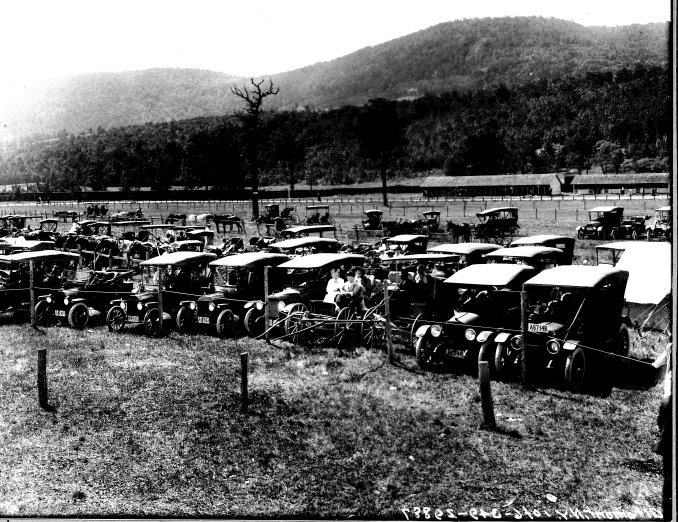
The parking area at the 1916 Altamont Fair showed that there remained a sizable number of horse-drawn rigs on the road, but that they were rapidly being replaced by automobiles. With the production of modestly priced Ford Model T’s and less expensive used cars for sale, more and more of the state’s population took to the road in an automobile. 

Martin Blessing’s cry, “Hurry out! A horseless carriage is coming by,” alerted family members to rush out front of their farm in Fullers where, frightened by the commotion, his small daughter peeped out from behind her mother’s skirt as the strange contraption rolled by.

Anna Anthony, recalling this event in her old age, never forgot her first sight of a car. Perhaps it had been the Locomobile Steamer that Arthur Barton, living on a farm a few miles west on the turnpike, remembered as his first car, describing it as “a wooshing, bouncing carriage-like affair careening ‘madly’ down the old plank road in a cloud of dust and steam.”

Even those who had not yet seen an automobile were aware of their development after reading articles such as “The Horseless Carriage” published in a September 1899 Enterprise. As the first decade of the 20th century unfolded, more and more attention was given to local automobiles and their owners in the pages of The Enterprise.

Owning a car in that era was not for the faint of heart. City folk seemed to become car owners before those in more rural areas and it seems out-of-towners were the first to pass through Guilderland.

In 1904, Mr. and Mrs. Tompkins of New York City stopped by in Altamont while on their way to their summer home near Berne, disgusted that rain had delayed them in the mid-Hudson Valley when the normal running time between New York City and Albany would have been 12 hours.

A year later, they arrived with another couple in a second car headed for Berne when, as they climbed the steep hill out of the village (now Helderberg Avenue), the Tompkins’ auto stalled, brakes failed, car began rolling backward, wife jumped out, and husband ended up partly overturned against an embankment. No injuries to either, car righted, cranked up the engine and they were on their way.

That same year, intending to visit his sister, Mrs. E.H. York of Guilderland Center, George Crounse’s engine died in Gallopville, causing the humiliation of having to hire a farmer and team of horses to tow him to Altamont where he had to telephone to Albany for “a professional” to come out to fix the problem. Not only was driving an automobile an adventure, it was an expensive one!

And already in 1906 the folks in Guilderland Center were outraged at “the speed autoists make through the streets of our village. Some estimate the rate at 60 miles an hour, some 40 and some 30 or 20.”

Early automobiles had to be hand cranked to start (electronic starters were in the future); had limited horsepower; were forced to travel for miles on wretched roads, causing frequent flat tires; and, outside of cities, there were very few places to buy gasoline or find mechanical help.

A few of the very early cars operated on steam power, which had its own set of problems. And of course, none could travel in winter before antifreeze.

The identities of the first car owners in Guilderland are unknown, but by 1906 Altamont’s Charles Beebe’s and W.H. Whipple’s drives were noted in The Enterprise. There were surely others. “Auto parties” were noted at that time, passing through on their way to enjoy the amenities of the Helderberg Inn.

Sands’ Sons

Eugene and Montford Sands got it right when they stated in one of their Sands Sons’ advertisements: “The automobile is here to stay.” Already successful Altamont grain and coal merchants, the two entrepreneurs opened an auto agency in 1907.

An early offering included for $275 a Success runabout (a two-passenger open car) featuring a “powerful” 4 horsepower engine with wheel steer (several very early cars had tillers for steering) or for $600 a Federal runabout with a 15- to 18-horsepower engine.

For a big spender willing to part with $1,250 the Model B, a 24-horsepower, two-cylinder automobile with a removable rear seat that could carry five persons — “a wonder for the price.”

During the early automobile years there were many companies manufacturing cars with brands that within a few years were out of business, making their names unfamiliar today. Among the automobiles acquired by local men were Reo, Overland, Locomobile, Columbia, Brush, and Great Western.

Sands advertised others such as the Success and Model and it’s assumed that they were purchased by local drivers. Fords and Buicks were also locally owned as well.

By 1908, automobiles’ popularity was firmly established, appearing on local roads with increasing frequency. Sands Sons cleverly whipped up enthusiasm for the new technology not only with announcements and advertising in The Enterprise but also by exhibiting automobiles at the Altamont Fair where the brothers touted the merits of the new 1909 Great Western five-passenger touring car to over “200 prospective” buyers during Fair Week. The village and town column announced that Messrs. Clikeman acquired one of them.

Earlier in May 1908, the two car salesmen had focused attention on the trophy won in Menands, their Great Western coming in first for the fastest time in its class for five-passenger $1,250 cars in a steep hill-climbing contest.

Soon they were promoting a new $1,600 Great Western 30-horsepower model that had the advantage of being converted into a gentleman’s roadster by detaching the tonneau and substituting a rumble seat.

Their sales pitch ended with, “Watch out for this car as it will create a stir among auto enthusiasts.” And the really affluent man with an extra $3,500 could drive away from their dealership in a 50-horsepower Great Western.

However, the automobile that really caught on because it was inexpensive and rugged, becoming the most famous of the early autos was Ford’s Model T. It stood high off the ground, allowing the sturdy vehicle to maneuver over rutted country roads giving it appeal to rural drivers.

Aware that only a limited number of local men were wealthy enough to purchase a large touring car, Sands’ Sons introduced a two-passenger Brush runabout, claiming the runabout not only had gas mileage of 25 to 40 miles, but that a woman could drive it easily.

These two car salesmen assured prospective buyers this “very neat and easy running car” was capable of climbing any hill in the area, announcing an Albany dealer had plans to drive a Brush up the Capitol steps. New York state authorities put the kibosh on that publicity stunt and it never happened.

Many years later, it was recalled that sometimes the Brush ran well; other times the engine made a hill climb sputtering, “I think I can, I think I can, I thought I could, I thought I could … I can’t!”

Erecting a big tent at the 1910 fair, the Sands continued to push the Brush, assuring would-be buyers that, if they made a purchase during Fair Week, Sands would give them a “special figure.” Current Brush owners were invited to use the tent as their fair headquarters.

Two people who at some point purchased Brush runabouts were Eugene Gallop, who was the mailman on a rural route, and Irving Lainhart, who delivered groceries in his Brush until 1918 when he traded it in for a Ford.

In addition to selling cars, Sands’ Sons also advertised that they had supplies of batteries, lubricating oils, gasoline, etc. for automobile owners and chauffeurs. Automobile owners of the era were a versatile group changing their own tires and dealing with simple mechanical problems, but for things more serious a mechanic was needed.

The demand was quickly met in 1907 when Mr. James Bradley opened up a shop in the rear of Lape’s Paint Store in Altamont, advertising himself as an experienced mechanic who could repair automobiles.

Problems arise

At this time, Guilderland’s large population of upset, unhappy horses (and their owners!) were usually terrified when approached or overtaken by these noisy, smelly behemoths especially since the roads were very narrow, putting car and horse in close clearance of each other.

Guilderland Center’s F.C. Wormer ended up painfully, but not seriously, hurt when his horses, spooked by a passing car, took off, dumping the unfortunate F.C. in the road.

As Dr. Fred Crounse was driving his auto to Meadowdale, he began passing Cyrus Crounse whose skittish horses became so terrified by the car, they rushed toward it and one ended by jumping on part of the car, “smashing some of the fixtures on the driver’s side. A few dollars in repairs made the machine as good as new,” but no mention was made whether they were Dr. Crounse’s dollars or Cyrus Crounse’s.

As automobiles proliferated another problem became obvious.

Again in 1907, the Guilderland Center correspondent wanted to know why there was no speed limit out in the country, claiming that the previous Sunday morning “there came tearing down through the Centre an auto at a velocity of speed that would put a western cyclone to blush,” showering people on their way to church with dust and grit and endangering the children.

On another occasion an auto driven “wildly” through Guilderland Center struck and killed Seymour Borst’s pet dog. Again there was a call for more strict laws against those “speed fiends who rush madly down our streets.”

Automobiles had become a permanent part of childhood experience. Marshall Crounse, the 9-year-old son of Dr. and Mrs. Fred Crounse, ran in front of a car while on vacation with his parents in Florida and was knocked down with at least one wheel rolling over his legs just below his hips. Miraculously escaping serious injury, Marshall was fine by the time of his family’s return to Altamont.

Ten other children had a more positive experience when Mrs. David Blessing, their Sunday School teacher, arranged for Montford Sand to cram all 10 into his big touring car for a drive to a picnic at Frenchs Hollow.

The danger of fire became evident. A very expensive touring car driven by summer cottage owner Gardner C. Leonard’s chauffeur burst into flames a mile and a half east of Altamont. The chauffeur threw himself out of the car just in time for, when the fire was out, the only thing left were the two front wheels.

The frames of those early cars were of wood, causing them to burn rapidly once the gasoline was ignited. When another auto fire destroyed a vehicle on the Western Turnpike in what is now Westmere, it was noted the owner had insurance.

“Death in Auto Accident” headlined the most tragic fire in 1911 when Mrs. William Waterman, out with her husband for a drive near Altamont’s Commercial Hotel on the Main Street, suddenly screamed she was on fire.

Her light summer clothes quickly blazed up, resulting in her death the next morning. Although The Enterprise reported the cause of the fire was gasoline, the car itself didn’t burn.

Many years later, a recollection of the incident claimed the car was a Locomobile Steamer, an early car where paraffin or naphtha provided the fuel for the fire to heat the water to make steam to power the automobile. These impractical cars quickly went out of production.

One August 1911 morning, William Whipple, driving the Sands’ autotruck, pulled out of Altamont carrying Montford Sand in the passenger seat. While traveling down “church hill” past the entrance to Fairview Cemetery (now Weaver Road) the autotruck encountered two women approaching in a horse-drawn buggy.

The skittish horse panicked and, jumping into the ditch overturned the rig, throwing the women out. Seeing their plight, Sand immediately leaped out of the autotruck, stumbled and fell, striking his head. Unconscious, he was carried back to his Altamont home where he died hours later.

The dangers of automobile ownership had already become apparent and it was a tragedy that Montford Sand, one of the brothers who did the most in the very early days to popularize the automobile in Guilderland, died in an automobile-related accident.

As the numbers of cars on the road increased, the death toll from auto accidents began to rise. In Guilderland, the two most dangerous spots were at the intersection of the Western Turnpike and the Altamont-Schenectady Road (now routes 20 and 158) and at the railroad crossing in Guilderland Center.

By 1916, statistics showed that there were 300,000 motor vehicles registered in New York state alone and reports had come in of the decline in earnings for railroad passenger lines. As new careers for mechanics, car salesmen, and car-related businesses opened, businesses related to horses and horse-drawn vehicles declined and eventually almost totally disappeared. A technological and transportation revolution had begun.

SLINGERLANDS — The first order of business is to report that Doug is under the weather and unable right now to amble to the doors of the restaurants the OFs frequent to join us for breakfast and they won’t let him out of rehab. This is too bad not only for Doug but for the OFs as well; we all want Doug to get well soon and get back to work so this OF can return to sleeping late.

This scribe, appointed by those at the table he was at, did not have his eavesdropping ears on so did not pick up on conversations at other tables. However, since he was seated at the first table in line at the Windowbox Café, enough OFs stopped by to say good morning and briefly chat about this and that; the this of that was really full of this and that.

One of the this or that’s (take your pick) is that Jake followed Doug into rehab. What Jake was doing there was not mentioned or not really known at that time. The OFs, however, do wish him to get better and wish both these OFs get back to the table. Soon!

There were a few get-well cards passed around to sign so that the OFs began to think whether or not they added their John Hancock to one or not, or what the card was for. It is neat to receive one of these cards when sick or hurt. Reading the names most of the time cheers one up, and in most cases adds to the healing process because the OF wants to get better and be one of the signers.

Mentioned over and over, the OFs, just by the title of the group, are a bunch of literally OMOTM and age more often than not becomes a topic. Tuesday morning, Nov. 11, it was the maximum age, and not as morbid as it sounds.

Sometimes it is sad, and sometimes not; it is a blessing. At times, it is expected and others not expected at all, and at times should never have happened when it did. But at the table this morning, the OFs covered the event from stem to stern.

With the exception of just a couple, every living thing on this planet has died — human, animal, bird, fish or plant. Yet, no matter how it is talked about, nothing can hide the sadness, grief, or emptiness that follows a death. Even if it is said to be a blessing, there is a hole the one who passed on occupied and nothing is going to fill it up.

If we did not turn to dust, or the inanimate turn to rust, just think of how much extra weight would be added to this hurling ball, so much so that maybe it would be thrown out of whack and we would hurl out of our orbit and collide with Mars. The OFs think deep.

The OMOTM would like to offer their sympathies and condolences to Harold Guest and his family on the passing of his son, Harold Guest III. See the Enterprise obituary page to read about his life.

My goodness! Our table, and those visiting, seemed to be down in the dumps but they were not. The conversations on these subjects were almost as routine as those on the latest car, truck, or old tractor. 

Those OFs that joined in the banter at the Windowbox in Slingerlands were: Harold Guest, Wally Guest, Frank Fuss, Roland Tozer, Peter Whitbeck, Will Lubletez, Gerry Chartier, Robert Schang, Russ Pokorny, Warren Willsey, Chuck Batcher, Lou Schenck, Rev. Jay Francis, Al Schager, Gerry Cross, Elwood Vanderbilt, Bob Donnelly, Dave Hodgetts, Alan DeFasio, Paul Guiton, Johnny Dap, and me.

— Photo from Frank L. Palmeri

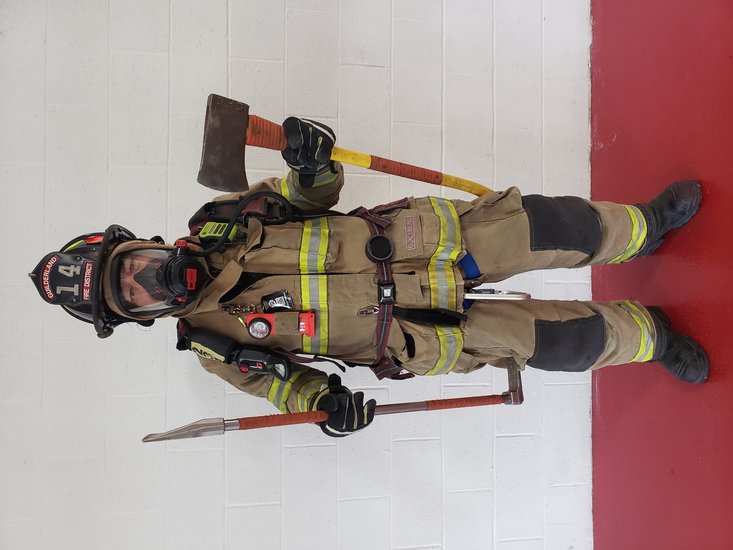
Frank Palmeri poses in turnout gear with every inch of skin protected while breathing through a Self Contained Breathing Apparatus pack.

“You must do the thing you think you cannot do.”

— Eleanor Roosevelt
 

When I joined the Guilderland Fire Department two years ago, I had no idea what to expect. Two weeks into it, I was on a call to a huge house fire, where my team put out fire in the garage.

After, at 3 a.m. in the dark of night at the parking lot back at the station, I remember being hosed down to wash the firefighting foam off my turnout gear, all the while thinking: What have I gotten myself into?

Since then, like the Grateful Dead sing, it’s been a long, strange trip, culminating with me having just achieved “Class A,” or interior firefighter status. Wow.

If you had told me ten, five, or even two years ago that, retired at age 66, I’d become trained and certified to enter burning buildings as a member of a volunteer fire department, I'd have looked at you like you had two heads. Really.

But once I dipped my toe into the firefighting world by volunteering, it just snowballed, and here I am today. I still can’t believe it myself.

At this point I’ve taken well over 200 hours of state-certified fire training in addition to weekly drills. I have learned so much about fire behavior and firefighting procedures, and so much more: knots, rope work, tools, teamwork under pressure, cooking for large groups, and going from street clothes to “on air” — that is, wearing full PPE [personal protective equipment] and breathing clean air from a back mounted air tank — in less than two minutes.

All of this training was free, though the effort and dedication it takes are truly monumental.

In my most recent interior firefighter training, to get us used to live fire, they put us in a room with the temperature at the ceiling of 800F. That’s 100F more than a pizza oven.

We had on turnout gear with every inch of skin protected. Plus we were breathing air from our SCBA (Self Contained Breathing Apparatus) packs. Still, you do feel how hot it is.

I honestly can’t tell you how long we were in there. It may have been a minute, it may have been five minutes, I don’t know, but I was sure glad to leave that burning cauldron.

Firefighter instructors are all about “blackout” drills. This is where your vision is obscured so you can’t see anything. When you consider that sight is 70 percent of your sensory input, you can imagine how disorienting this can be.

They do these drills because this is what a fire with thick, black smoke is like. You simply cannot see your hand in front of your face, so you have to prepare for it.

Where we train there is a building that has a maze in it. They turned off all the lights and we had to find our way out.

Then they put us in a metal shipping container filled with junk. In the container were fire hoses. You had to find the right hose, and then orient yourself on that hose by feeling the hose couplings (smooth-bump-bump, back to the pump) so you were going the right way.

At the same time, an instructor was hiding in the container with you, snaring you with nylon webbing, to simulate getting caught on something. You had to free yourself from that before moving on.

Prior to this training, situations like this would have freaked me out. After this training, I now realize that, when there is no actual fire with accompanying smoke and heat, it’s a whole level easier. Crawling around on your hands and knees in total darkness is actually kind of fun without the threat of dying from heat and smoke inhalation, if you can believe that.

The big drill for me was when my crew of three did a second-floor search and rescue. First we brought a 24-foot extension ladder to the building and set it up right below the window. Then I crawled up the ladder and got to the window.

There was a dense thick, gray smoke pouring out (no heat, this smoke was from a smoke machine, not actual live fire). I attached my air supply to my mask and then crawled into the room and went left. My partner did the same, but he went right.

At this point, you keep in touch with the wall while advancing around the room. In your other hand is some kind of a tool, like an axe. While moving around the room, you use the tool to search for victims.

Remember, while this search is going on you cannot see a blessed thing. Once you find the victim — in this case, a 150-pound adult human dummy — you move the victim to the window, lift him up, and transfer him out the window onto the ladder where the third member of the team brings him down. Then you crawl back out the window and lower yourself down the ladder.

The night of this drill we had many other difficult tasks that were quite physical involving hoses, ropes, tools, the maze, etc. When this night was over, I was as spent physically as I’ve even been in my entire life.

Let’s put it this way: That morning, I weighed myself and I was 211 pounds. When I returned home that night, even after eating three meals that day, I was 206 pounds. I literally lost 5 pounds in one night doing this training. Want to lose weight? Join the fire department!

There is a great word that is not used often, but it’s the perfect word to describe what all the brave men and women in the fire services do each and every day. That word is sangfroid.

It means keeping your composure, or staying cool, in dangerous or trying circumstances. The only way you can do this kind of work is to stay calm, not panic, and revert back to your training.

This is why most fire companies drill and train all the time. It’s the only way to stay sharp in the face of what is very dangerous and at the same time very satisfying work. To be on a team doing this kind of work is just amazing.

Keep in mind I’m doing all this at the ripe old age of 66. Fortunately, I’ve kept myself in pretty decent shape and I go to the gym whenever I can, but I’ll be honest with you: I can’t keep up with guys and girls half my age.

Sometimes I just have to stop, rest a bit, take a few deep breaths, and then continue on. I wish I could just go flat-out non-stop like the younguns, but it is what it is.

The main reason I went for interior fire training is because most volunteer firefighters have full-time jobs. This means that, during the day when a call comes in, there is not the turnout you would get if it were at night or on the weekend.

My thinking is, when the officer in the truck that is racing to the fire looks back to see who’s in there joining him or her on the call, they’d rather see a 66-year-old guy who has been trained than see nobody. I may not do it as fast or as long as the kids, but I can still do it.

I meet a lot of people around town who read this column. That’s great and I love talking to you. Having said that, I really don’t want to meet you when I’m performing my firefighting duties, for obvious reasons. To assist in this, I’m asking you to:

— Change your smoke detector batteries once a year;

— Don’t smoke in bed;

— Discard hazardous waste like solvent soaked rags accordingly;

— Keep your hallways and stairways clear at all times;

— Have a family fire safety meeting;

— Never leave a lit candle or fireplace unattended;

— Have several fire extinguishers on hand and know how to use them;

— Turn the stove and oven off when you are done cooking;

— Don’t overload electrical circuits; and

— If you have any device with a lithium ion battery, learn how to charge it correctly.

Volunteering for a local fire department is a great thing to do. You don’t have to be interior to help. There are many other roles; there is always some way to help, and they always need more volunteers.

Contact your local fire department to see how you can help, even if just to donate. It’s the right thing to do.

Let me leave you with “The Firefighter’s Prayer.” I found this in a book on firefighting. It is credited to Anonymous.

When I’m called to duty, God,

wherever flames may rage,

give me strength to save a life,

whatever be its age.
 

Help me to embrace a little child

before it is too late

or save an older person from

the horror of that fate.
 

Enable me to be alert

to hear the weakest shout

and quickly and efficiently

to put the fire out.
 

I want to fill my calling and

to give the best in me;

to guard my neighbors and

protect their property.
 

And if, according to your will,

While on duty, I must answer

death’s call,

less with your protecting hand

My family, one and all.