A year of hard-earned progress for New Scotland and Voorheesville
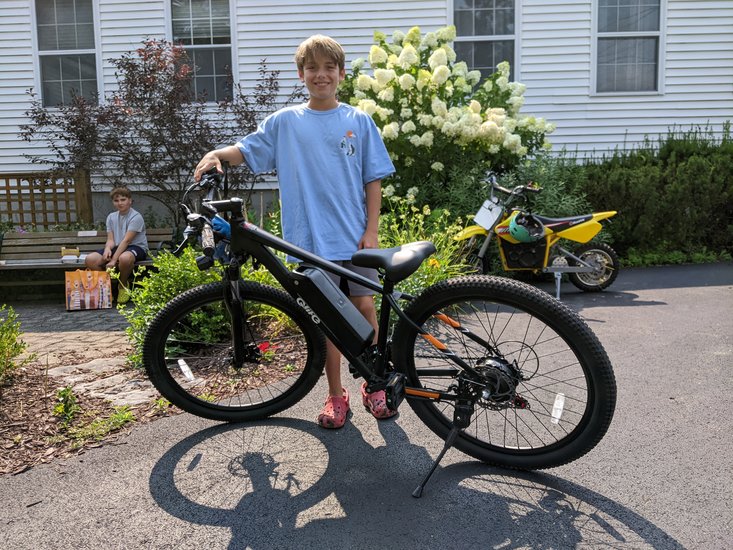
Daniel Long poses with his new e-bike this summer near the Methodist church in Voorheesville where he and his friend were enjoying a picnic.
NEW SCOTLAND — The past year in New Scotland and Voorheesville could be characterized as one marked by hard-earned progress.
Only in the past few weeks did Voorheesville receive confirmation that its decade-plus long pursuit to install a Quiet Zone in the heart of the village finally became reality.
The news was tamped down by a federal judge who dealt the village a blow in its attempt to stop Norfolk Southern from constructing a crew-change facility without having asked permission from Voorheesville to do so, let alone subjecting itself to local review of its federally-protected building process.
In New Scotland, the town is one of a small number of New York state municipalities that had the foresight to plan for the flood of green-energy projects popping up in response to the statutory requirement that 70 percent of New York’s electricity come from renewable sources by 2030.
BESS
But a contingent of vocal residents didn’t see it as a good thing that the town adopted battery storage regulations ahead of the rush to cash in on the green infrastructure boom. Rather, this group chose to pick a fight over transparency just weeks before the November local election.
New Scotland first took up large-scale energy storage in December 2023, soon after it was approached by companies looking to install shipping-container-sized batteries on local properties.
The town adopted Local Law E in May 2024.
Councilman Dan Leinung said at the time that the regulations provided a framework “for the designation of properties suitable for the location, construction, and operation of battery energy storage systems,” meaning New Scotland, by adopting rules to govern battery storage and thus avoiding a hasty retreat toward an installation moratorium, would not, like so many other local municipalities, appear subject to the whims of the loudest voice in the room calling for the pause.
The first test came when RIC Energy proposed a five‑megawatt battery facility on seven acres at the New Scotland Beagle Club, a 137‑acre property on Indian Fields Road in Feura Bush. Beginning in July, the planning board pored over technical details: five Tesla units measuring 8 feet high by 6 wide and 30 feet long would capture solar energy during the day and discharge 20,000 kilowatt‑hours — roughly the average daily consumption of 700 homes — into the grid during evening peaks.
The company planned to train volunteer firefighters and in September Planning Board Chairman Jeffrey Baker confirmed that RIC would hold a four‑hour session covering battery chemistry, failure modes, codes, firefighting tactics and a draft emergency‑response plan.
Safety loomed over every meeting.
Onesquethaw Volunteer Fire Company member John Freihofer told the planning board in August that the proposed 11,000‑square‑foot battery array “scares us — in the worst way possible,” warning that a fire might require “a million gallons of water” that Feura Bush could not provide.
RIC responded with a statement noting that its system was engineered to prevent fires and that it had incorporated New York’s fire code into its planning; Wes Hillegas of RIC later explained that the proper response to a lithium‑ion battery fire is to protect adjacent units and “let our equipment, materials burn” rather than dousing the burning container.
Residents’ concerns boiled over during an Oct. 7 public hearing on the proposal, as the first speaker began by conflating the Feura Bush project with one proposed by Councilman Adam Greenberg on Wormer Road.
Chairman Baker corrected her, but Erica Smith pressed on to argue that New Scotland was unprepared for multiple battery projects and that volunteer fire departments lacked training and water supplies. David Ritz demanded redundant sensors and shut‑off protocols.
Rich Brown accused the appointed planning board of having already made up its mind, while Jess Sardella, who chairs the New Scotland Republican Party, suggested the “very convenient and questionable timeline” between developers approaching the town and adoption of the battery law showed that the fix was in. Sardella circulated a petition calling for a 12‑month moratorium and delivered it to the town board, even as she noted that, of the almost 40 signatures, at least three were enrolled as Democrats.
While RIC’s proposal may have been the town’s first, it was quickly eclipsed by one from New Leaf Energy, which in September sought permission to install a trio, which shrank to a duo soon after, of large-scale battery storage facilities on separate 13-acre Wormer Road properties owned by Councilman Greenberg.
The project became a flashpoint in the November race for town board. Republicans claimed that Greenberg, an incumbent Democrat who cruised to victory on Nov. 4, had enriched himself by voting to regulate large-scale energy storage systems in town. Greenberg had voted for the town’s BESS law months before being approached by New Leaf.
The political dimension was apparent at the Oct. 7 public hearing on the RIC Energy proposal. The standing-room-only public hearing saw over two dozen residents voice nearly unanimous opposition to the RIC proposal.
Most speakers had legitimate concerns about the project — safety issues centering on fires or system failures, which are issues that had been brought up repeatedly by the planning board since the facility was first proposed in July. The town, in response to the pushback, reposted the entire application and supporting materials online as well as posting a link to a webinar about BESS.
Greenberg addressed the allegations of impropriety directly, telling The Enterprise on Sept. 5 that he initially received letters about property he owns next to a substation in East Greenbush. “They were looking into that, and I mentioned that I had some other property if they were interested,” he said. New Leaf Energy became interested in the New Scotland sites after checking on access to the nearby substation. “I would say on the New Scotland properties, maybe a year ago we started to talk about that or they started to look into it,” he said.
Asked about the appearance of impropriety, Greenberg said, “I was approached after that law was passed,” referencing the town’s adoption of its energy-storage law in April 2024. Later in the interview, Greenberg noted that, while he is a member of the town board, he’s also a resident. “I have properties. I also have to go through the proper channels," he said. The project is subject to special-use permit and site-plan review.
Both Greenberg and the Beagle Club’s projects are still under review.
Hilton Barn
The 125-year-old Hilton Barn, which the town board saved from destruction by moving in across Route 85A to make it a community center adjacent to the county’s rail trail, initially had an estimated project cost of $1.2 million, but then COVID happened, costs soared, and change orders were approved.
The slate roof, for example, cost $513,500, approximately $61,000 over the project's original cost. A $529,200 contract with Sanz Construction of Staten Island for work on the barn needed $150,000 in additional funds to deal with significant deterioration on the upper levels of the barn. By the end of last year, the town had allocated about $285,000 of the $600,000 it had received in American Rescue Plan Act funding toward the project.
Adding injury to insult, the town is now facing a lawsuit from a Brooklyn man who claimed to have sustained “severe, serious, and permanent personal injuries" after a fall from scaffolding for which he says the town was responsible. In a complaint filed in May, Roman Tsegelniuk alleged that, on July 25, 2024, he was lawfully working on restoration of the Hilton barn when he “fell from an unsecured, defective, and dangerous scaffold on the premises.”
Tsegelniuk filed suit against the town because, he claimed, New Scotland was the general contractor and construction manager of the project, responsible for hiring and retaining contractors or subcontractors. The town in July said it would file a third-party complaint against Tsegelniuk’s employer, Sanz Construction.
By September, New Scotland had filed a third-party claim against Sanz, an attempt by the town to shift its potential financial burden along with defense costs to Sanz. The town is seeking a judgment against Sanz for indemnification, costs arising from a successful Tsegelniuk suit, plus any other relief the court “deems just and proper.”
Voorheesville trains
At the start of December, a federal judge ruled that Voorheesville had no right to stop Norfolk Southern from building a crew-change facility off of School Road, allowing the project to move forward.
The judge further ordered that the village was “immediately enjoined and restrained from enforcing the stop work order and underlying zoning requirements preventing Norfolk Southern from constructing the crew-change facility.”
Norfolk Southern needs the crew-change facility because of its move to capture a major share of the car-moving freight market between New York and New England. The 161-mile route is owned by CSX, which is allowing Norfolk Southern to use its tracks but with the caveat that Norfolk Southern has to keep moving until it reaches almost the other side of Massachusetts.
Train crews have strict limits on how many hours they can legally operate a train. The issue for Norfolk Southern is that its crews start their journey as far west as Binghamton, some 130 miles from Voorheesville and, by the time they arrive in the village, the crew is legally near the end of its work shift.
Since Norfolk Southern can’t stop and swap crews during the 161.5-mile journey along CSX tracks, the crew change has to take place as close to CSX’s territory as possible, which happens to be Voorheesville. If the swap doesn’t take place in the village, the train can’t legally complete its journey to Massachusetts without the crew timing out.
In September, the company wrote in a letter to the village that it was “about to commence construction of a building that will support railway operation.” The company claimed it was “exempt from local land use regulations in connection with this project, which does not require us to seek permits” and added, “we wanted to inform you of our intention and provide you with copies of our building plans.”
Voorheesville issued a stop-work order the same day.
“It’s the railroad,” Mayor Rich Straut told The Enterprise on Dec. 16, two weeks after the ruling, “and we knew it was going to be a long shot.” Straut went on to say, “I felt good about it,” referring to the village’s chance to stop construction, “but the laws and everything around railroads definitely have the favor, which is very discouraging.”
He continued, “So, what I read into it is the judge basically said, ‘Listen, the railroad can do whatever they want.’ And I know it’s more complex than that, but yeah.” Straut said there are still issues to be decided, “so [Judge Sannes] didn’t rule on everything. She just said you can’t enforce the stop-work order.” Norfolk Southern in a Dec. 4 court filing moved to have the remainder of the case tossed.
Still to be determined are concerns raised by the village over a settlement agreement among itself, Norfolk Southern, and CSX, along with a third-party suit filed against JC Pops, owner of the land where the facility is to be built.
Even as the Norfolk Southern legal saga played out, Voorheesville faced the more immediate and recurring danger of train-vehicle collisions at its Main Street crossing.
In November, for the third time in less than two years, a car was on the losing end of an encounter with a CSX freight train making its way through the village of Voorheesville. And for the third time, the driver escaped unharmed.
Albany County Sheriff Craig Apple posted at the time that his office had just responded “to a car versus train incident in Voorheesville.” Apple wrote, "A vehicle attempted to execute a U-turn at an intersection and narrowly averted a fatality as the driver exited the vehicle in a timely manner.” According to the sheriff, “The train subsequently crushed the car for approximately three-quarters of a mile.” He noted, “The driver escaped unscathed.”
The incidents cast a spotlight on not only the village’s 14-year attempt to install safety gates at the Main Street and Voorheesville Avenue crossings, but what could happen if those incidents hadn’t turned out OK.
In 2021, Norfolk Southern sought to make hay with CSX’s attempted $601 million acquisition of a regional railway in Massachusetts in which Norfolk Southern has a 50-percent stake. The deal meant more trains through Voorheesville and the potential collapse of its long-sought Quiet Zone.
The prospect of additional traffic from a second major freight carrier prompted Voorheesville to file its own objection to the deal with the Surface Transportation Board in July 2021. The move brought both railroad companies to the negotiating table. In a Dec. 16, 2021 letter of agreement, filed with the board on Dec. 23, 2021, the village agreed to withdraw its opposition in exchange for specific commitments regarding the Quiet Zone.
By late 2022, a year after Voorheesville rescinded its objection to the deal, CSX informed the village and county that ongoing maintenance for the two four-quadrant gate systems would cost approximately $50,000 per year, and that the village and county would be responsible for paying.
The move highlighted the ongoing clash between municipalities and freight carriers when it comes to establishing a Quiet Zone. Under federal rules, its public authorities that initiate quiet zones must show that the risk of collisions without horns is mitigated by supplemental safety measures such as four‑quadrant gates. Railroads like CSX insist that cities pay not only for installation but also for perpetual maintenance and liability, arguing that Quiet Zones are local amenities rather than railroad necessities.
Case studies from Cartersville, Georgia; Glendale, Ohio; Plymouth, Michigan; Plant City and Tampa, Florida show similar patterns: agreements that shift costs and risk to local governments, escalation clauses tied to inflation, and municipalities abandoning projects when the financial burden becomes insurmountable.
In Voorheesville’s battle, the maintenance fee was secondary to CSX’s request for indemnification. That's because, in seeking to establish a Quiet one, a city, county, town, or village can fundamentally alter its legal liabilities. By silencing the train horn, a municipality allegedly assumes a greater share of the risk should an accident occur. And, while federal statute can pre-empt some lawsuits based solely on the failure of a conductor to sound his or her horn in a compliant Quiet Zone, government regulations can’t ever completely eliminate liability.
By shifting focus away from the person driving the train, questions can be asked about the adequacy of safety measures put in place by the local public authority, meaning a municipality can be sued if these measures are deemed insufficient, improperly designed, or malfunctioning, creating a new duty of care.
Village attorney Rich Reilly said earlier this year that, by “not requiring us to take on liability exposures other than sort of beyond the road [maintenance] that we actually maintain or the county maintains,” the village escapes having to become a “sort of the insurer if something goes wrong at that crossing.”
Clearly, Reilly learned a lesson Albany County hadn’t.
On Dec. 12, the county entered into an agreement with CSX to maintain the safety-gate systems, which are due to be installed this summer.
A typical maintenance agreement, from Class I freight carriers goes something like, “Industry shall indemnify and save harmless Railway, Railway’s parent, subsidiary and affiliated companies, and its and their respective directors, officers, agents … from and against any and all claims, demands, losses, suits, judgments, costs, expenses … and liability,” and here’s the kicker, “except to the extent that such loss of or damage to such railcar or lading, or both, is caused by the negligence of Railway.”
These companies assume no responsibility up until the point where it’s completely obvious something was their fault.
CSX’s contract with Albany County agrees to “indemnify, defend, and hold harmless” the company from “any and all suits, claims, liability, losses, damages, expenses, and costs (including reasonable attorney's fees)” incurred by or asserted against it. But the difference between CSX and, say, for example, BNSF, Union Pacific, or Norfolk Southern is that Albany County has no obligation to defend CSX if it engaged in “intentional, wrongful acts,” which proving in a court of law is a difficult feat.
So, Albany County becomes liable for virtually any accident at these crossings, regardless of who caused it.
Effectively, the only cases where Albany County would be off the hook for indemnity would be virtually improbable scenarios where CSX deliberately causes harm: a train engineer intentionally rams a vehicle, an employee sabotages warning devices, or the railroad deliberately creates a hazard intending injury.
Atlas Copco expansion off, then on again
In March, Voorheesville faced another economic development setback as Atlas Copco’s $40 million expansion project was put on hold due to Trump administration policies.
“We have felt some effects from the new administration,” Kevin O’Connor, head of development for Albany County, said at the time. “I met with a group of other economic-development organizations from around the region, and there appears to be a whole thing of projects by European and Canadian companies in the U.S. [on hold].”
O’Connor said during the March 4 meeting of the county IDA, “I assume that’s part of the tariff war, if you will. At that time I had not seen anything to that effect, but we were informed recently that Atlas Copco, which as you know is owned by a German company, their board voted not to approve [the Voorheesville expansion]. They didn't disapprove it, but they did not approve the project. So the project is on hold for right now.”
The company’s compressors are used in the carbon-capture and sequestration (CSS) processes used by American industries such as in ethanol production, cement manufacturing, and power generation. With CSS, these industries are able to reduce climate-changing greenhouse gases by capturing the carbon-dioxide emissions and permanently storing it underground.
The growth of the CCS industry has been hampered by a lack of domestic manufacturing capacity, particularly when it comes to the type of large-scale compressors made by Atlas Copco. To meet this demand, the company needed and was approved to build a facility out of compliance with village code.
Voorheesville’s zoning board of appeals in June 2024 approved a variance to allow for an addition to the existing building to be built 20 feet higher than the 40 feet allowed by zoning. The facility's 101,000-square-foot footprint would expand by 65,000 square feet, where zoning allows only for 20,000 square feet.
Months prior to the village approval, the project was buoyed by the federal government, which notified Atlas Copco in April 2024 that it had submitted a successful application to the Department of Energy for tax credits related to clean-energy manufacturing. The green credits would allow Atlas Copco to receive back 30 percent of its approximately $40 million investment every year for 10 years.
The project was put on hold in March because of the “election back in November,” O’Connor said during the June meeting of the county IDA, alluding to the election of Donald Trump as president, which O’Connor said was followed by the company’s desire “to see how things shaped out.”
The time allowed Atlas Copco to cut “back on some ancillary things,” O’Connor said, which lowered the project cost from $40 million to $32 million.
With costs shrinking, the company’s sales-tax exemption was adjusted from $1,625,625 to $1,375,000, with the real-property-tax exemption decreased from $734,000 to $670,000 — the property tax abatement, $21,000 per $1 million of assessed value, is spread out over 10 years. The company’s annual Payment In Lieu Of Taxes over that time will be $221,550.
The downward revision also affected a grant the company received as part of Albany County’s Sustainable Technology and Green Energy program, which decreased from $500,000 to $475,000.
Electric bikes
With electric bike use “exploding all over the village,” Trustee Jack Stevens said in July, “sooner or later,” Voorheesville is going to “have to come up” with a way of dealing with e-bikes.
Stevens said there had been a recent incident near the corner of Scotch Pine and Locust drives, where a young rider “came around the corner hard and ran right into the side of a car door.” Deputy Clerk Barbara Maughan said that, earlier that day, July 22, there had been a group of riders “zooming around” Hotaling park, “beeping the horn quite a bit.” Then, when she went to the village’s bank, Ballston Spa National Bank, Maughan saw a group of e-bikes being ridden near the intersection of Circle and Scotch Pine drives, “in the middle of the street.”
While a 2020 state law establishes a classification system for electric bikes and scooters, it has no requirements for registration, licensing, and insurance. Rather, individual municipalities can make their own rules although few in Albany County have. The state requires that riders be at least 16 years old.
By September, the situation in Voorheesville had prompted more board discussion. “It’s become a thing much more quickly,” Mayor Rich Straut said. “We see young people riding in the streets. We see them riding around the park. They’re very fast ... We’ve had a couple of complaints about them.”
During the Sept. 23 village board meeting, Kaitlin Wilson told her fellow trustees that she’d been approached by a couple from Salem Hills “about the e-bike situation.”
“They’re very concerned about kids riding in the middle of the road” and getting hit by a car, Wilson said. Trustee Stevens said there’d been two more recent incidents in his Scotch Pine neighborhood. “One kid ran into the door of a woman,” Stevens said, “and another one ran into the back of a car.”
Mayor Straut said he witnessed a young resident who did not yet appear to be 16 years old “riding down the middle” of Maple Avenue during the busy evening commute.
During a village block party the weekend prior to Sept. 23, Straut said he and Doug Miller, the village’s public safety commissioner, spoke with a pair of Albany County Sheriff’s deputies about the situation. “They said they would keep an eye out for those kind of things,” but since they have duties that extend beyond the village, which does not have its own department, “they can’t be here all the time.”
The village now has to get creative. Without police enforcement, what will stop kids younger than 16 from riding e-bikes?
The village has the makings of a strategy, largely based around educational outreach. The campaign, to be aimed at parents, would communicate the law, safety risks, and expectations of young riders. The information would be pushed out on Facebook, published in Voorheesville's twice-a-year newsletter sent to residents, and posted on the village website.